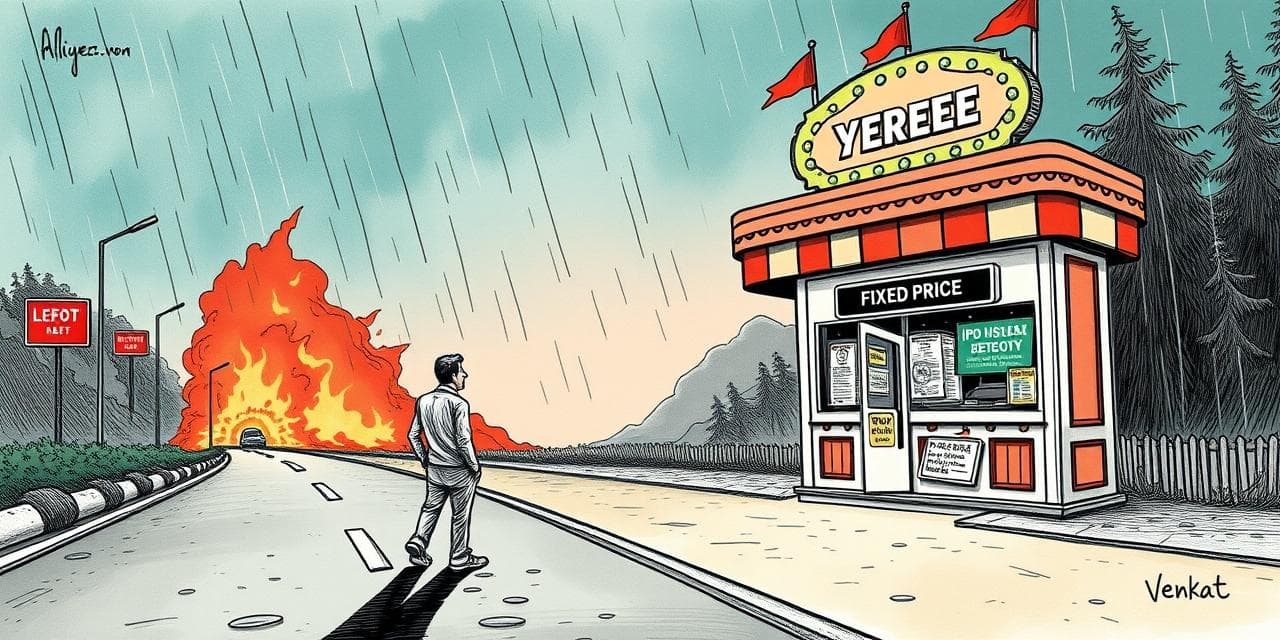

Nifty is down 12% from its February peak. Sensex lost 1,837 points yesterday alone. FPIs have pulled ₹87,000 crore out of Indian equities in March. Brent crude is at $113.
And today, three companies decided this is the perfect time to ask you for ₹1,950 crore.
Powerica wants ₹1,100 crore for its diesel generator business. Sai Parenterals wants ₹409 crore for its pharma CDMO operation. Amir Chand Jagdish Kumar wants ₹440 crore for its basmati rice exports.
You might apply to one or all of them. Not because you analyzed the balance sheets. Because the IPO application screen feels calmer than your crashing portfolio.
That instinct is costing retail investors crores. Here is the data.
Why Do Retail Investors Rush to IPOs During Market Crashes?
The secondary market is a war zone right now. Your Zerodha portfolio shows red everywhere. Every stock you own is below your purchase price. The Nifty number on your screen keeps falling.
Then the IPO notification arrives. Powerica: ₹375-395 per share. Fixed price. Known entry. No ambiguity.
Your brain does the comparison instantly. Buying TCS at ₹3,400 feels dangerous because it was ₹3,800 two weeks ago and could be ₹3,200 tomorrow. Applying to Powerica at ₹395 feels safe because that number will not change. You know exactly what you are paying.
This is the zero-risk bias at work. Humans prefer eliminating one small risk completely over reducing a larger risk significantly. The IPO eliminates price uncertainty at the entry point. It does nothing about what happens after listing. But your brain does not process "after listing" when it is comparing a fixed price band against a falling Nifty.
The result: IPO application rates spike during corrections. Retail investors who stopped buying stocks in the secondary market funnel that same capital into IPOs, convinced they found a safer vehicle.
They have not. They have found a more expensive one.
What Does the 2026 IPO Track Record Actually Show?
Eight of the 11 mainboard IPOs that have listed in 2026 are trading below their issue price.
That is a 73% failure rate for anyone who applied and held.
Compare this to 2024, when the mainboard IPO market had an 80% success rate, with 65 of 93 listings still trading above issue price by year-end. In 2025, the deterioration was already visible: median listing gains fell from 15.2% to 3.8%, and 59% of IPOs were trading below their listing price within months.
The companies listing in 2026 are not fundamentally worse than those in 2024. The market environment is worse. And IPO pricing does not adjust fast enough.
IPO price bands are set 2-3 weeks before the subscription window opens. The investment bankers use comparable company valuations, recent market multiples, and investor appetite from anchor book-building to set the range.
When Nifty drops 12% between the pricing date and the listing date, every assumption behind that price band is stale. The comparable companies are now trading cheaper. The market multiples have compressed. The institutional investors who participated in the anchor book at a higher valuation are already underwater.
On listing day, the new price discovery reflects the current market, not the one that existed when the price band was set. Retail investors who applied based on the old valuation absorb the gap.
This is not a theoretical risk. It is what happened to 73% of 2026 IPO applicants.
What Are Powerica, Sai Parenterals, and Amir Chand Actually Offering?
Before you apply to any of these, here is what the ₹14,000-15,000 minimum application actually buys you.
Powerica manufactures diesel generator sets for prime and backup power applications. This is a real business with real revenue. The company has a presence across industrial and commercial segments.
The GMP as of March 23 is ₹6. That implies a listing gain of 1.5%.
Think about what 1.5% means. You lock ₹14,615 for 9 days (application to listing). If you get allotment and the GMP holds, you make roughly ₹220. If the GMP is wrong (and GMP predictions have been wrong for most of 2026), you could list flat or negative.
Meanwhile, a Nifty 50 ETF bought today gives you exposure to 50 blue-chip companies at a 12% discount from the February peak. No allotment lottery. No 9-day lock-in. Immediate price discovery.
A pharma CDMO company with ₹163 crore revenue in FY25 and ₹14.45 crore PAT. Profit after tax grew 72% year-on-year, which looks impressive until you see the absolute number: ₹14.45 crore PAT on a ₹409 crore IPO valuation.
The GMP is ₹0. Zero. The grey market, which usually has at least some speculative premium, is pricing in no listing gains at all.
When the informal market tells you there is no money to be made, and the formal market is crashing around you, applying because "pharma is defensive" is not analysis. It is narrative-chasing.
A basmati rice exporter with the Aeroplane brand. Revenue of ₹2,001 crore in FY25 with PAT of ₹60.8 crore. This is the strongest financial profile among the three: a real brand, real scale, and growing margins.
The GMP is ₹6.50, implying roughly 3% listing gain.
The question you should be asking: if you had ₹14,840 (the minimum lot) to deploy in a market that has fallen 12%, would you rather own a basket of stocks at multi-month lows or one basmati rice exporter at a price set before the crash intensified?
The answer depends on your analysis. But if you are applying because "at least the IPO price is fixed," that is not analysis. That is comfort-seeking in a crisis.
What Does the IPO Rush During Crashes Actually Cost You?
Here is the math most retail investors never run.
Assume you have ₹50,000 to deploy. The market has fallen 12% from peak. You have two options:
Option A: Apply to all three IPOs. You lock ₹14,615 (Powerica) + ₹14,840 (Amir Chand) + ₹13,944 (Sai Parenterals) = ₹43,399 for 9 days. Based on current GMPs, your expected listing gain ranges from ₹0 (Sai Parenterals) to ₹220 (Powerica) to ₹455 (Amir Chand). Total expected gain: ₹675 on ₹43,399 deployed. That is 1.6%.
And you are unlikely to get allotment in all three. Mainboard IPO allotment rates for retail investors typically range from 10% to 40% depending on oversubscription. So your actual expected return on the ₹43,399 locked for 9 days is closer to ₹100-250.
Option B: Buy a Nifty 50 ETF today. You deploy the same ₹43,399 into a Nifty 50 ETF at 22,512. If the market recovers even half the correction (a 6% bounce, which happens within 30 days in 75% of VIX spike events), your gain is ₹2,604.
The ETF option has more volatility. It also has 10x the expected return and no allotment lottery.
But the ETF requires you to stare at a red portfolio and click "buy." The IPO lets you click "apply" on a clean screen with a fixed number. The second action feels safer. The first action is mathematically better.
How Does PortoAI's Behavioral Fingerprint Expose the IPO Rush Pattern?
Your IPO application history tells a story you might not want to hear.
PortoAI connects to your Zerodha and Groww accounts via read-only APIs and analyzes your transaction patterns across time. For IPOs specifically, the behavioral fingerprint looks for these signals:
Frequency clustering around fear events. Did you apply to zero IPOs in December and January when markets were stable, then suddenly apply to three in March when Nifty crashed? That is not a shift in your investment thesis. That is a flight response dressed up as an investment decision.
Sector incoherence. Are you applying to a diesel generator company, a pharma CDMO, and a basmati rice exporter in the same week? If those three sectors have nothing in common in your portfolio strategy, the common factor is not the businesses. It is the fixed price band.
Listing-day sell pattern. Do you sell every IPO allotment on listing day regardless of price? If yes, you are not investing in these companies. You are gambling on allotment and listing premiums. PortoAI flags this as casino mode behavior: high-frequency, outcome-dependent decisions driven by excitement rather than analysis.
Capital diversion from SIPs. Did you pause or reduce your SIP amount the same month you applied to three IPOs? This is one of the most expensive behavioral patterns PortoAI detects. You are taking money out of a disciplined, diversified, long-term vehicle and putting it into a concentrated, short-term bet. The SIP was working. The IPO is a distraction.
The data does not lie. Your IPO behavior during crashes has a pattern. Most investors do not see it until someone shows them.
What Should You Actually Do With Capital During a 12% Crash?
Not apply to IPOs. Not sell everything. Not "wait for the bottom."
Here is what works, based on behavioral data from thousands of Indian retail portfolios:
Before deploying any new capital, look at what you already own. PortoAI's sector concentration analysis shows most retail portfolios are 40-60% concentrated in 2-3 sectors. If your crash losses feel worse than Nifty's 12% decline, it is because your portfolio is more concentrated than you think.
The VIX is at 23. That means elevated uncertainty, not capitulation. Instead of deploying ₹50,000 today, split it: ₹15,000 this week, ₹15,000 next week, ₹20,000 the week after. If markets fall further, your second and third tranches buy cheaper. If they recover, your first tranche already captured the dip.
The IPO application button feels safe. A falling stock screen feels dangerous. But safety in investing comes from understanding what you own, not from the user interface design of the entry point.
If you spent 10 hours analyzing TCS and zero hours analyzing Sai Parenterals, buying TCS at a 12% discount makes more sense than applying to Sai Parenterals at a GMP of zero.
76% of SIPs started in 2025-2026 have been paused or discontinued as of March 2026. This is historically the worst time to stop. Your SIP is buying more units at lower NAVs. That is not a bug. That is the entire mechanism working as designed. Do not divert SIP money to IPO applications.
Is There Ever a Good Time to Apply for an IPO During a Crash?
Yes. When the business itself benefits from the crisis.
Oil at $113 is terrible for airlines and paint companies. It is excellent for oil explorers and defence contractors. If an oil services company were IPO-ing right now with strong fundamentals and a price band set conservatively relative to the new crude price reality, that could be a genuine opportunity.
None of the three IPOs opening today are crisis beneficiaries. Powerica sells diesel generators (sensitive to crude prices). Sai Parenterals is a pharma CDMO (defensive, but priced at 28x earnings with zero GMP). Amir Chand exports basmati rice (strong business, but ₹440 crore valuation in a market selling quality companies for cheaper).
The decision framework is simple: would you buy this company's stock in the secondary market at this price, today, without the IPO allotment lottery? If the answer is no, the IPO structure does not make it a yes.
The Real Cost of the IPO Safety Illusion
The money you lock in IPO applications for 9 days is money you cannot deploy in a crashing market.
₹43,399 locked from March 24 to April 2 misses whatever happens to Nifty in those 9 days. If the ceasefire holds (Trump announced a five-day postponement of strikes on Iranian energy sites on March 23), a sharp relief rally could add 3-5% to Nifty before your IPO money is even refunded.
In the 2020 COVID crash, Nifty fell 38% from peak and recovered 50% of the fall within 6 weeks. Investors whose capital was locked in IPO applications during the recovery missed the sharpest bounce in Indian market history.
Opportunity cost is invisible. The red number in your portfolio is visible. Your brain optimizes for what it can see. That is why you are drawn to IPOs during crashes. Not because they are better investments. Because they hide the pain.
PortoAI's behavioral fingerprint does not hide anything. It shows you exactly what your IPO timing pattern has cost you, in rupees, over the last 12 months.
Connect your Zerodha or Groww account. See your IPO timing pattern, sector concentration, and behavioral cost in under 2 minutes.
Try PortoAI FreeFrequently Asked Questions
Should I apply for an IPO during a market crash?
A market crash does not make IPOs safer. It makes them riskier. IPOs are priced weeks before listing day, based on market conditions that may no longer exist. If Nifty drops 12% between pricing and listing, the IPO's valuation is already stale. In 2026, 8 of 11 IPOs listed below their issue price. The price band gives you a fixed entry, not a floor. You can lose money from day one.
Is Powerica IPO worth applying for in March 2026?
Powerica manufactures diesel generator sets and is raising ₹1,100 crore at ₹375-395 per share. The business has real revenue. The GMP is ₹6, implying 1.5% listing gain. In a market where Nifty 50 companies are available at a 12% discount from February peak, locking ₹14,615 for 9 days for a potential ₹220 gain is an opportunity cost decision, not a value decision. Evaluate the business at this valuation in this market.
Why do IPOs listed during volatile markets underperform?
IPO price bands are set 2-3 weeks before the subscription window opens using comparable company valuations and recent market multiples. When markets fall 10-15% between pricing and listing, every assumption behind the price band is stale. Comparable companies are now cheaper. Market multiples have compressed. Institutional investors who participated in anchor books at higher valuations adjust downward on listing day. Retail investors absorb the gap.
What is the IPO success rate in India in 2026?
As of March 2026, 8 of 11 mainboard IPOs that have listed are trading below issue price, a 73% failure rate. Compare this to 2024's 80% success rate (65 of 93 listings above issue price) and 2025's declining median listing gains of 3.8%, down from 15.2% in 2024. The deterioration tracks the broader market correction, not a decline in company quality.
How does PortoAI detect unhealthy IPO behavior?
PortoAI's behavioral fingerprint analyzes your Zerodha and Groww transaction history, including IPO allotments and sell patterns. It flags: frequency clustering around fear events (suddenly applying to multiple IPOs during crashes), sector incoherence (applying to unrelated businesses in the same week), listing-day sell patterns (flipping every allotment), and capital diversion from SIPs to IPO applications. Each flag indicates behavior driven by emotion rather than analysis.
Should I pause SIP and apply for IPOs instead?
No. The SIP stoppage ratio hit 76% in early 2026 as investors diverted money to IPOs and cash. Historically, pausing SIPs during corrections is the single most expensive behavioral mistake Indian retail investors make. Your SIP buys more units at lower NAVs during corrections. That is the mechanism working. Diverting SIP money to IPO applications replaces a diversified, disciplined strategy with a concentrated, speculative one.
What is a better alternative to IPOs during a market crash?
Deploy capital into diversified vehicles like Nifty 50 ETFs at crash prices. Split your deployment into 2-3 tranches over the next few weeks instead of locking everything in one IPO application. Continue your SIPs. Use the correction to improve your portfolio's sector balance rather than adding a new single-stock concentration through an IPO allotment. Check PortoAI's sector concentration analysis before any deployment.