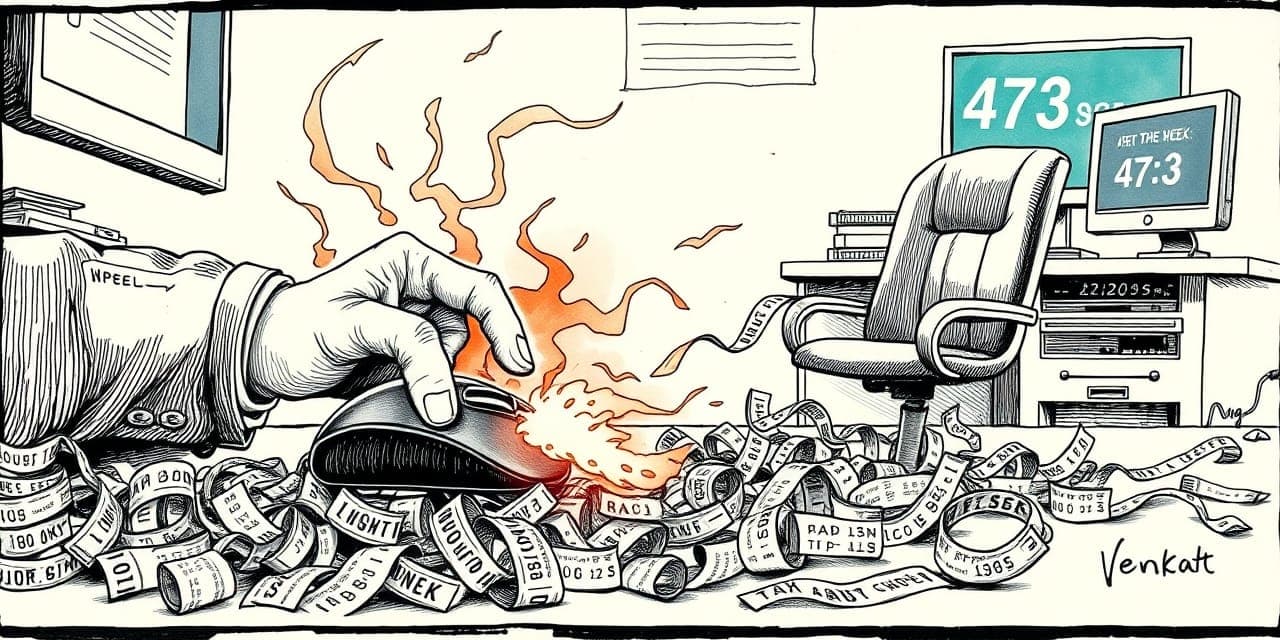

The Most Expensive Hobby in India
Overtrading doesn't feel like a problem while you're doing it. It feels like productivity. You're engaged, you're watching the market, you're participating. But the numbers tell a different story. Most overtraders pay more in brokerage and taxes than they ever make in profits.
"If your broker is making more money from your trades than you are, you have an overtrading problem."
The uncomfortable truth is that activity and results are inversely correlated for most retail traders. The best-performing retail accounts in India, on average, make fewer trades, not more. But "fewer trades" feels like laziness, like missing opportunities. So traders keep clicking, racking up charges and bad entries while calling it strategy.
Let's look at what overtrading actually costs and how to spot it in your own history.
What Does Overtrading Actually Mean in Indian Markets?
Overtrading is placing more trades than your profitable strategy requires, driven by emotion rather than analysis. It shows up as frequency spikes beyond your own baseline, rapid round-trips that burn capital in charges, and shrinking hold times that signal you are reacting to noise. For a Zerodha account with a 5-trade weekly baseline, placing 20 trades in a single loss-driven day is overtrading by any definition.
Each pattern has a distinct signature in your order history.
A normal equity investor might place 5-10 trades per month. An active intraday trader might do 2-3 per day. These are baselines, and they vary by strategy. The problem isn't the absolute number. It's the spike.
You normally place 3-4 trades per week. Then suddenly, you're placing 15 in a single day. A market crash, a hot tip on Telegram, boredom on a slow WFH Tuesday: whatever the trigger, the spike itself is the red flag. Frequency spikes almost always correlate with worse outcomes, because they happen when emotion is driving activity rather than analysis.
In terms of what "excessive" looks like: 30+ trades in a month for someone whose profitable baseline is 5-10 trades is a significant overtrading pattern. That's a 3-6x spike, and it typically shows up after a loss event or a period of boredom. PortoAI tracks this ratio (your current frequency relative to your own profitable baseline) rather than comparing you to some generic average.
Buying and selling the same stock within hours, often at a loss. Each round-trip costs brokerage, STT, GST, and exchange charges. On a Zerodha intraday trade of ₹50,000, a round-trip costs roughly ₹40-50 in charges. Do that 10 times in a day and you've burned ₹400-500 before any market losses.
At 30 such trades in a month, which is not unusual for an overtrader, the charge drag alone is ₹1,200-1,500. Over a year, that's ₹15,000-18,000 given entirely to your broker. On a ₹5 lakh account, that's a 3-3.5% annual headwind from charges alone. Add losing trades on top, and you understand why overtrading accounts bleed out quietly over months before the trader notices.
For F&O, the math is worse. Each lot of Bank Nifty or Nifty has higher charges per round-trip, and the leverage means bad entries cost more in absolute terms. An F&O overtrader placing 40 trades a month can easily pay ₹8,000-12,000 in charges, which adds up to ₹1 lakh per year just in transaction costs.
Your average holding period starts dropping from days to hours to minutes. This is a classic escalation pattern. The shorter your hold time, the more you're reacting to noise rather than investing in moves.
Pull your last 90 days of trades and calculate the average hold time for profitable trades versus losing trades. In almost every overtrading account, the profitable trades have longer hold times. The impulse trades, the ones placed out of boredom or excitement or loss-chasing, are closed quickly, usually at a loss.
This single metric, average hold time on winners versus losers, tells you more about your trading health than your overall P&L.
What causes overtrading in Indian F&O markets?
Understanding why you overtrade matters because the remedy is different for each cause.
Boredom overtrading happens when the market isn't giving you clean setups but you're watching the screen anyway. You've done your pre-market work, your watchlist setups haven't triggered, but there are 4 hours left in the session and doing nothing feels wrong. So you find a setup that's 60% there instead of 90%, and you trade it. These trades typically have a lower win rate and smaller profit when they do win. You're essentially paying a boredom tax.
Excitement overtrading happens after a winning streak. You've had three good trades in a row. You feel sharp, in sync with the market, unbeatable. So you place a fourth, fifth, and sixth trade that you wouldn't have taken in a neutral state. The profits from the first three get redistributed to the market via the next three. This is extremely common, and your order history will show it: clusters of trades that start with 2-3 wins followed by 3-4 losses in quick succession.
Loss-chasing overtrading is the most destructive and is closely related to revenge trading. A loss triggers more trades to recover it, each one slightly less disciplined than the last. By the time the session ends, the original loss has doubled or tripled. The FOMO cost analysis for Indian traders covers this spiral in detail with SEBI data.
How does PortoAI detect overtrading in your trade history?
When you connect your Zerodha or Groww account, PortoAI builds a behavioral baseline from your trading history. It calculates your normal trading frequency, average hold time, and typical position size during profitable periods. Then it watches for deviations from that baseline.
Here's what the detection looks like in practice:
- Baseline: 4 trades/week, average hold time 8 days, position size ₹25,000-30,000
- Current week: 22 trades, average hold time 47 minutes, position size ₹40,000-50,000
- Alert triggered: "Your trading frequency is 5.5x your baseline. Your historically profitable trades have a hold time of 6+ days. Consider pausing before your next trade."
The comparison is always against your own profitable baseline, not against some external benchmark. This matters because a high-frequency scalper and a positional swing trader have completely different normal patterns. PortoAI doesn't tell the scalper they're overtrading because they placed 15 trades today. It tells you when you're deviating from the version of yourself that makes money.
The overtrading detection is one layer of a broader behavioral fingerprint that PortoAI builds from your order history. The fingerprint includes:
- Win rate by frequency tier: Your win rate when trading 1-3 times a week versus 10+ times a week. For almost every retail trader, the win rate drops sharply as frequency increases.
- Time-of-day performance: Overtrading often concentrates in specific windows. The last hour of the session is a common overtrading danger zone. If your losses cluster between 2:30 PM and 3:30 PM, that's a pattern worth knowing.
- Day-of-week patterns: Thursday (expiry day for Bank Nifty and Nifty) is when overtrading spikes the most. PortoAI specifically flags Thursday activity against your non-expiry-day baseline.
PortoAI also calculates your commission drag: the percentage of your capital eaten by trading costs. Most overtraders are shocked to see this number. A trader doing 20 round-trips daily on F&O can lose 2-3% of capital monthly to charges alone, before a single losing trade.
The report doesn't just show you the charge amount in rupees. It shows you the opportunity cost: what those charges would have compounded to if left in the account. ₹15,000 in annual charges on a ₹5 lakh account, reinvested at even a modest 12% annual return, is worth significantly more than the marginal edge from those additional trades.
The Cooling Period
When PortoAI flags overtrading, it triggers a cooling alert with a summary of your recent activity, the cost of those trades, and a comparison to your profitable baseline. Once you see the numbers, the urge to overtrade usually fades on its own.
The reason the alert works isn't technological. It's psychological. In the middle of a trading session, you can't see the pattern. You're inside it. The alert pulls you out, shows you the view from above, and gives your rational brain the information it needs to override the impulse.
This is the same mechanism behind the revenge trading pause: forced distance between impulse and action, created by showing you your own data at the moment you need it most.
A Simple Self-Audit You Can Do Today
You don't need PortoAI to start this analysis. Open your Zerodha Console or Groww order history and do this:
- Export your last 6 months of trades.
- Calculate your monthly trade count. Find the average and the peak month.
- Compare the P&L in your peak-frequency months versus your low-frequency months.
- Calculate your average hold time for winning trades versus losing trades.
In most active retail accounts, the pattern is consistent: your lowest-frequency months have your best risk-adjusted returns. Your highest-frequency months coincide with your worst drawdowns.
If that's true for you, the strategy practically writes itself: trade less. Not lazily, but deliberately. Set a monthly trade limit before the month starts. Stop when you hit it. Review the P&L at month end.
"You don't need to win more trades. You need to take fewer bad ones."
Overtrading rarely operates alone. It is usually paired with revenge trading after losses and poor position sizing, the combination that explains why most F&O accounts deteriorate in streaks rather than steadily. The three behavioural patterns that blow F&O accounts covers all three in a single framework.
Connect your broker and see your overtrading cost in exact rupees. Free behavioral report.
Try PortoAI FreeFrequently Asked Questions
How many trades per month is overtrading?
There is no universal number. It depends on your strategy and account size. But a useful benchmark is your own baseline. If you normally trade 5-10 times a month and suddenly you're at 30-40, that spike is the problem regardless of the absolute number. PortoAI compares you to your own profitable history, not to an industry average.
What does overtrading actually cost in rupees?
On a typical Zerodha account, each equity intraday round-trip costs roughly ₹40-50 in total charges (brokerage, STT, GST, exchange fees). At 30 trades a month, that's ₹1,200-1,500 in charges alone, not counting any losing trades. For F&O overtraders, the cost per lot is higher, and the P&L impact of bad entries compounds on top of the charge drag. Over a year, an active overtrader can easily lose ₹15,000-100,000 in pure transaction costs.
What causes overtrading?
Three main triggers: boredom (nothing good to trade, but you trade anyway), excitement (a winning streak makes you feel invincible), and loss-chasing (trying to recover a loss by placing more trades). Each has a distinct signature in your order history, and PortoAI's behavioral engine classifies which type you're experiencing so the alert is relevant rather than generic.
How does PortoAI's behavioral baseline work?
When you connect your Zerodha or Groww account, PortoAI analyzes your full order history to calculate your normal trading frequency, average hold time, and typical position sizing during your profitable periods. These become your personal baseline. Future activity is measured against your own profitable patterns, not against a generic benchmark.
Can I stop overtrading without software?
Yes. The most effective manual technique is a daily trade limit: decide before market open the maximum number of trades you will place, and stop when you hit it. Combining that with a pre-trade checklist (thesis, stop loss, size) eliminates most impulse trading. PortoAI automates the monitoring and adds a real-time alert layer on top of your own rules.