
What Happens in the 48 Hours After a Big Trading Loss?
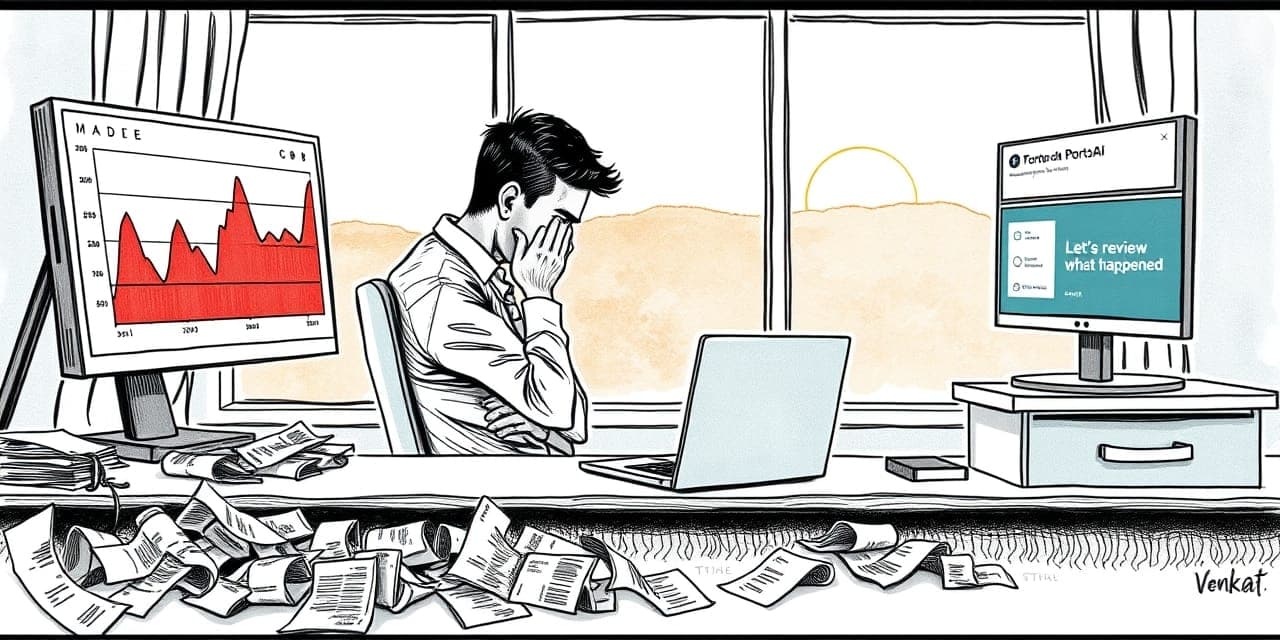
You just lost ₹50,000 on a Bank Nifty trade. Your hands are shaking. Your screen is red. You're already thinking about the next trade that will "make it back." If you're wondering what to do after a big loss in trading, the honest answer is: almost nothing. The 48 hours after a significant loss are the most dangerous window in a trader's life. Not because of the market, but because of what your brain does to you.
The loss itself is damage. What you do next determines whether it stays a wound or becomes a catastrophe.
We've analyzed thousands of post-loss trading sessions from Indian retail accounts. The patterns are remarkably consistent. And they're almost never good.
The Three Post-Loss Patterns We See
Every trader who takes a big hit falls into one of three categories within the first 48 hours. Understanding which one you are is the first step toward not letting a loss define your quarter.
The Freezer closes their trading app and doesn't open it for weeks. Sometimes months. The loss creates a psychological block so strong that even looking at a chart triggers anxiety. On the surface, this seems responsible: you're "taking a break." In reality, it's avoidance.
The problem with freezing is that markets don't wait for you. The Freezer often misses the recovery move that follows a sharp drawdown. They come back weeks later, see that the market has moved 5% higher, and feel even worse. The guilt of missing the recovery compounds the original loss. Some never return at all.
The Revenge Trader is the opposite extreme. Within minutes of booking the loss, they're back in the market with a bigger position. The logic, if you can call it that, is simple: "I need to make this back before the day ends."
This is the most destructive pattern in retail trading. We've covered it in detail in our piece on revenge trading in Bank Nifty, but the short version is this: revenge trading turns a ₹50,000 loss into a ₹1,50,000 loss. The sizing is emotional. The timing is desperate. The outcome is predictable.
The Rational Resetter takes 24-48 hours away from the screen. They journal what happened. They check whether the losing trade was a valid setup that simply didn't work or a discipline break they can prevent. They come back with a smaller position size and a clear plan.
Most traders are a #1 or a #2. Very few are a #3. The gap between knowing the right response and executing it under emotional pressure is enormous. That gap is where most trading accounts die.
The Data: How Traders Behave After Big Losses
This isn't speculation. SEBI's 2023 study on F&O trading revealed that 89% of individual traders in India lost money over a three-year period. The aggregate losses exceeded ₹1.8 lakh crore. What the headline number doesn't tell you is how those losses accumulated.
The pattern is consistent across accounts:
- A significant single-day loss, usually from oversized positions or expiry-day theta decay
- An immediate increase in trading frequency: the average time between a big loss and the next trade is under 2 hours for revenge traders
- Position size escalation: the next trade is typically 1.5x to 3x larger than the trader's normal size
- A cascade of losses: the enlarged positions fail, each loss triggering another attempt to recover
- Account destruction: within 2-4 weeks, the account is down 40-60% from the original drawdown
The tragedy is that step 1 is often survivable. A ₹50,000 loss in a ₹5,00,000 account is a 10% drawdown. Painful, but recoverable with discipline. It's steps 2 through 5 that turn a manageable setback into an account-ending spiral.
"The loss doesn't kill the account. The reaction to the loss kills the account."
Trading frequency data from NSE shows a clear correlation: traders who place the most orders in the sessions immediately following a big loss have the worst 30-day forward returns. The market rewards patience after a drawdown. It punishes urgency. How PortoAI detects overtrading in your Zerodha history is a practical look at how this spiral becomes visible in your own order data.
A Post-Loss Protocol for Indian Traders
Here's a concrete, step-by-step protocol designed for Indian F&O and equity traders. This isn't theory. It's built from studying the habits of the small minority who recover well from significant losses.
Log out of Zerodha, Groww, Angel One, or whatever platform you trade on. Not just the app. Log out of TradingView. Close the market-related Telegram groups. Remove yourself from the information stream entirely. The market will be there tomorrow. Your capital might not be, if you act right now.
Write down the trade. Not a vague "I lost money on Bank Nifty." Write the specifics: entry price, exit price, position size, the reason you entered, the reason you exited (or didn't exit soon enough). Now answer one question honestly: was this a valid setup that failed, or did you break your own rules?
If the setup was valid and your sizing was correct, the loss is just variance. It happens. If you broke your rules, by entering without a stop loss, sizing too large, or trading on a tip from a Telegram channel, the loss is a behaviour problem. The fix is different for each.
Pull up your last 20 trades. Calculate what percentage of your capital you risked on each. If the losing trade was significantly larger than your average, that's the real problem, not the direction of the trade. In Indian F&O markets, where a single Bank Nifty lot requires roughly ₹1,00,000 in margin, it's easy to be over-concentrated without realising it.
When you do come back, trade at 50% of your usual size for at least 5 sessions. This accomplishes two things: it limits the damage if you're still tilted, and it rebuilds confidence through small wins. Scale back to full size only when your journal shows three consecutive sessions of disciplined execution.
This protocol isn't flashy. There's no secret indicator, no recovery strategy that "always works." It's boring and methodical. That's exactly why it works. Your P&L problem is almost always a behaviour problem, not a strategy problem.
How AI Detects Post-Loss Spirals
The protocol above works if you follow it. The problem is that you won't always follow it. When cortisol is flooding your brain and your screen is showing a five-figure loss, "close the app and journal" feels impossible. You need something external that watches for the patterns you can't see in yourself.
This is what PortoAI is built for.
PortoAI connects to your broker through read-only API access and monitors your order history in real time. After a significant loss event, it watches for three specific escalation signals:
- Rapid re-entry: If you place a new order within minutes of booking a large loss, PortoAI flags it. Speed after a loss is almost never a good sign.
- Position size spikes: If your next trade is meaningfully larger than your trailing average, that's the clearest indicator of emotional sizing. PortoAI calculates your normal range and alerts you when you deviate.
- Pattern deviation: If you normally trade Nifty options but suddenly switch to Bank Nifty weekly expiries, or if you jump from your usual strike selection to deep OTM contracts, PortoAI recognises the shift.
When these signals combine, you get a direct alert: "You've placed 3 trades in the last hour after a ₹25,000 loss. Your position sizes are 2x your 30-day average. Consider taking a break."
PortoAI doesn't block your trades. It doesn't make decisions for you. It's the pause between impulse and action: the 30 seconds of clarity that lets you ask, "Am I trading my plan, or am I trading my emotions?" That pause, applied consistently, is worth more than any indicator on your chart.
When Is It Safe to Start Trading Again After a Big Loss?
Not every break needs to be 48 hours. Sometimes a few hours is enough. The question isn't how long you stayed away, it's whether you're actually ready.
Here are the signs you're ready to trade again:
- You can describe the loss without emotional charge. If talking about the trade still makes your chest tight, you're not ready.
- You have a specific plan for your next trade. Not "I'll see what the market gives me." A defined entry, stop loss, target, and position size written down before you open the app.
- Your position size is back to normal or below normal. If you're planning to "go bigger to recover faster," close the app again. You're not ready.
- You've identified what you'll do differently. If the answer is "nothing, it was just bad luck," that might be true. But verify it with data, not hope.
The traders who recover well from losses share one trait: they treat the post-loss period as a diagnostic exercise, not a recovery mission. The goal isn't to make the money back. The goal is to understand what happened and ensure the conditions that led to the loss don't repeat.
If you're tired of relying on willpower alone, connect your broker and let PortoAI watch for post-loss patterns you can't see yourself. It won't trade for you. It will make sure you don't trade against yourself.
Frequently Asked Questions
Frequently Asked Questions
What should I do after a big trading loss?
Stop trading for at least 24-48 hours. Review what went wrong without making excuses. Check if the loss was from a valid setup or from breaking your rules. Resume only with reduced position sizes. The worst thing you can do is immediately try to "make it back." That's how a manageable loss becomes an account-threatening one.
Is it normal to lose money trading?
Yes. Even professional traders have losing trades regularly. The difference is risk management and emotional discipline. SEBI data shows that 89% of individual F&O traders in India lost money over a three-year period. Losses are part of trading. How you respond to them is what separates the 11% who survive from the 89% who don't.
How can AI help after a trading loss?
PortoAI detects post-loss behavior patterns that humans can't see in themselves: like revenge trading, sudden position size increases, rapid-fire orders, or deviation from your normal trading style. It sends real-time alerts before you compound the damage, acting as an objective check on your emotional state when you need it most.