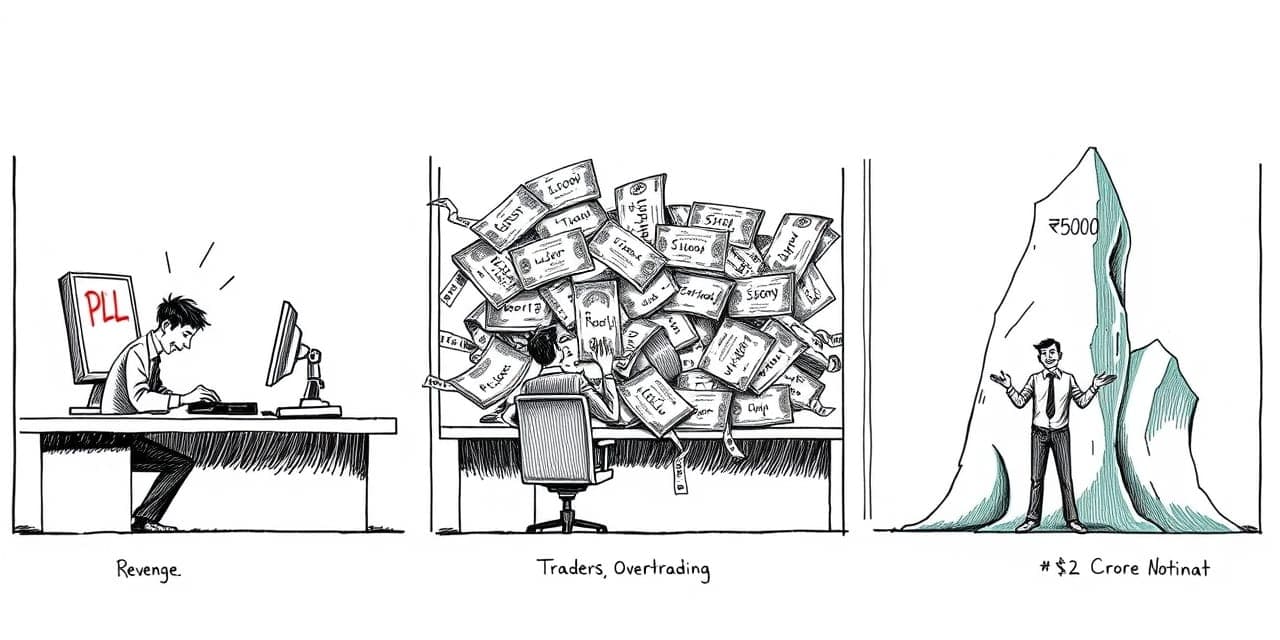

What SEBI's Data Actually Shows
The headline from SEBI's study: 93% of F&O traders lose. This is accurate. Less discussed is the distribution within that figure. A small subset of traders accounts for a disproportionate share of the losses. These are not random underperformers. They are traders whose patterns of behaviour in losing streaks and on high-volatility days follow a specific signature: escalation rather than withdrawal.
The profitable 7% are not necessarily better analysts or faster at reading charts. What distinguishes them, in the aggregate, is that they do not do the three things described below at any significant scale. Their edge is not informational. It is behavioural.
This is both discouraging and instructive. Discouraging because behavioural patterns are harder to fix than analytical errors: knowing the pattern does not automatically break it. Instructive because the patterns are identifiable, and identification is the prerequisite for intervention.
Pattern 1: Revenge Trading
Revenge trading is the most documented and the most destructive.
The mechanism: a trade goes against you. The loss, even if within your original risk parameters, creates a specific psychological pressure. Your brain registers a deficit that it wants to close. The impulse is not to cut risk and reassess; it is to place another trade, larger or more aggressive, to recover the money. The revenge trade is typically not a well-reasoned position. It is an emotional response dressed in market analysis.
In equity trading, revenge trading is damaging but bounded: cash positions limit the scale of potential loss. In F&O, leverage removes that natural boundary. A revenge trade in Bank Nifty futures at 1 lot is not equivalent to a revenge trade of ₹50,000 in the cash market. It controls ₹15,00,000+ of notional exposure. The emotional pressure that produced the original revenge impulse has now created a position where a 1% adverse move costs more than the initial loss.
The pattern compounds: the revenge trade loses, the pressure doubles, the next trade is larger still. The full anatomy of revenge trading in Bank Nifty (including how it shows up in your order history) is covered in detail separately. The sequence is visible in aggregate trade data. Large accounts blown in a single session often show this signature: a moderate early loss, a significant position increase, a second larger loss, a third even larger position, account zero. The entire sequence can occur within 90 minutes of market open.
The insidious feature of revenge trading is that it occasionally works. Markets are volatile. A revenge trade placed in desperation sometimes recovers the initial loss and produces a net positive day. This intermittent reinforcement is, in behavioural terms, the most effective way to entrench a pattern: more effective than consistent success, more effective than consistent failure. The random reward creates the same psychological loop as a slot machine.
Traders who have successfully revenge-traded their way to recovery several times are the most difficult to help. The pattern has been directly reinforced. The fact that it has also, at other times, produced catastrophic losses is processed differently by the brain than the reinforced wins.
Pattern 2: Overtrading on Volatile Days
There is a counterintuitive relationship between market volatility and trading performance for retail F&O traders. On days when market volatility is highest (large index moves, major events, expiry days) the average retail F&O trader's performance is worst, not best. The intuition would be the opposite: more movement should mean more opportunity. The data says otherwise.
The explanation is that high-volatility days are precisely when the behavioural patterns discussed here activate most strongly. How PortoAI detects overtrading in your Zerodha history shows the seven specific data patterns to look for. The larger the swings, the stronger the emotional pressure. The more trades placed in reaction to those swings, the higher the transaction costs and the greater the randomness introduced into the outcome.
Overtrading on volatile days has a specific signature: trade count spikes sharply, average holding time per trade drops sharply, the proportion of trades with a pre-defined setup or rationale drops sharply. The trader stops operating a process and starts reacting to price movement. In high-volatility environments, price movement is noise. Reacting to noise at F&O leverage is expensive.
"The days that feel like maximum opportunity are typically the days of maximum loss for traders who let volatility drive their decision-making rather than their process."
Weekly and monthly F&O expiry days are the single most consistent source of overtrading losses for retail participants. Expiry creates genuine dynamics (time decay acceleration, pinning around strike prices, institutional hedging flows) that experienced participants understand and incorporate into positioning. For retail traders without this framework, expiry days often produce the following sequence: elevated volatility early, a series of losing trades taken reactively, followed by the revenge trading pattern described above, followed by a bad close.
The data is sufficiently consistent that expiry day trade volume and P&L are a useful diagnostic. If your average P&L on expiry days is significantly worse than your average P&L on non-expiry days, the volatility is not treating you as an opportunity. It is treating you as the other side of a trade.
Pattern 3: Notional-Blind Position Sizing
This is the most technical of the three patterns, and in some ways the most dangerous because it does not feel like a mistake while you are making it.
Options traders in India typically think about their positions in terms of the premium paid. "I bought Nifty 22,000 CE for ₹120 per lot, so I have ₹9,000 at risk." This is not wrong: the maximum loss on a long options position is the premium paid. But it creates a distorted view of what the position actually represents.
That ₹9,000 premium controls a notional position in Nifty of approximately ₹1,65,00,000 (75 lots × current Nifty level). A trader who would never take a ₹1,65,00,000 equity position regularly takes equivalent F&O positions because the entry cost (the premium) feels small.
The consequence is not that every options trade blows up: long options have defined risk. The consequence is position accumulation. A trader who thinks in premium terms will routinely hold five or ten simultaneous positions because each individually seems small. The aggregate notional exposure is not small. If the positions are correlated (which they typically are, since most retail traders are directionally biased) the portfolio behaves as a single large directional bet on a market move.
In futures (Nifty, Bank Nifty, individual stocks) there is no premium cap. The entire notional is at risk in the mark-to-market sense. A single Nifty futures lot at current levels represents roughly ₹22,00,000 of exposure. A trader who has allocated "₹2 lakh to F&O" and holds a Nifty futures position has not allocated ₹2 lakh. They have allocated ₹22 lakh, using ₹2 lakh as margin. The remaining ₹20 lakh of exposure is leveraged. A 1% adverse move wipes the margin.
Most retail futures traders know this intellectually. Few internalise it in the moment of taking the position. The disconnect between cognitive knowledge and behavioural response is what makes this pattern so persistent.
Why These Patterns Repeat
None of the three patterns described here are unique to F&O. They exist in equity trading, in cricket, in poker, in any domain where results are variable and feedback is immediate. What makes F&O different is leverage: it multiplies the consequence of each pattern to the point where a single bad sequence can be terminal.
The patterns persist because:
They are not random. They follow triggers: a loss, a volatile day, a sequence of small wins that produces overconfidence. The same trigger reliably produces the same behavioural response. This is what makes them detectable.
They are not consciously chosen. The trader engaging in revenge trading is typically not thinking "I am now revenge trading." They are constructing a post-hoc rationale: "the market is oversold," "this level is strong support," "the previous trade was just bad luck." The pattern happens below the level of deliberate decision-making.
The reinforcement structure is unfavourable. Small wins reinforce the pattern. Large losses produce shame rather than analysis. The lessons that should build better behaviour ("this loss happened because I deviated from my process") are frequently not drawn.
What Detection Looks Like
The three patterns leave clear traces in trade data.
Revenge trading shows up as: trade frequency increasing in the 30-minute window after a loss, position size increasing after a loss, win rate dropping sharply after losses relative to baseline.
Overtrading shows up as: trade count on high-VIX days being 2x or more baseline, average P&L per trade on high-volatility days being significantly worse than baseline, holding time per trade dropping on days when trade count spikes.
Notional-blind sizing shows up as: number of simultaneous open positions increasing over time without a corresponding increase in portfolio size, correlation between open positions above 0.7, aggregate notional exposure as a multiple of portfolio size drifting upward quarter-over-quarter.
None of this analysis requires a market view. It requires trade history data and the willingness to look at it with the question: does my behaviour diverge from my stated process, and when?
PortoAI connects to your Zerodha account and analyses your trade history for these three patterns. See what your data shows about how you actually trade, not how you think you trade.
Try PortoAI FreeFrequently Asked Questions
Why do most F&O traders lose money in India?
SEBI's 2024 study found that 93% of individual F&O traders lost money over a three-year period. The primary causes are not lack of market knowledge but behavioural: revenge trading after losses, overtrading on volatile and expiry days, and position sizing that ignores the notional exposure embedded in options and futures. The profitable minority is not systematically better at market prediction. They are better at not doing these specific things in high-stress market conditions.
What is revenge trading in F&O?
Revenge trading is taking a new position (typically larger or more aggressive than your normal sizing) immediately after a loss, driven by the impulse to recover what you lost rather than by a well-defined setup. In F&O, the leverage embedded in futures and options means a revenge trade gone wrong can convert a manageable loss into an account-ending loss within a single session. The pattern is reinforced intermittently by instances where it works, which makes it particularly hard to break through willpower alone.
How do I know if I am overtrading in F&O?
Signals include: your trade count on volatile days or after early losses is noticeably higher than your baseline; your average P&L per trade is worse on your highest-volume days; you are taking trades in the last 30 minutes of the session that you would not have taken at 10am; your worst monthly P&L months are also your highest-trade-count months. Overtrading is not about absolute trade count. It is about trades taken outside your process, usually under emotional pressure.
What position sizing mistake do F&O traders make most often?
The most common mistake is sizing options positions by premium paid rather than notional exposure. A ₹9,000 Nifty options premium controls ₹1.6 crore+ of notional exposure. Traders who think in premium terms routinely hold portfolios where the aggregate notional is 20-50x their account size. If the positions are directionally correlated (which most retail traders' positions are) the portfolio behaves as a single large directional bet. A sustained trending move against that direction can be catastrophic even if no single position had unusual risk.
Can AI help prevent behavioural mistakes in F&O trading?
AI can detect the signatures of these patterns in your historical trade data: frequency spikes after losses, position size escalation, late-session clustering, aggregate notional drift. It cannot make decisions for you or override your trades. What it can do is flag, with specificity, when your current behaviour matches the pattern that historically preceded your worst drawdowns. The most useful intervention is not instruction. It is a mirror: this is what you did last time this situation occurred, and this is what happened next.