
Rs 1,842 crore is changing hands on March 20. Not one rupee of it goes to CMPDI.
This is the fact buried in page 4 of the DRHP that most retail applicants never reach. Coal India is selling 10.71 crore shares. The government collects the money. The company you are buying into gets nothing for growth, nothing for debt, nothing for a new product line.
And yet, by Monday morning, applications will pour in. Telegram channels will post the GMP. Your broker app will send a push notification. Someone in your office will say, "government company, can't go wrong."
They said the same thing about IREDA in November 2023.
What Is CMPDI and What Does "100% OFS" Actually Mean?
Central Mine Planning & Design Institute Limited is a 1974-vintage consultancy subsidiary of Coal India. It handles mine planning, geological surveys, and design services primarily for Coal India group companies. It holds a 61% market share in coal sector consultancy in India, per the company's DRHP filed with SEBI. By any measure, a legitimate, profitable business.
The IPO structure, however, is not about the business raising money. It is about the government reducing its stake.
An Offer for Sale works like this: the existing shareholder, Coal India, sells its shares to the public and pockets the proceeds. CMPDI's balance sheet looks identical before and after the IPO. No new capital arrives. No debt is retired. No plant gets built. The government disinvests. Retail investors absorb the selling.
This is not hidden. It is in the DRHP. The problem is that most retail applicants never read that far. They see "Coal India subsidiary," they hear "government IPO," and their brain completes the rest: safe, stable, listing gain likely.
That cognitive shortcut is what this article is about.
Is "Government-Backed" Actually Safe? The Evidence from Rs 3 Lakh Crore in Losses
The belief is intuitive. Government-run companies cannot go bankrupt. They are backed by sovereign resources. They have policy support. If a PSU business struggles, the government steps in.
All of that can be true and the stock can still fall 60% from peak. These are different risks.
The PSU stocks that retail investors poured into during 2022-2024 are now delivering a painful lesson in the difference between credit risk and valuation risk. The business does not fail. The narrative runs out of buyers.
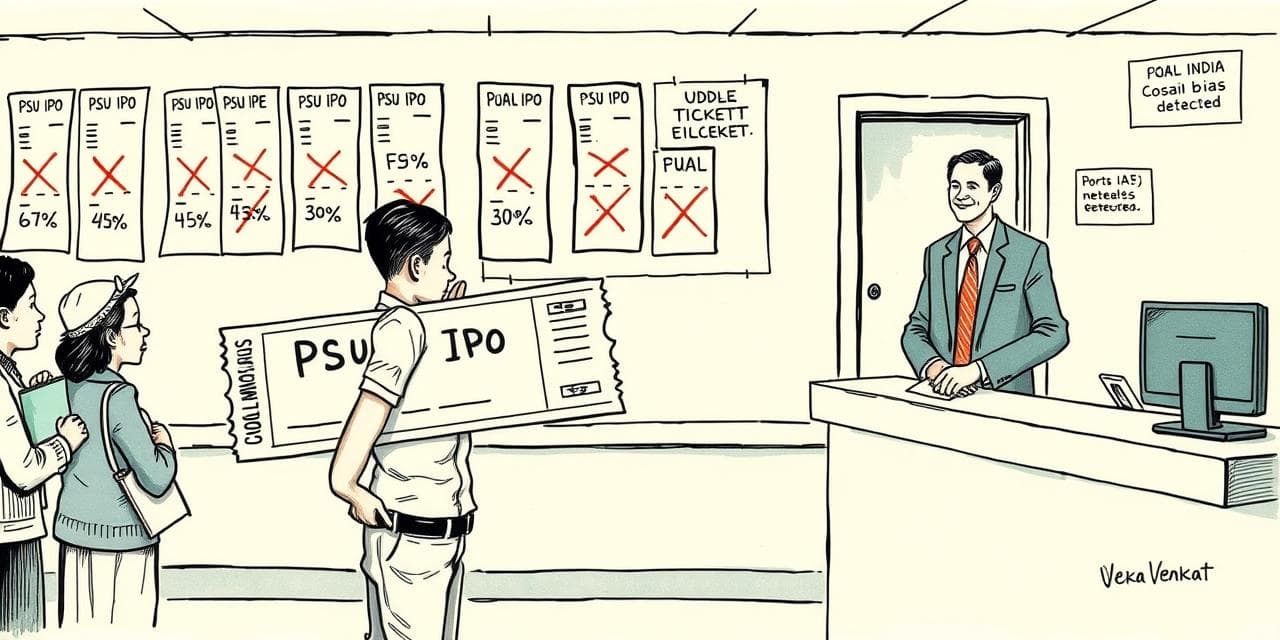
IREDA: listed November 2023 at a 56% premium on debut. Reached Rs 320, a near 10x from the Rs 32 issue price. By March 2026, trading around Rs 117. That is a 63% fall from peak. The company is still profitable. The renewable energy mandate from the government has not been cancelled. The stock still fell 63%.
RVNL: Railway infrastructure is a national priority. The government is spending trillions on railways. RVNL's order book is real. The stock crashed 45% in six months per BusinessToday data.
IRFC: Finances Indian Railways assets. Near-zero default risk. The stock fell 30% from its all-time high and stayed there.
The mechanism is the same in each case. A PSU IPO attracts a narrative wave, "India infrastructure story," "green energy mandate," "railway capex boom." That narrative attracts retail investors and momentum traders who bid the price up far beyond what the earnings justify. Eventually the momentum exhausts itself. Fundamentals reassert. The stock re-rates down. The retail investors who bought the narrative, not the business, absorb the correction.
CMPDI's narrative is "coal sector dominance." India's largest coal consultancy. 61% market share. Coal still contributes over 55% of India's electricity generation. That narrative is true today.
The question is what price it is worth.
Is the CMPDI GMP of Rs 24 Actually Telling You Anything Useful?
As of March 18, CMPDI's grey market premium sits at roughly Rs 24 above the issue price, implying a listing around Rs 196 and roughly 14% listing gain potential. Your Telegram group has probably already posted this number with three fire emojis.
Here is what GMP actually measures. It reflects informal buying and selling among a specific set of participants in an unregulated market before listing. It captures short-term speculative sentiment, specifically the demand from people who plan to sell on listing day. It says nothing about institutional demand on listing day, nothing about long-term investors buying, and nothing about whether the business justifies the price.
The historical record on GMP as a predictor is poor. Analysis of recent IPO cohorts shows that nearly one-third of mainboard IPOs in 2025 listed below their peak GMP-predicted gains, as noted in a Businessworld review of IPO grey market trends. In some cases, heavily hyped IPOs with strong GMP signals listed flat or negative when institutional anchor investors did not follow through.
The mechanism: GMP runs hot when retail demand is loud. Retail demand gets loud when Telegram channels amplify the signal. The channels amplify because subscriptions are high. Subscriptions are high because the GMP looked good. This is a feedback loop, not fundamental analysis.
What Does Your IPO Application History Actually Say About You?
There is a specific investor profile that shows up repeatedly in PortoAI's behavioral analysis. Call it the IPO lottery trader. They apply to every major IPO. Their application decisions are correlated with oversubscription ratios and GMP, not with any fundamental assessment. They hold for one to three days post-listing and exit. Sometimes they win. Often, when they get allotment in a dull IPO that the crowd also applied to, they hold because the listing gain didn't materialize and they convince themselves it's a long-term hold.
That last pattern is where the real damage happens. A stock bought at IPO price for a three-day trade that is now 30% underwater sits in the portfolio for months because the investor anchors to the issue price and refuses to sell at a loss.
PortoAI's behavioral fingerprint connects to your Zerodha and Groww account and reads the actual data. It detects whether your IPO application history shows selective, fundamental-driven decisions or crowd-following GMP chasing. It also flags anchoring bias in positions where you are holding an IPO stock at a large loss with no reassessment.
Most investors do not know their own IPO pattern. The data tends to be unflattering.
The PSU safety fallacy shows up in the data as a specific cluster: concentrated positions in government-sector stocks, entered at elevated valuations during narrative peaks, held long after the narrative has broken down. It looks like sector concentration risk combined with loss aversion. The government label made the initial entry feel safe. The same label now makes the exit feel like giving up on a good business.
Before You Apply to CMPDI: Four Questions Your Instincts Will Skip
Most retail investors decide to apply to an IPO within thirty seconds. The GMP looks good, the brand sounds familiar, the subscription closes soon, they tap apply. These four questions take ten minutes. They are the ones that distinguish a deliberate decision from a crowd reflex.
One: Where does Coal India's revenue from this sale go, and what does that tell you?
Coal India is raising Rs 1,842 crore by selling CMPDI shares. The government has a divestment target to meet. This IPO is convenient for Coal India, not necessarily optimal for CMPDI shareholders. Ask why the promoter is selling now. Is Coal India rotating capital into a better opportunity? Is the sector at peak valuations? Is the timing related to the government's fiscal year-end divestment targets? These are the questions the seller does not advertise.
Two: What is CMPDI's revenue concentration, and is it a risk?
The majority of CMPDI's revenue comes from Coal India and its subsidiaries. This is not diversification. If Coal India's capex budget gets cut in a future government's budget, CMPDI's order book shrinks. India's stated energy transition policy targets reducing coal's share of the energy mix over the next decade. This does not make CMPDI a bad business today. It means the long-term narrative has a regulatory ceiling that PSU infrastructure stocks in cleaner sectors do not have.
Three: What is your actual exit plan, and does it match your application rationale?
If you are applying for a 14% listing gain, check the last five times IREDA, RVNL, or IRFC allottees tried the same move. Many got allotment but the listing gain was less than the GMP implied, the market was volatile on listing day, and they held hoping for a recovery. Define your exit price before you apply. Rs 200 sell limit order set on listing day. If the market does not cooperate, you exit. Not hold and hope.
Four: Does this IPO improve your portfolio, or does it just add another government-sector exposure?
If you already hold Coal India, NTPC, Power Grid, or any infrastructure PSU ETF, CMPDI adds concentrated exposure to the same sector and the same macro bet. PortoAI's portfolio analysis feature shows sector-level concentration across your holdings, including unlisted and recently listed stocks. Before adding another PSU, know what your existing PSU exposure already looks like.
CMPDI Is Not the Problem. The Habit Is.
CMPDI may or may not be a good listing-day trade. The business is real. The profits are real. The government mandate is real. At the right price, for the right investor with a clear thesis, it could be worth holding.
The problem is not CMPDI specifically. The problem is the automatic mental shortcut that turns "government-backed" into "safe to apply without reading the DRHP." That shortcut has already cost Indian retail investors crores in IREDA, RVNL, and IRFC corrections. CMPDI will not be the last PSU IPO. The habit of applying because it feels safe, without defining your exit, without reading the OFS structure, without checking your existing sector exposure, will keep burning you in the next one and the one after that.
Connect your Zerodha or Groww account to PortoAI before you apply. Check your IPO application history. Find out if your pattern is analysis-driven or crowd-driven. The data will tell you what your instincts won't.
See your IPO behavior pattern in PortoAI
Try PortoAI FreeFrequently Asked Questions
Is CMPDI IPO a good investment for long-term holding?
CMPDI is a profitable, dividend-paying consultancy with 61% market share in coal sector services. But the IPO is 100% OFS, meaning Coal India takes all proceeds and CMPDI gets no growth capital. At Rs 163-172 per share, the valuation is in line with comparable PSU service companies. Whether it is worth holding depends on your view of India's coal sector over the next decade. The company is tied to Coal India's project pipeline, which is government-policy dependent. Evaluate the business, not the government branding.
What does OFS mean in an IPO?
OFS stands for Offer for Sale. In an OFS IPO, existing shareholders sell their stake to the public. The company receives zero proceeds. In CMPDI's case, Coal India is selling 10.71 crore shares and will collect the entire Rs 1,842 crore. CMPDI gets nothing. This is the opposite of a fresh issue, where the company raises capital for expansion, debt repayment, or working capital. When you see 100% OFS on a DRHP, ask yourself: why is the existing shareholder selling now?
Is grey market premium (GMP) reliable for predicting listing price?
GMP is an informal, unregulated signal. It reflects speculative demand among certain participants before the IPO lists, not institutional analysis. For CMPDI, the current GMP implies around 14% listing gain. Historical data shows that GMP-based projections are unreliable: many IPOs have listed flat or negative despite strong GMP signals. The mechanism fails when institutional demand on listing day doesn't match the retail speculation that drove the GMP. Never apply to an IPO purely because the GMP looks good.
What happened to IREDA and RVNL investors who held after listing?
IREDA listed at a 56% premium in November 2023 and eventually reached Rs 320, a 10x from its issue price of Rs 32. By early 2026, it had fallen to around Rs 117, a 63% decline from peak. RVNL crashed 45% in six months. IRFC fell 30% from its all-time high. The businesses did not fail. The stocks re-rated down as the PSU hype cycle ran out of buyers. Investors who entered chasing the narrative, not the valuation, absorbed the full correction.
How does PortoAI analyze my IPO application history?
PortoAI's behavioral fingerprint analyzes your IPO applications alongside your buy/sell data from Zerodha and Groww. It identifies patterns: do you apply to every hyped IPO regardless of sector, or do you apply selectively? Do you sell on listing day regardless of price, or do you hold? Do your IPO picks cluster around high-GMP issues? The pattern tells you whether your IPO behavior is driven by analysis or crowd signals. Most retail investors do not know their own IPO pattern until they see the data.
What is CMPDI's business model and key risks?
CMPDI is a consultancy that provides mine planning, geological surveys, and design services primarily to Coal India subsidiaries. Its key risk: over-dependence on Coal India, which accounted for the majority of its FY25 revenue. If Coal India cuts capex, CMPDI's order book shrinks. There is also India's stated energy transition policy, which targets reducing coal dependency over the next 10-15 years. Buying CMPDI is partly a bet that India's coal sector stays large through that transition period.