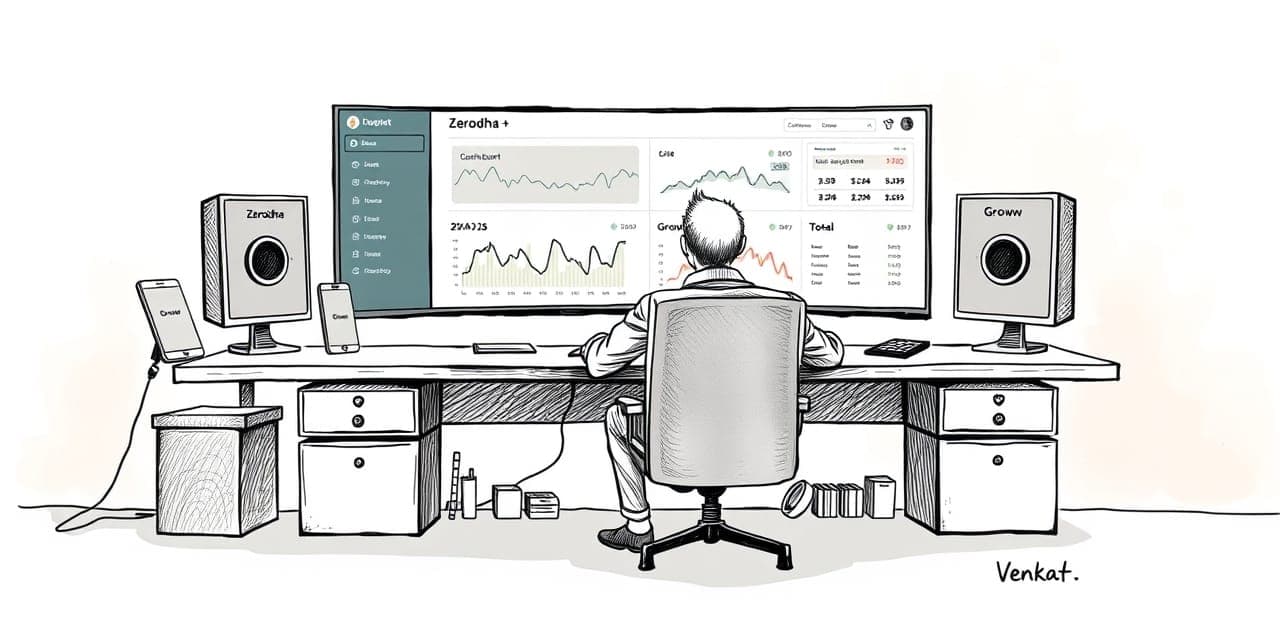

The Problem: Your Portfolio Is Split Across Apps
You have 4 stocks in Zerodha, 3 SIPs in Groww, maybe some gold bonds, and absolutely no idea what your real exposure looks like. If that sounds familiar, you're not alone, and you need an AI portfolio tracker for Zerodha and Groww that actually stitches the picture together.
According to AMFI data, India crossed 20 crore mutual fund folios in 2025, with a significant chunk held alongside direct equity accounts on platforms like Zerodha and Groww. Each one shows you a clean, self-contained view of what you hold. None of them shows you the truth.
The truth is messy. Your Nifty 50 ETF in Zerodha overlaps with your large-cap fund in Groww. Your Reliance shares are duplicated across three mutual fund portfolios. Your banking exposure across HDFC Bank, ICICI, and SBI is scattered across direct holdings, flexi-cap funds, and sectoral ETFs, adding up to 35% of your total portfolio. But no single app will tell you that.
Fragmented portfolios create three specific dangers:
- Hidden concentration risk: You think you own 15 stocks. In reality, six of your mutual funds hold the same five names. Your "diversified" portfolio is a concentrated bet with extra steps.
- Duplicate sector exposure: IT stocks in your direct portfolio, an IT ETF in Zerodha, and a tech-heavy flexi-cap fund in Groww. One sector correction wipes out more than you expected.
- Blind rebalancing: When you add ₹50,000 to a new SIP, you have no idea if you're doubling down on sectors you're already overweight in.
This is not a theoretical problem. It's the default state of every Indian investor who uses more than one app.
What Makes a Portfolio Tracker "AI-Powered"?
The word "AI" gets slapped on every fintech product that has a search bar and a recommendation engine. So let's draw a clear line.
A basic portfolio tracker aggregates your holdings and shows you P&L. It tells you what you own and whether it's up or down. That's table stakes. Any spreadsheet can do this. Zerodha Console and the Groww app already do it for their respective platforms.
An AI-powered portfolio tracker does something fundamentally different. It analyzes your behavior over time and surfaces patterns you can't see yourself. Specifically:
- Pattern detection: Are you consistently buying after a stock has already run up 10%? Are you adding to losers hoping they'll recover?
- Behavioral alerts: Did you make 14 trades in a single week when your normal average is 3? That's overtrading, and it's costing you in brokerage, STT, and slippage.
- Proactive risk warnings: Your portfolio is 28% banking. That's fine unless you also work in financial services, in which case your income and your investments are correlated in exactly the wrong way.
- Tax intelligence: Not just showing your STCG and LTCG, but identifying which holdings to sell for tax-loss harvesting before March 31.
Most tools that call themselves "AI portfolio trackers" are really just dashboards with charts. The distinction matters because a dashboard waits for you to look at it. A genuine AI companion watches your portfolio continuously and tells you when something needs attention, even when you're not checking.
StockIQ vs Tickertape vs PortoAI: Feature Comparison
Three platforms claim to offer AI-powered portfolio tracking for Indian investors. Here's how they actually compare:
| Feature | StockIQ | Tickertape | PortoAI |
|---|---|---|---|
| Zerodha connection | Yes (Kite Connect) | Yes (via Smallcase) | Yes (Kite Connect API) |
| Groww connection | Yes | Limited | Yes (official API) |
| Multi-broker aggregation | Basic | No (single view) | Full unified dashboard |
| AI behavioral analysis | No | No | Yes (overtrading, revenge trading, bias detection) |
| Tax-loss harvesting | Yes (STCG/LTCG) | Basic | Yes (with timing suggestions) |
| Concentration risk alerts | Manual | No | Automated, real-time |
| Sector overlap detection | No | Partial (Smallcase only) | Yes (looks through MF holdings) |
| Free tier | Yes (basic tracking) | Yes (limited features) | Yes (basic portfolio view) |
| Paid plan | From ₹199/mo | From ₹249/mo | From ₹149/mo |
StockIQ does a solid job on the fundamentals. XIRR tracking is accurate, and their tax-loss harvesting tool is genuinely useful around tax season. The free tier covers basic portfolio aggregation, which is enough if all you want is a unified P&L view. Where it falls short is behavioral analysis. It shows you numbers, but doesn't interpret patterns in your trading history.
Tickertape is part of the Smallcase ecosystem, which gives it strong stock and ETF discovery tools. If you're researching what to buy, it's excellent. But portfolio tracking is clearly secondary. It's designed to funnel you toward Smallcase baskets rather than analyze what you already own. Multi-broker aggregation is limited, and there's no behavioral layer.
PortoAI was built specifically for the multi-broker Indian investor. The core differentiation is behavioral analysis: it doesn't just show your holdings, it watches how you trade over weeks and months, flags destructive patterns like revenge trading and overtrading, and explains how your behavior is affecting returns. The unified dashboard treats your Zerodha stocks and Groww mutual funds as a single portfolio, including look-through analysis of mutual fund holdings.
How Broker Connections Actually Work (API vs Scraping)
This is the section that matters most if you're hesitant about connecting your broker to any third-party app. The hesitation is justified, but the risk depends entirely on how the connection works.
Some portfolio trackers ask for your Zerodha login credentials directly. They store your username, password, and TOTP secret, then log into Kite on your behalf to pull data. This is called credential scraping, and it's dangerous for obvious reasons:
- The app has full access to your trading account
- Your credentials sit on someone else's servers
- The app can theoretically place or cancel orders
- Zerodha explicitly prohibits this and can freeze your account if detected
If any app asks you to type your Kite password into their interface, close the tab.
Zerodha's Kite Connect API provides a read-only data connection using OAuth authentication. Here's the flow:
- You click "Connect Zerodha" in the portfolio tracker
- You're redirected to Zerodha's own login page, not the tracker's
- You authenticate with your credentials and TOTP directly on Zerodha's site
- Zerodha issues a read-only access token to the tracker
- The tracker can see your holdings, positions, and order history. Nothing more.
No password is shared. No trading access is granted. The token expires automatically, and you can revoke it anytime from your Kite dashboard.
Groww's API works similarly: OAuth-based, read-only, with explicit user consent at each step.
PortoAI uses official APIs exclusively. We wrote a detailed breakdown of the security model in our post on connecting AI to Zerodha without sharing your password. If trust is your primary concern (and it should be), that's worth reading before you connect anything.
What PortoAI Shows That Others Don't
Here's where basic tracking ends and AI analysis begins.
When you connect both Zerodha and Groww, PortoAI doesn't just list your holdings side by side. It looks through your mutual funds to the underlying stocks and maps everything to a single exposure view.
That means if you hold Infosys directly in Zerodha (₹80,000) and also own a Nifty IT ETF and two flexi-cap funds that collectively hold another ₹45,000 of Infosys, you see one number: ₹1,25,000 total Infosys exposure at 8.3% of your portfolio. No other consumer-grade tracker in India does this automatically.
This is the feature that separates a tracker from a companion. PortoAI monitors your trading history across brokers and identifies patterns that hurt returns:
- Overtrading weeks: You normally make 2-3 trades per week, but last week you made 11. What happened? Market panic? A hot tip? Either way, the excess brokerage and STT alone cost you ₹1,200.
- Averaging down on losers: That stock you bought at ₹450 is now at ₹310, and you've added to it three times. PortoAI flags when averaging down becomes a behavioral trap rather than a strategy.
- Concentration drift: Your portfolio started the year with 12% banking exposure. Six months later, it's 31%, not because you actively chose banking, but because your SIPs and direct buys gradually tilted you there.
A regular tracker tells you your portfolio is down 5%. PortoAI tells you why and whether your behavior caused it.
Did the entire market correct 4% and your portfolio dropped 5%? That's a beta issue: your portfolio is slightly more volatile than the Nifty 50. Manageable.
But did the market drop 2% while your portfolio dropped 7%? That means your concentration in a specific sector or stock amplified the drawdown. That's a portfolio construction problem, and PortoAI will show you exactly which holdings drove the excess loss.
This is the difference between staring at a red P&L number and understanding what to do about it. For a broader look at how AI tools are changing Indian stock market investing, see our comparison of the best AI tools for the Indian market.
How to Set Up Multi-Broker Tracking in 2 Minutes
Getting started is deliberately simple. There are no forms to fill, no documents to upload, and no credentials to share.
Create an account with your email or Google login. No KYC required for portfolio tracking. You're connecting existing, KYC-verified broker accounts.
Click "Add Broker" and select Zerodha. You'll be redirected to Kite's login page. Authenticate with your credentials and TOTP. PortoAI receives a read-only token. Done.
Same process. Click "Add Broker," select Groww, authenticate on Groww's site. Your mutual fund holdings, SIPs, and any direct stock positions sync automatically.
Within seconds, PortoAI builds your unified dashboard. You'll see:
- Total portfolio value across both platforms
- Sector-wise exposure including look-through MF holdings
- Stock-level overlap detection
- Concentration risk score
- Behavioral baseline (built from your trading history over the following weeks)
That's it. Two broker connections, one dashboard, and for the first time, an accurate picture of what you actually own.
If you've been switching between apps trying to mentally combine your portfolios, that ends now. Connect your brokers and see your real portfolio in 2 minutes.
Connect your Zerodha and Groww accounts. Get your unified portfolio view in 2 minutes.
Try PortoAI FreeFrequently Asked Questions
Frequently Asked Questions
Can I track Zerodha and Groww in one app?
Yes. PortoAI connects to both Zerodha and Groww to show your combined portfolio, total exposure, sector overlaps, and real risk in a single dashboard. The connection uses official APIs. No passwords are shared, and access is read-only.
Is there a free AI portfolio tracker for Indian investors?
PortoAI offers a free tier for basic portfolio tracking. StockIQ also has a free plan. Most tools require a paid plan for AI-powered insights like tax optimization, behavioral analysis, and proactive risk alerts. The free tiers are enough to see your unified holdings across brokers.
How does an AI portfolio tracker differ from a regular one?
Regular trackers show your holdings and P&L. AI trackers analyze patterns such as concentration risk, overtrading, and behavioral biases, and proactively alert you. The difference is between a mirror that shows you what happened and a companion that tells you what to do about it.
What is look-through analysis?
Look-through analysis shows you the actual stocks and sectors inside your mutual funds, not just the fund names. PortoAI breaks down your ETFs and mutual funds to show true sector exposure across your entire portfolio.