
The Uncomfortable Truth About AI and Stock Markets
Every fintech startup in India claims AI will make you rich. Scroll through Twitter, and you'll find dozens of apps promising "AI-powered stock picks" and "machine learning alpha." The pitch is seductive: let an algorithm do the hard work while you collect returns. But if you're searching for how AI can help with stock market investing in India, you deserve an honest answer instead of a sales pitch.
Here's the uncomfortable truth: AI is a tool, not a crystal ball. No algorithm, no matter how sophisticated, can consistently predict where Nifty will close tomorrow, which small-cap will turn into a multibagger, or when the next market crash will hit. Anyone telling you otherwise is selling something.
But that doesn't mean AI is useless for Indian investors. Far from it. The real value of AI in stock market investing is radically different from what most people expect. It's not about finding the next Tata Elxsi before everyone else. It's about stopping you from destroying the returns you've already earned.
"The greatest threat to your portfolio isn't the market. It's you."
What AI Actually Does Well (And What It Can't)
Let's be specific about where artificial intelligence delivers genuine value and where it falls flat.
- Process massive datasets quickly. An AI can scan thousands of quarterly results, compare ratios, and flag anomalies across BSE-listed companies in seconds. A human analyst doing the same work would need weeks.
- Detect patterns in historical data. Machine learning models can identify recurring patterns in your trading behavior: when you trade more, when you lose more, and whether those two things are correlated (they usually are).
- Analyze sentiment at scale. AI can process thousands of news articles, earnings call transcripts, and social media posts to gauge market sentiment. This doesn't predict prices, but it adds context to your research.
- Identify behavioral biases. This is the real breakthrough. AI can look at your actual trade history and identify patterns you can't see yourself: revenge trading after losses, overtrading on volatile days, averaging down compulsively on losing positions.
- Predict black swan events. No model predicted demonetization, the COVID crash, or the Adani-Hindenburg situation. These events are, by definition, outside the training data.
- Guarantee returns. Any AI tool promising guaranteed returns is either lying or doesn't understand markets. Period.
- Replace human judgment on macro factors. Whether India's GDP growth justifies current valuations, or whether RBI's policy stance will shift, these are judgment calls that require understanding context, politics, and human behavior in ways AI cannot replicate.
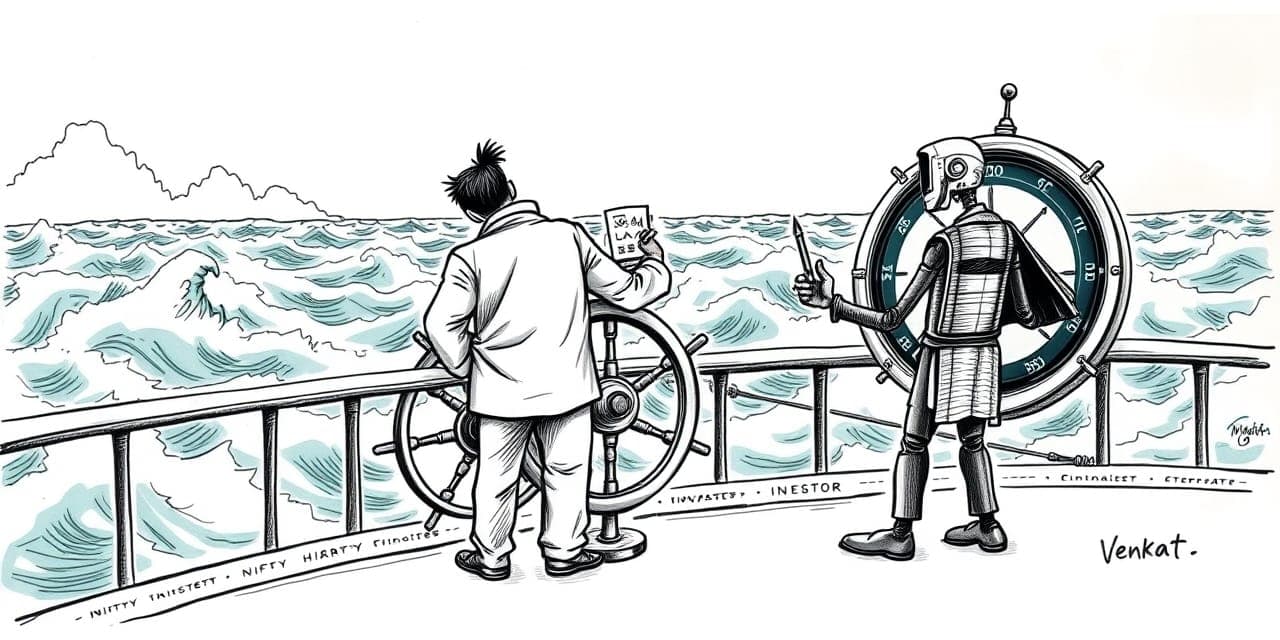
Think of it this way: AI is like a very good rearview mirror. It can show you exactly where you've been, what patterns your driving follows, and where you tend to make mistakes. But it cannot see around the next blind corner. The driver still needs to steer.
Why Do 89% of Indian F&O Traders Lose Money?
In January 2023, SEBI released a study on the performance of individual traders in the equity F&O segment. The numbers were staggering.
89% of individual F&O traders incurred losses during FY20 to FY22. The average loss was approximately ₹1.1 lakh per person per year. Only 11% made a profit, and even among those, the median profit was modest compared to the risks taken.
But here's the finding that matters most for this conversation: losses were strongly correlated with trading frequency. The more often people traded, the more they lost. This isn't a knowledge problem. Many of these traders understood technical analysis, could read candlestick charts, and followed the right accounts on social media. It's a behavioral problem.
The traders who lost the most weren't necessarily the ones picking the worst stocks. They were the ones who:
- Traded too frequently, paying enormous sums in brokerage, STT, and GST
- Doubled down after losses instead of stepping back
- Chased momentum after it had already played out
- Held losing positions too long and cut winners too early
These are behavioral patterns. And behavioral patterns are exactly what AI is built to detect.
Three Ways AI Changes the Game for Indian Investors
If AI can't predict the market, what is it actually good for? Three things stand out.
This is the highest-value application of AI for retail investors, and it's the one nobody talks about because it's not as glamorous as "AI stock picks."
When you connect your broker account to a tool like PortoAI, it builds a behavioral profile from your actual trading history. Not from what you think you do, but from what you actually do. The gap between those two is usually enormous.
PortoAI can detect overtrading patterns by comparing your current trading frequency to your baseline. It flags revenge trading when it sees you entering larger positions immediately after a loss. It identifies FOMO entries by analyzing whether you tend to buy after a stock has already run up 15-20%. The cost of FOMO trading for Indian investors is larger than most people realize. Data shows cumulative losses from repeated reactive entries can exceed ₹1 lakh per year for active traders.
None of this requires predicting the future. It only requires analyzing the past, and AI is exceptionally good at that.
Many Indian investors split their activity across two or three brokers. Options on Zerodha, mutual funds on Groww, some stocks on Angel One. The result is that nobody, least of all the investor, has a clear picture of their total exposure.
AI-powered aggregation tools pull your holdings and trade history from multiple brokers into a single view. For the first time, you can see that you're 40% concentrated in banking stocks across all your accounts, or that your total F&O exposure is three times what you thought it was. You can see the real numbers. This alone prevents the kind of accidental over-concentration that wipes out portfolios during sector-specific corrections. For a detailed breakdown of what these tools offer, see our guide to AI portfolio trackers for Zerodha and Groww.
Reading a company's annual report takes hours. Comparing its financials against peers takes more hours. Tracking management commentary across four quarters of earnings calls? That's a weekend project.
AI compresses this work. You can ask a purpose-built financial AI to summarize key changes in a company's latest quarterly filing, compare its margins to sector peers, or flag unusual items in the balance sheet. The AI isn't making the investment decision. You are. But it's doing in minutes what used to take hours of manual work.
The important caveat: generic AI chatbots fail at this because they lack access to live Indian market data. You need tools specifically built for Indian markets, pulling from BSE/NSE filings and real-time feeds. For a comprehensive breakdown of what's available, see our comparison of the best AI tools for the Indian stock market.
The Real Value: Fixing Your Behaviour, Not Picking Stocks
Here's the turn most AI investing articles never make: the biggest source of losses for Indian retail investors isn't bad stock picks. It's bad behavior.
You might have a perfectly good thesis on why a stock should go up. But if you overtrade it, panic sell during a dip, revenge trade after a stop-loss hits, or keep averaging down past your risk limit, the thesis doesn't matter. The behavior will eat the returns.
This is where PortoAI's approach differs from typical "AI for stocks" tools. Instead of trying to tell you what to buy, a problem AI hasn't solved and may never solve reliably, PortoAI analyzes your actual trading history and flags the patterns that are costing you money.
It works like this:
- Connect your Zerodha or Groww account with read-only access. PortoAI never places trades on your behalf.
- Your trading history is analyzed to build a behavioral fingerprint: your typical frequency, hold times, position sizes, and how you react to wins and losses.
- Deviations trigger alerts. When your behavior shifts toward patterns historically associated with losses, such as trading faster, sizing up after losses, or entering positions outside your usual watchlist, PortoAI flags it before the damage is done.
"The best AI investing tool isn't one that tells you what to buy. It's one that tells you when to stop."
The results compound over time. Avoiding three or four revenge trades per month might save ₹20,000-50,000 for an active F&O trader. Over a year, that's potentially more than most stock-picking algorithms would add. And it works regardless of market direction. Behavioral discipline matters in bull markets and bear markets alike.
How to Start Using AI for Your Portfolio
If you're convinced that AI has a role in your investing process, here's a practical framework for getting started.
Many apps slap "AI-powered" on their marketing without any meaningful AI under the hood. Ask yourself: does this tool actually analyze my behavior, or does it just show me charts with a chatbot attached? If it can't tell you something specific about your trading patterns that you didn't already know, it's not using AI in a way that helps you.
The most important first step is connecting your brokerage account to a behavioral analysis tool and looking at the data. Most investors are surprised by what they find. You might discover that your win rate on trades held for more than 5 days is 60%, but your win rate on intraday trades is 30%. That single insight is worth more than any stock tip.
It's tempting to use AI for the exciting part: finding the next winner. Resist that urge. Fix the leaks in your process first. Once you've eliminated overtrading, revenge trading, and concentration risk, your existing stock-picking process will perform better simply because you've stopped sabotaging it. You can explore PortoAI's full behavioral analysis feature set on the features page.
Connect your Zerodha or Groww account and see what your trading patterns reveal.
Try PortoAI FreeWhat AI Actually Gets You
AI is not going to make you rich in the Indian stock market. Nothing will, reliably. But AI can make you less poor by catching the behavioral mistakes that silently drain most retail portfolios.
The SEBI data is clear: the problem isn't picking the wrong stocks. It's trading too often, reacting emotionally, and ignoring risk limits. These are solvable problems. AI solves them not by being smarter than the market, but by being more honest with you than you are with yourself.
That's not as exciting as "AI predicts next multibagger." But it's real. And in investing, real is the only thing that compounds.
Frequently Asked Questions
Can AI predict the Indian stock market?
No. No AI can reliably predict market movements. Markets are influenced by unpredictable events such as geopolitical shifts, policy changes, and natural disasters that fall outside any model's training data. AI is better used for analyzing patterns in your own trading behavior, where the data is complete and the patterns are detectable.
How do Indian investors use AI for stocks?
Most Indian investors use AI for stock screening (Tickertape), portfolio tracking (StockIQ), fundamental research (Screener AI), or behavioral analysis (PortoAI). The highest-impact use case, based on SEBI's loss data, is identifying and fixing your own trading mistakes: overtrading, revenge trading, and emotional position sizing.
Is AI investing safe in India?
AI tools that only analyze data with read-only access are safe. They observe your portfolio without the ability to modify it. Be cautious of any tool that claims to place trades on your behalf, as automated trading carries additional risks. Always check if the platform is SEBI-registered for advisory services, and never share your trading password with any third-party tool.
What is the best free AI tool for Indian stock market beginners?
PortoAI offers a free tier that connects to Zerodha or Groww and provides portfolio analysis, behavioral insights, and stock research. For stock screening, Screener.in is excellent and free.