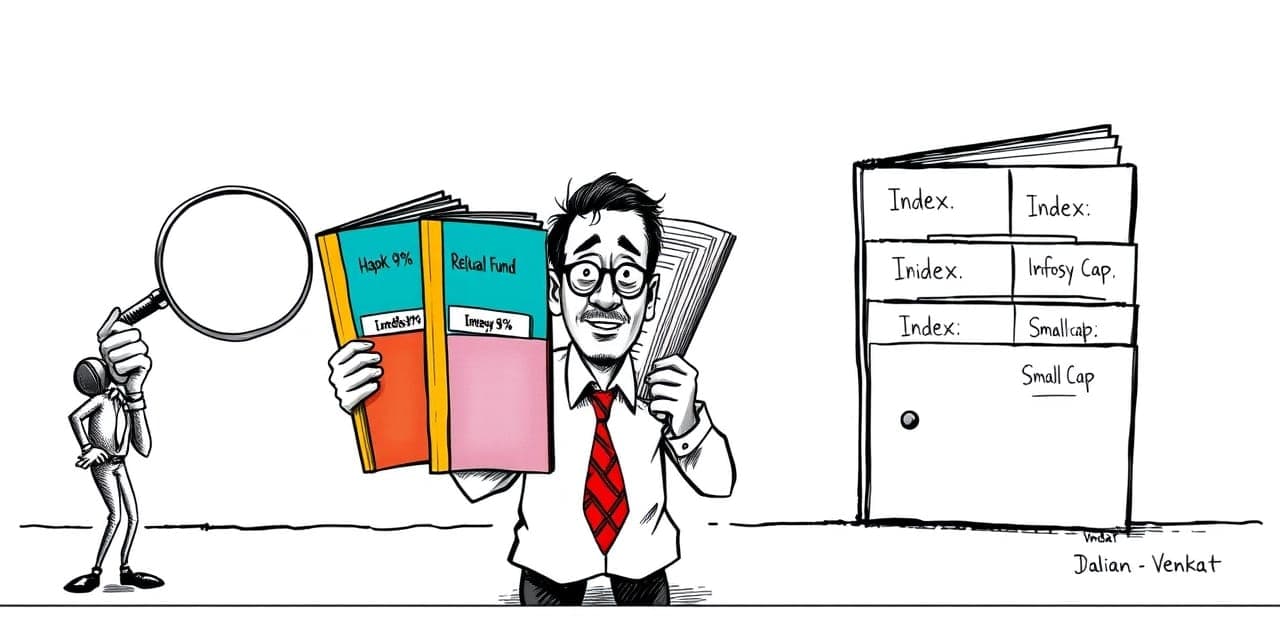

Does holding multiple funds mean you are diversified?
There is a specific mental model that leads Indian investors to accumulate SIPs across many funds: more funds means more diversification. It is intuitive. It is largely wrong.
Diversification, genuine risk reduction through owning uncorrelated assets, requires that the underlying holdings actually be different. A portfolio of six large-cap funds is not a diversified equity portfolio. It is a portfolio of six different fund managers all holding approximately the same 50-80 stocks in slightly different weightings. The correlation between large-cap funds in India, measured by their NAV movements, consistently runs above 0.85-0.95. When Nifty falls 3%, your six-fund portfolio will fall approximately 3% too, regardless of which six fund managers you chose.
The number of funds is not the measure of diversification. The diversity of underlying stock exposures is.
What Is Actually in Your Funds
Open the monthly factsheet of any five large-cap or flexi-cap funds in India. Look at the top 10 holdings of each.
You will find, with very high probability, that the following names appear in the top 10 of most or all five funds: Reliance Industries, HDFC Bank, ICICI Bank, Infosys, TCS, Larsen & Toubro, Kotak Mahindra Bank, Bharti Airtel, Axis Bank, and HUL, in varying orders and proportions.
This is not a coincidence or a failure of fund management. It is a structural feature of Indian equity markets. The top 20 stocks by market capitalisation represent roughly 60-65% of the Nifty 500 index. Large-cap funds are mandated to hold at least 80% of their portfolio in large-cap stocks. The large-cap universe: the top 100 stocks by market cap, is a constrained space. Every fund operating in it will end up with concentrated exposure to the same set of names.
The variation between large-cap funds is real but marginal. One fund holds 9% in Reliance; another holds 7%. One holds 8% in HDFC Bank; another holds 10%. These differences in weighting affect returns at the margin. They do not create meaningfully different risk profiles.
"Owning five large-cap funds is not diversification. It is hiring five different chefs to cook variations of the same dish."
How Overlap Compounds Across Platforms
The problem is compounded for investors who use both Zerodha Coin and Groww, and most Indian investors with active investment habits do.
A common pattern: you started a SIP in a large-cap fund on Groww three years ago. You opened a Zerodha account, got interested in direct plans, and started a new SIP in a different large-cap fund on Coin. You recently added a flexi-cap fund to the Zerodha portfolio because a financial YouTuber recommended it.
Your view on Groww shows you one portfolio. Your view on Zerodha shows you another. Neither platform shows you the combined picture: the actual aggregate stock-level holdings, weighted by your investment across both platforms. Without this combined view, you cannot see the overlap that makes your three-fund "diversified" portfolio effectively a single highly concentrated large-cap portfolio.
The HDFC Bank exposure in Fund 1 on Groww, plus the HDFC Bank exposure in Fund 2 on Zerodha, plus the HDFC Bank exposure in Fund 3 on Zerodha, may add up to 12-15% of your total equity portfolio concentrated in a single bank. You cannot see this number anywhere on either platform individually.
Measuring Your Actual Concentration
The right way to think about portfolio concentration is at the stock level, not the fund level. The question is not "how many funds do I hold?" but "what is my effective exposure to each underlying stock, across all funds weighted by my investment amount?"
To calculate this manually:
- For each fund, get the current portfolio disclosure (available in monthly factsheets from the AMC website or SEBI disclosures)
- For each stock in each fund, multiply the fund's weight in that stock by the amount you have invested in that fund
- Sum across all funds to get your total rupee exposure to each stock
- Divide each stock's total by your total equity portfolio value to get your effective percentage
This calculation is not conceptually complex. It is operationally tedious, particularly if your holdings span multiple platforms, multiple funds, and multiple AMCs. The tedium is why most investors never do it. The consequence is that they manage their portfolio at the fund level while their actual risk is operating at the stock level, largely invisible to them.
Categories That Actually Diversify
Not all fund categories have high overlap with each other. The diversification benefit of adding a second fund to a portfolio depends heavily on what category it is relative to what you already hold.
Once you understand your real stock-level concentration, the next step is measuring whether your returns justify the overlap: which is where reading your XIRR correctly becomes essential.
High overlap (marginal diversification benefit):
- Large-cap + another large-cap
- Large-cap + flexi-cap (flexi-caps in India are typically 70-80% large-cap by actual holding)
- Multi-cap + flexi-cap (substantial portfolio similarity in practice)
Moderate overlap (some genuine diversification):
- Large-cap + mid-cap (genuinely different stock universes, though macro correlation remains high)
- Flexi-cap + small-cap
Low overlap (genuine diversification at stock level):
- Large-cap + sector fund in a non-correlated sector (pharma, IT, consumption vs. financials-heavy large-cap)
- Equity + debt (different asset class, true diversification at the portfolio level)
- Domestic equity + international fund (geography diversification, though correlation rose post-2020)
The category combination that most Indian investors accidentally assemble, large-cap + flexi-cap + multi-cap, is the high-overlap combination. The perception is three different funds; the reality is one diversified large-cap portfolio with three sets of management fees.
How many mutual funds do you actually need in a SIP portfolio?
Portfolio research consistently finds that diversification benefits plateau at relatively low stock counts, typically 20-30 stocks for domestic equity portfolios. Beyond that, additional holdings reduce concentration marginally but add complexity linearly.
For SIP investors in mutual funds, the equivalent conclusion is that 3-5 genuinely differentiated funds capture most of the available diversification. "Genuinely differentiated" means different by stock universe and low correlation in underlying holdings, not just different fund names or fund houses.
A well-constructed core portfolio for a moderate-risk Indian equity investor might look like:
- One large-cap index fund (low cost, captures the large-cap universe efficiently)
- One active mid-cap fund (genuine stock differentiation from large-cap, potential for alpha)
- One small-cap fund for investors with a 7+ year horizon and higher risk tolerance
This three-fund structure has genuine diversification across market cap segments, lower overlap than any combination of three active large-cap funds, and lower aggregate cost than a portfolio of six actively managed funds.
Adding a fourth fund, international equity, gold, or a specific sector, adds genuine diversification. Adding a seventh large-cap fund adds fees. Investors who want to understand whether their fund choices are actually working should learn how to read their XIRR correctly before adding another SIP.
When Concentration Is a Choice
Not all concentration is accidental. Some investors deliberately concentrate in sectors they understand or have conviction in, technology, healthcare, financials. This is a different situation from accidental overlap.
Deliberate concentration is a position. Accidental overlap is a measurement failure. The difference matters because you cannot manage a risk you cannot see.
If you have decided to be concentrated in financials because you believe Indian bank credit growth will deliver strong returns over the next decade, that is an investment thesis. You should know your financials exposure, size it appropriately, and own the decision. If you are concentrated in financials because you happen to hold three funds that all overweight HDFC Bank and ICICI Bank, and you have never calculated the aggregate, that is a different situation entirely.
The investor with a deliberate thesis can be wrong. The investor with accidental concentration cannot even be deliberately right.
PortoAI connects your Zerodha and Groww accounts and shows your actual stock-level exposure across all funds, not just fund-level summaries. See what you actually own.
Try PortoAI FreeFrequently Asked Questions
What is portfolio overlap in mutual funds?
Portfolio overlap is the percentage of your equity holdings that are duplicated across two or more funds. If multiple funds in your portfolio hold the same stocks, your effective concentration in those stocks is higher than any single fund's weighting suggests. In Indian large-cap and flexi-cap funds, overlap above 50-70% between any two funds is common, meaning half or more of your holdings may be in the same stocks even when you think you hold different funds.
How much overlap is normal between Indian mutual funds?
Among large-cap and flexi-cap funds, 50-70% pairwise overlap is common. The top 10 holdings of most large-cap funds are dominated by the same names, Reliance, HDFC Bank, ICICI Bank, Infosys, TCS, because large-cap funds must hold 80%+ in large-cap stocks and the Indian large-cap universe is a constrained set of roughly 100 stocks. Multiple large-cap funds in the same portfolio mainly diversify fund manager exposure, not stock exposure.
How do I check mutual fund overlap in India?
Most fund comparison tools show pairwise overlap between two funds. To calculate your actual portfolio-level overlap, you need to aggregate each fund's stock holdings weighted by your investment amount in that fund, then sum across all funds. The result shows your true stock-level exposure. This requires current fund portfolio data from AMC factsheets and weighting by your actual investment amounts, tedious manually, but the most accurate way to understand your true concentration.
Is it bad to hold multiple SIPs in the same fund category?
It depends on the category. Multiple large-cap SIPs create high overlap with marginal diversification benefit. Adding a mid-cap or small-cap fund to a large-cap fund creates genuine diversification by moving into a different stock universe. The most common mistake is running multiple large-cap or flexi-cap funds believing they are diversified when the underlying stock holdings are substantially the same.
What is the right number of mutual funds for an SIP portfolio?
Research consistently finds that 3-5 genuinely differentiated funds capture most available diversification. Beyond that, additional funds increase cost and complexity without meaningfully reducing concentration. "Genuinely differentiated" means different stock universes with low correlation, not just different fund houses managing similar large-cap mandates. A large-cap index, an active mid-cap, and optionally a small-cap fund covers most of the equity risk spectrum with low overlap.