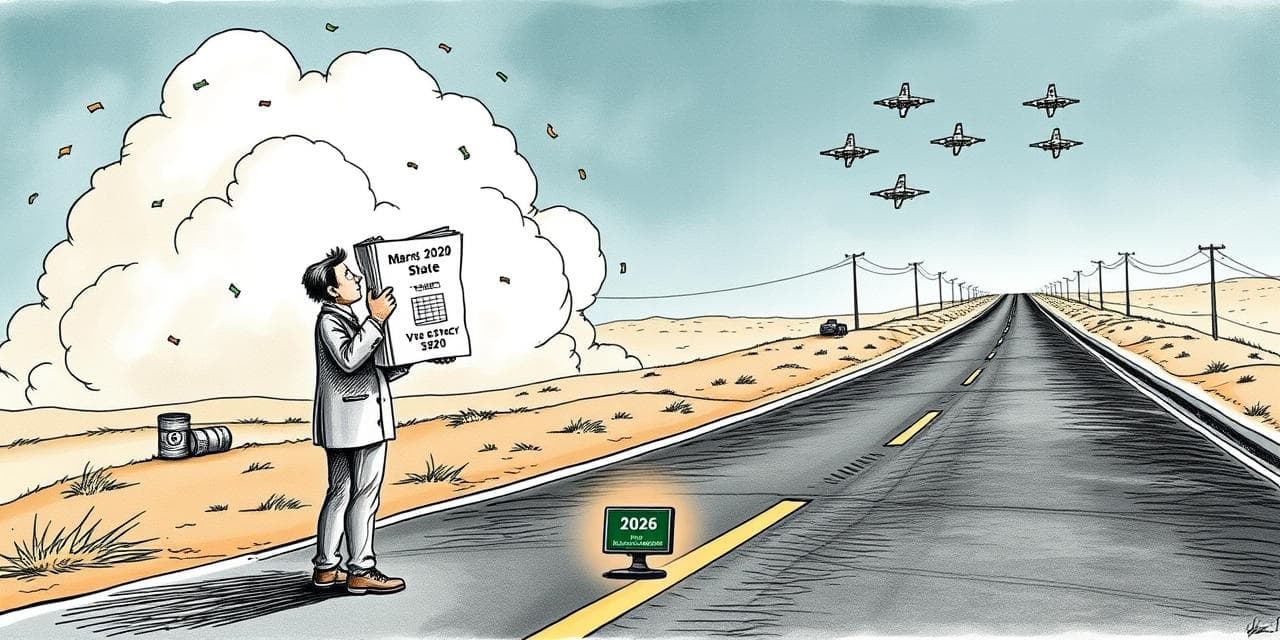

You remember March 2020. Nifty fell 38%. You panicked for three days. Then you bought Reliance at ₹870 and HDFC Bank at ₹740. By December, your portfolio was up 90%. You tell that story at every dinner party.
Now it is March 2026. Nifty is down 15% from its February peak. Sensex lost 1,837 points yesterday. Rs 47 lakh crore in market value is gone. FPIs have pulled ₹1.34 lakh crore out of Indian equities this year.
And you are doing the same thing. You opened Zerodha this morning, looked at the red, and thought: "I've seen this before. I know what happens next."
You do not know what happens next. You remember what happened last time. Those are two completely different things.
What is anchoring bias, and why does it hit crash survivors hardest?
Anchoring bias is a cognitive shortcut. Your brain latches onto the most vivid, emotionally intense experience it has and uses that as the reference point for every similar situation. Psychologists Tversky and Kahneman documented this in 1974: even random numbers influence people's estimates when presented before a question.
Your anchor is not a random number. It is the most profitable trade of your life.
March 2020 felt like the end. Then it was not the end. The V-shape recovery was one of the fastest in market history. If you held nerve and bought, you were rewarded spectacularly. That experience branded itself into your decision-making circuitry.
Now, every crash looks like March 2020 to you. Every red day triggers the same response: this is temporary, buy more, wait for the bounce. The anchor is so strong that you skip the step where you actually compare the two situations.
PortoAI's behavioral fingerprint detects this exact pattern. When your buy frequency increases during a market fall but your thesis documentation does not change, the system flags it. Not because buying during a crash is always wrong. Because buying during a crash without a new thesis is anchoring, not analysis.
How is the 2026 crash different from the 2020 Covid crash?
Here is where the anchor breaks. Line them up side by side and the differences are not subtle. They are structural.
The cause is inverted. Covid was a demand shock. The world stopped buying things. Factories shut. People stayed home. Demand collapsed, and with it, prices. The 2026 crash is a supply shock. US-Israel military strikes on Iran starting February 28 have disrupted Strait of Hormuz shipping lanes. Brent crude surged past $113 per barrel. Supply is constrained. Costs are rising. This is the opposite problem.
The resolution path is unknown. Covid had a clear end point: vaccines. By late 2020, multiple vaccines were in trials, and markets priced in recovery before a single dose was administered. What is the vaccine equivalent for a Middle East war? Trump announced a 5-day postponement of strikes on March 23. Tehran denied any productive conversations happened. There is no Phase III trial for geopolitical de-escalation.
RBI has no ammunition left. In 2020, RBI slashed the repo rate from 5.15% to 4.00%, a 115 basis point cut that flooded the system with liquidity. By March 2026, RBI has already cut 125 basis points through 2025 and paused at 5.25% in February 2026. With crude above $110 pushing inflation higher, further cuts risk stagflation. The monetary policy safety net that caught the Covid fall does not exist today.
FPI behavior is structurally different. In 2020, FPIs returned within months because Indian growth was intact and rates were attractive. In 2026, FPIs have sold ₹1.34 lakh crore year-to-date, with ₹87,000 crore in March alone. This is not panic selling. It is a calculated rotation into US bonds and gold as safe havens. They are not coming back on a ceasefire headline.
Corporate earnings weakness is organic. In 2020, weak earnings were artificial: lockdowns shut factories and stores, but demand was waiting to return. In 2026, the weakness is real. Higher input costs from crude, a weaker rupee at ₹93.89, and compressed margins across sectors from auto to FMCG are structural problems that do not disappear when a news headline changes.
Is "buy the dip" a strategy or a memory?
Ask yourself this question honestly. When you opened your trading app this morning and considered buying, what was your thesis?
If your thesis is: "Last time Nifty fell this much, it recovered in 6 months," that is not a thesis. That is a memory.
A real thesis for buying during the 2026 crash would sound like: "I believe crude oil will return below $90 within three months because [specific reason], which will relieve margin pressure on [specific sector], and current valuations at [specific PE multiple] price in a scenario worse than what I expect."
Notice the difference. The first version references 2020. The second version references 2026.
PortoAI's portfolio analysis shows this distinction clearly. When it tracks your trading patterns during a drawdown, it separates thesis-driven accumulation (you bought specific stocks at specific valuations with documented reasoning) from anchor-driven accumulation (you bought everything that was red because red means temporary).
If your March 2026 buy list looks suspiciously like your March 2020 buy list (same stocks, same sectors, same "quality at a discount" reasoning), the behavioral fingerprint flags it. This is the same pattern that causes your portfolio to fall more than the index: concentrated bets based on narrative, not analysis. The market is different. Your analysis should be too.
What does the data say about crash recovery timelines in India?
Not all recoveries are V-shaped. This is the part your 2020 memory conveniently edits out.
| Crash | Trigger | Peak-to-trough | Recovery time |
|---|---|---|---|
| 2008 Global Financial Crisis | Lehman Brothers, credit freeze | -60% | 25 months |
| 2020 Covid | Lockdowns, demand shock | -38% | 5 months |
| 2015 China Devaluation | Yuan devaluation, commodity rout | -23% | 11 months |
| 2011 European Debt Crisis | Sovereign debt, FPI outflows | -28% | 14 months |
| 2026 Iran War (ongoing) | Oil supply shock, geopolitical | -15% and counting | Unknown |
The Covid V-shape was the exception, not the rule. The 2008 crash, which was also supply-side (credit supply), took over two years to recover. The 2011 crash, driven partly by oil prices and FPI outflows (sound familiar?), took 14 months.
If you are planning for a 5-month recovery because that is what happened in 2020, you are planning for the exception. The base case for a supply-side shock with ongoing geopolitical uncertainty is 12 to 18 months.
Why does your portfolio feel calm when it should not?
This is the most dangerous part of anchoring bias. It does not just distort your analysis. It distorts your emotional response.
You feel calm right now because you "have seen this before." That calm is not wisdom. It is pattern-matching gone wrong.
In 2020, the calm investors who bought the dip were right. That success created a feedback loop: crash = opportunity, fear = buying signal, calm = correct. Your brain now produces calm during every crash because calm was rewarded last time.
But calm is only useful if the situation actually matches. A firefighter who stays calm in a house fire is experienced. A firefighter who stays calm during a chemical plant explosion because "fire is fire" is anchoring. The hazard is different. The protocol should be different. The emotional response should be different.
PortoAI's overtrading detection picks up on this. When your trading volume increases during a crash but your risk metrics (position sizing relative to portfolio, stop-loss distances, sector concentration) do not tighten, the system reads it as false confidence. Real crash-buying comes with tighter risk controls, not the same controls from the last crash.
What should you actually do if you are anchoring to 2020?
Stop comparing. Seriously. Close the "2020 vs 2026" tab in your brain and start from scratch.
Step 1: Write down your thesis for 2026 without referencing 2020. If your thesis requires the phrase "last time" or "historically" to work, it is anchored, not reasoned. What specific catalyst will end the oil supply disruption? What specific data point will bring FPIs back? What specific earnings quarter will show margin recovery?
Step 2: Check your position sizing. Are you buying the same quantities you bought in 2020? Adjust for the fact that this crash may take 12 to 18 months to recover, not 5. Your cash runway needs to survive a longer drawdown.
Step 3: Audit your sector exposure. In 2020, buying BFSI and IT during the crash was brilliant because those sectors recovered fastest on digital demand. In 2026, with crude above $110, buying oil-sensitive sectors (OMCs, airlines, paints, FMCG) on the same logic is fighting a different war with the same weapons. Check what your XIRR is actually telling you about whether your crash-buying is creating value or averaging into a structural decline.
Step 4: Let PortoAI run your behavioral fingerprint. Connect your Zerodha or Groww account and let the system compare your March 2026 trading patterns against your stated risk tolerance. If the AI detects increasing buy frequency with no corresponding thesis update, widening position sizes in falling sectors, or portfolio concentration drifting beyond your stated limits, you are anchoring. The cooling period feature forces a pause before your next trade, giving your rational brain time to override the anchor.
Step 5: Set a "what would change my mind" threshold. Anchored investors never define exit conditions because they "know" it will recover. Write down the scenario where you would admit the dip-buying thesis was wrong. Crude at $130? Rupee at ₹98? FPI outflows crossing ₹2 lakh crore? If you cannot name the number, you do not have a thesis. You have a hope.
Are you buying the dip or replaying 2020?
Here is a quick diagnostic. Answer honestly:
- Can you explain why this crash will reverse without saying "last time" or "historically"?
- Have you adjusted your position sizes downward for a potentially longer recovery?
- Is your buy list different from what you bought in March 2020?
- Have you tightened your stop-losses compared to your normal levels?
- Can you name the specific catalyst that will end this drawdown?
If you answered "no" to three or more, you are not buying the dip. You are replaying 2020 from muscle memory. And muscle memory in a new situation is how experienced investors lose more than beginners, because they act faster on the wrong instinct.
PortoAI's behavioral fingerprint exists for exactly this moment. It does not care about your dinner party story. It reads your actual trade data from Zerodha and Groww, measures your behavior against your stated goals, and tells you when the two diverge. The pattern it catches most often during crashes: investors who think they are being disciplined because they are following a playbook that worked once.
The Covid crash made you money. That is a fact. The 2026 crash is not the Covid crash. That is also a fact. Your portfolio does not care which fact you find more comforting. It cares which one you act on.
Connect your Zerodha or Groww account. PortoAI's behavioral fingerprint shows whether your crash-buying is analysis or anchoring.
Try PortoAI FreeFrequently Asked Questions
Is the 2026 market crash worse than the Covid crash?
In absolute rupee terms, the damage is approaching Covid-level: ₹47 lakh crore wiped out since February 28. But the percentage decline is smaller so far (15% vs 38%). The difference is structural. Covid was a demand shock with a clear end point (vaccines). The 2026 crash is a supply-side oil shock with no resolution timeline, making the recovery path much less predictable.
Should I buy the dip during the Iran war crash?
Not with the same logic you used in March 2020. The V-shape recovery in 2020 happened because demand was artificially suppressed and bounced back when lockdowns lifted. In 2026, crude oil above $110, FPI outflows of ₹1.34 lakh crore, and a weakening rupee at ₹93.89 are structural headwinds with no clear reversal catalyst. If you buy, do it with a thesis specific to 2026, not a memory from 2020.
What is anchoring bias in stock market investing?
Anchoring bias is the tendency to rely too heavily on the first piece of information you encounter (the anchor) when making decisions. In investing, your most vivid market experience becomes your anchor. If your formative crash was Covid 2020, you anchor to V-shape recoveries, quick bounces, and buy-the-dip rewards. This anchor distorts your analysis of every future crash, even when the conditions are completely different.
Why did the Indian stock market crash in March 2026?
The crash was triggered by US-Israel military strikes on Iran starting February 28, 2026. Brent crude surged past ₹113 per barrel, FPIs pulled ₹87,000 crore from Indian equities in March alone, the rupee weakened to ₹93.89 against the dollar, and global risk-off sentiment accelerated selling. Unlike Covid, this is a supply-side shock with no clear timeline for de-escalation.
How can I tell if I am anchoring to past market crashes?
Three signs: (1) your buy-the-dip thesis uses the phrase "last time it recovered in X months" without explaining why this time has the same recovery mechanics, (2) you are increasing position sizes during the fall without adjusting for the different macro environment, and (3) you feel calm because you "have seen this before." PortoAI's behavioral fingerprint tracks whether your trading frequency and position sizing match rational analysis or pattern-anchored reflexes.
Will the stock market recover like it did after Covid?
Eventually, yes. Markets recover from every crisis. The question is when and how. Covid recovery was V-shaped because lockdowns ended, demand returned, and RBI cut rates aggressively. In 2026, crude oil is supply-constrained, RBI has paused rate cuts at 5.25%, FPIs are structurally rotating out, and corporate earnings are under organic pressure. A slow U-shape or L-shape is more likely than a V-shape. Planning for a 12 to 18 month recovery horizon is more realistic than expecting the 6-month Covid bounce.