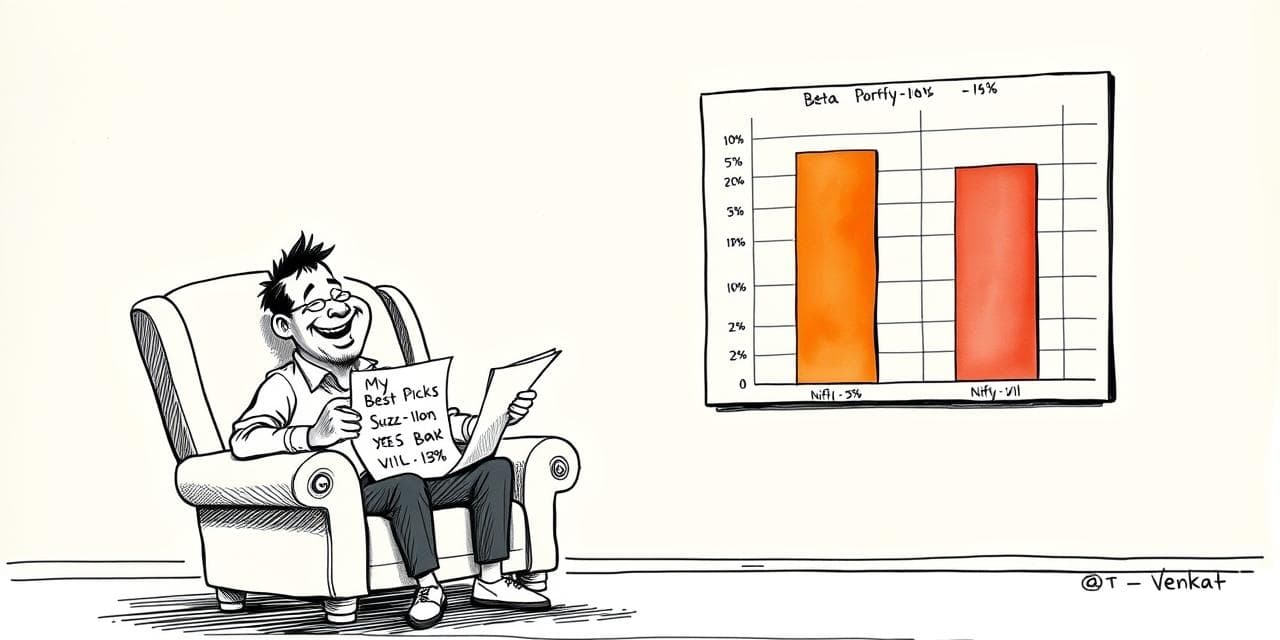

17 of 20. That is the number.
17 of the 20 stocks most owned by Indian retail investors fell 10-15% since the Iran war escalated on February 28, while Nifty fell 5%. The week ending March 13, 2026 was the worst for the index in four years. Your portfolio probably had a much worse week.
This is not a bad-luck story. This is a structure story. Indian retail investors have spent the last three years systematically accumulating exactly the stocks that crash hardest during macro shocks. And the macro shock has arrived.
Why Does the Index Fall 5% But Your Stocks Fall 12%?
The Nifty 50 is a weighted average of 50 large-cap companies. At the top: HDFC Bank (13% weight), Reliance (9%), Infosys (6%), ICICI Bank (5%). These companies have thick institutional ownership, stable earnings, and foreign investor floors. When FPIs sell Indian equities, they sell everything, but other institutions are buying the large-caps back. Impact on the index is muted.
Your portfolio is not the Nifty.
The typical retail investor portfolio overweights small and mid-cap stocks, concentrates in sectoral themes (renewable energy, PSU banking, telecom), and holds stocks with beta north of 2. Beta is the number that explains the gap between your loss and Nifty's loss.
A stock with beta 2 moves twice as much as the index. Nifty falls 3% in a session: that stock falls 6%. Nifty falls 5% in a week: that stock falls 10-12%. Most retail investors hold 8-12 stocks, all of which happen to have beta above 1.5, because those are the stocks that generated excitement in the 2023-24 bull run.
When the index falls 5%, a portfolio with average beta of 2 falls 10%. That is not bad luck. That is arithmetic.
Which Retail Favourite Stocks Got Crushed This Week?
Suzlon Energy, the stock held by the most retail investors in India, fell to a 52-week low of ₹38.19 during morning trade on March 9. YES Bank, held by over 60 lakh retail investors, fell 6.84% in a single day to ₹19.31 from ₹20.73. Vodafone Idea dropped sharply across multiple sessions. Tata Motors, another retail favourite, declined through the week alongside most auto names.
Three sectors got hit hardest:
PSU and OMC names: The oil price shock created two-sided pain for OMCs. As we covered in detail in why BPCL and HPCL fall when crude rises, Indian downstream oil companies lose margin when crude spikes because retail fuel prices are government-controlled. Retail investors, not knowing this mechanism, buy these stocks as an "oil play" and lose money both ways.
Telecom and turnaround stories: Vodafone Idea and YES Bank are the canonical retail concentration plays. Both have the highest number of retail shareholders relative to institutional holders. When panic sets in, there is no institutional floor. Crores of retail investors try to exit at once with nobody on the other side.
Small-cap renewable energy: Suzlon and peers rode a 2023-24 theme of India's green energy buildout. The theme was real. But the valuations got stretched well past fundamentals. Stocks in this category carry beta above 2.5 and no earnings buffer to absorb a macro shock.
None of this is the fault of Iran or crude oil. These stocks were already overvalued relative to their earnings. The geopolitical shock just accelerated a correction that was coming regardless.
Why Do Retail Investors Always End Up in the Wrong Stocks?
Familiarity bias is the answer, and it works in a very specific way for Indian retail investors.
You buy Suzlon because you read about India's solar capacity targets. You buy YES Bank because a friend made 3x on it in 2021 and you want the next leg. You buy VIL because you assume Ambani and Birla won't let it fail. These are narratives, not balance sheets. Narratives feel real when stocks rise. Falling prices expose what earnings were never there to support.
The FOMO cycle works like this: a stock rises 80% over 18 months, driven by retail buying. You see the rise late, enter near the peak, and now hold a concentrated position in a stock that has already done its work. The stock was cheap at ₹8. You bought at ₹48. You are holding the narrative, not the value.
Meanwhile, institutional investors hold HDFC Bank because of consistent return on equity, Infosys because of dollar earnings hedging the rupee, and Asian Paints because of domestic moat and pricing power. None of these companies are exciting. All of them fell this week. But they fell 3-5%, not 12-15%.
Retail versus institutional crash performance is not about information. It is about the kind of stocks each group concentrates in.
Does Your Portfolio Have a Beta Problem?
Most retail investors have never calculated their portfolio beta. They think in terms of "I like this stock" and "I believe in this sector." Beta is the number that converts those beliefs into a crash forecast.
Here is a rough test. Look at your three largest holdings. For each one, ask:
What percentage of the shareholders are retail investors (not institutions, not promoters)? If the answer is above 60% for any of your top holdings, that stock has no institutional floor during a selloff.
How did this stock perform in the last market correction (October-November 2024, for example)? If it fell 20% when Nifty fell 8%, that is a beta of roughly 2.5. Apply that to the current 5% Nifty drop and you get a 12-13% decline. Which is probably close to what you actually saw.
SIP overlap compounds this. Many retail investors hold both direct stocks and mutual funds, thinking the funds provide diversification. But if your funds are small-cap or sectoral funds concentrated in the same names your direct portfolio holds, you have the same concentration problem with extra steps.
How Institutional Money Protected Itself While Yours Did Not
FPIs sold ₹45,329 crore worth of Indian equities in the first 8 sessions of March, the worst monthly outflow since January 2025. Domestic institutional investors, primarily mutual funds, absorbed a significant portion of this selling.
Domestic institutions absorbed HDFC Bank, Reliance, Infosys, ITC. Nobody absorbed YES Bank, Suzlon, VIL.
This structural difference is why the "market fell" headline does not match your portfolio experience. The Nifty number is an average. The distribution underneath it is deeply unequal. Large-caps with institutional support fell and recovered faster. Mid and small-caps with majority retail ownership fell harder and are still falling.
The rupee hitting a record low of ₹92.37 created an additional wedge. Dollar-earning companies (IT sector) benefited marginally. Domestic businesses with no forex income (Suzlon, YES Bank) got no offset. Your retail-heavy portfolio almost certainly had no rupee hedge built into it.
What Should You Actually Do Right Now?
Not: sell everything. Not: average down aggressively. Not: switch to gold and come back later.
The immediate question is whether your current portfolio holdings have a case for recovery based on earnings, or whether you are holding narrative stocks with no fundamental support below current prices.
If you have been averaging down on these positions, stop. Averaging down on a fundamentally weak stock in a macro selloff is not value investing. It is loss compounding. The stock is not cheap because it fell 15%. It may have been expensive at the price where you first bought it.
The structural fix is portfolio composition, not market timing. After this crash settles, your goal should be to understand your actual portfolio beta, know your retail ownership concentration in each holding, and deliberately add some large-cap positions with institutional ownership as a counterbalance.
PortoAI's sector concentration analysis runs this calculation directly from your Zerodha or Groww portfolio. It shows you your effective beta, your retail ownership exposure by stock, and which of your holdings have no institutional floor when the next macro shock hits. That information changes what you buy next, not what you sell today.
The question to answer before the next market opens: is my portfolio positioned for the next crash, or still positioned for the last bull run?
Connect your Zerodha or Groww portfolio to see your real beta, sector concentration, and which holdings have no institutional floor when markets fall.
Try PortoAI FreeFrequently Asked Questions
Why does my portfolio fall more than Nifty during a crash?
Most retail portfolios are concentrated in high-beta stocks: Suzlon, YES Bank, Vodafone Idea, Tata Motors. These stocks move 2-3x the Nifty's daily move. When Nifty falls 5%, these stocks fall 10-15%. It is not bad luck. It is the mathematical consequence of holding stocks with a portfolio beta above 1.5.
What is portfolio beta and why does it matter?
Beta measures how much your portfolio moves relative to the Nifty. A beta of 1 means your portfolio moves in line with Nifty. A beta of 2 means a 5% Nifty fall becomes a 10% portfolio fall. Most retail investors hold portfolios with beta between 1.5 and 2.5 without realising it, because they concentrate in high-beta favourites like Suzlon and VIL.
Which stocks have the highest retail investor concentration in India?
The stocks with the most retail shareholders include Vodafone Idea, YES Bank, Suzlon Energy, Tata Motors, IRFC, NTPC, and Reliance Power. These are the same stocks that fall 2-3x the Nifty during market crashes, because when crores of retail investors all try to sell at once, there is not enough institutional buying to absorb the pressure.
Should I sell my Suzlon or YES Bank shares during this crash?
That depends entirely on your specific cost price, holding period, and tax situation, not on a general recommendation. What matters is understanding why these stocks fell harder than Nifty and whether the reason is temporary or structural. Selling in panic often locks in the maximum loss. But holding because of attachment to a story is equally dangerous. Know your beta before you decide.
How is the Iran war affecting Indian retail investors differently from institutional investors?
FIIs and DIIs hold portfolios tilted toward large-cap, high-liquidity names like HDFC Bank, Reliance, and Infosys. These stocks fell, but with institutional support on the other side. Retail investor favourites have no such floor. 60+ lakh retail shareholders in stocks like YES Bank all panic at the same time, with no large fund on the other side buying. That asymmetry is why retail portfolios crash harder.
Can PortoAI help me understand my portfolio's concentration risk?
Yes. PortoAI's behavioral fingerprint analysis shows your actual exposure by stock, sector, and market-cap band. It calculates your portfolio's effective beta versus Nifty 50 and flags when concentration in retail-heavy stocks creates amplified downside risk. The data is pulled directly from your Zerodha or Groww account via read-only API, without sharing your password.