
You own HDFC Bank. Of course you do.
It is the largest private bank in India. It sits at the top of the Nifty 50 with the highest weightage of any stock. Every mutual fund holds it. Every index ETF owns it. Your financial advisor told you it was a "quality compounder." You bought it, forgot about it, and slept well.
On March 18, 2026, the chairman of that bank resigned. His reason: "Certain happenings and practices within the bank, that I have observed over last two years, are not in congruence with my personal values and ethics."
Two days later, three senior executives were fired for mis-selling Credit Suisse AT1 bonds to NRI clients. They marketed perpetual, high-risk instruments as safe fixed-maturity deposits with assured returns.
The stock fell 8.5% in a single session. Hit a 52-week low of ₹770. ₹61,000 crore in market value disappeared. BlackRock publicly criticised the bank. And you, the retail investor who bought it because "HDFC Bank is safe," are now staring at a 20% drawdown in 2026.
Let's talk about what actually went wrong. Not at the bank. At your portfolio.
What exactly happened at HDFC Bank?
The sequence matters.
March 17: Atanu Chakraborty, part-time chairman and independent director, writes his resignation letter. He had been with the bank since 2021 and oversaw the mega-merger of HDFC Ltd. with HDFC Bank in July 2023. His term had been extended until May 2027.
March 18: The bank receives and accepts his resignation. Keki Mistry is appointed interim chairman with RBI approval, effective March 19.
March 19: Markets open. HDFC Bank crashes 8.5% to ₹770, a 52-week low. It is the worst-performing Nifty stock that day. Because HDFC Bank carries roughly 12-13% weight in the Nifty 50, the index drops over 200 points from this single stock alone.
March 20: The bank confirms that three senior executives have been terminated following an internal investigation. The issue: mis-selling of Credit Suisse Additional Tier-1 bonds to NRI customers through the Dubai and Bahrain branches. Staff convinced NRIs to shift FCNR deposits from India to Bahrain, then sold them AT1 bonds as "fixed-maturity products with assured returns." AT1 bonds are perpetual. They carry significantly higher risk than deposits. This was a fundamental misrepresentation.
March 21: Bloomberg reported that BlackRock's portfolio manager openly criticised HDFC Bank's governance at an investor call. The bank's ADRs fell 8% in US trading.
The RBI stepped in to say HDFC Bank has "sound financials" and is run by a "professional board and competent management." The market did not care. By the end of the week, the stock had lost ₹61,000 crore in market capitalisation.
Why did 35 out of 38 analysts still say "Buy"?
Here is the number that should make you uncomfortable: even after the chairman resigned over ethics, even after executives were fired for mis-selling, 35 out of 38 analysts maintained a "Buy" or "Strong Buy" rating on HDFC Bank.
Their logic: the fundamentals are intact. MSME credit growth is 17.2%. Asset quality is stable. Valuations are now "attractive" after the fall.
They are not wrong about the numbers. They are wrong about what they are ignoring.
Governance risk does not show up in a P/E ratio. A chairman resigning over "ethical concerns" does not change the quarterly earnings. But it changes what the earnings mean. When the person whose job is to ensure the board acts ethically decides the board is not acting ethically, the numbers you are reading may not be the numbers that matter.
This is the blind spot. Screens and spreadsheets show you price, earnings, growth. They do not show you whether the people running the company are doing what they say they are doing. You cannot backtest governance.
Is your portfolio overexposed to HDFC Bank right now?
Most Indian retail investors have no idea how much HDFC Bank they actually own.
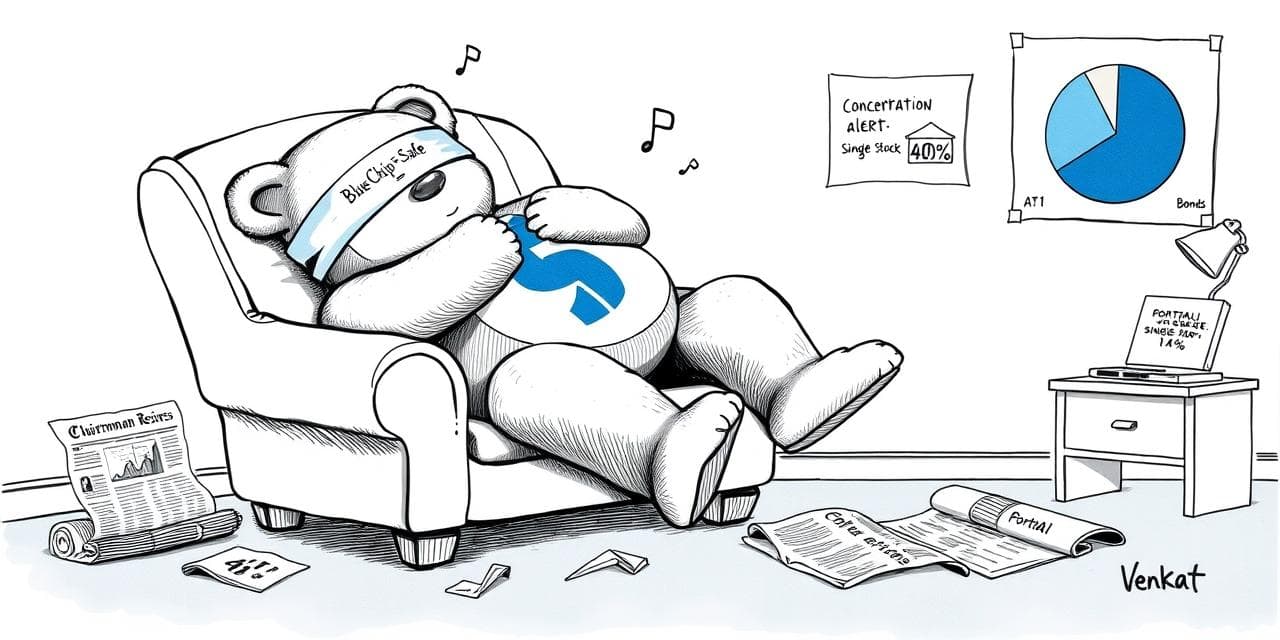
Think about it. You hold HDFC Bank directly. Your large-cap mutual fund holds it. Your Nifty 50 index fund holds it at 12-13% weight. Your flexi-cap fund probably holds it. Your banking sector fund definitely holds it.
Add it up. If HDFC Bank is 5% of your direct equity, 10% of your mutual fund portfolio through three different schemes, and 13% of your index allocation, your real exposure to this one stock could be north of 10% of your total equity portfolio.
When that one stock drops 20% in a quarter, your portfolio doesn't just feel the hit from your direct holding. It takes it from every direction.
This is what PortoAI's sector concentration analysis is built to detect. It reads your Zerodha and Groww holdings, maps mutual fund overlap, and flags when a single stock or sector quietly becomes a dominant position. The alert fires before the crisis, not after the chairman's resignation letter.
You thought you were diversified. Your data says you were concentrated.
What is blue-chip bias and why does it cost you money?
Blue-chip bias is the belief that large, well-known companies are inherently safe. You do not analyse them the same way you would analyse a mid-cap or small-cap stock. You skip the governance checks. You ignore the concentration. You treat the brand name as a substitute for due diligence.
HDFC Bank is the textbook example. India's largest private bank. Decades of compounding returns. Part of every model portfolio recommendation you have ever read. The stock every financial advisor calls "core holding." The company that merged with HDFC Ltd. in the largest banking merger in Indian history.
None of that prevented a chairman from resigning over ethics. None of that prevented executives from selling toxic bonds to retail customers as safe deposits.
Blue-chip bias works exactly like confirmation bias in stock research: you filter for information that confirms what you already believe and dismiss signals that challenge it. When the quarterly results are good, you say "told you so." When the chairman resigns, you say "temporary noise" and add more.
The SEBI study from September 2024 found that 93% of individual traders in the F&O segment incurred losses between FY22 and FY24. But even in equity delivery, the biases are the same. You hold losers too long because the brand name makes you believe the drawdown is temporary. You add more on every dip because "HDFC Bank at ₹770 is a steal." You do not examine whether the reason for the dip is a temporary market panic or a structural governance failure.
Should you sell, hold, or buy more right now?
This is the wrong question. The right question is: why did you buy it?
If your thesis was "HDFC Bank is India's largest private bank, it is safe, I will hold it forever," then you never had a thesis. You had brand loyalty. And brand loyalty is not a risk management strategy.
If your thesis was "HDFC Bank will grow its loan book at 15-18% CAGR, maintain NIMs above 3.5%, and the HDFC Ltd. merger synergies will play out over 3-5 years," then ask yourself: does the chairman's resignation change any of that? Does the AT1 bond scandal in Dubai affect the domestic retail lending franchise?
That is the analysis. Not "should I sell HDFC Bank" but "do I actually know why I own it?"
PortoAI's behavioral fingerprint tracks your decision patterns across every trade and holding. It can show you whether your HDFC Bank position was a considered allocation or an unconscious default. Whether you added more after every dip because the valuation improved or because the loss hurt and you wanted to average down. The difference between those two reasons is the difference between investing and hoping.
What does the AT1 bond scandal tell you about "safe" institutions?
Here is the part most coverage misses.
HDFC Bank executives in Dubai and Bahrain took NRI deposits, moved them offshore, and then sold those customers Credit Suisse AT1 bonds. They presented perpetual, subordinated debt instruments, the kind that got wiped to zero when Credit Suisse collapsed in 2023, as "fixed-maturity bonds with assured returns."
This happened at India's most trusted private bank. Not at a shady NBFC. Not at a startup fintech. At the bank your parents have their savings account with.
The mis-selling was not a rogue trader going off-script. Three senior executives, including the group head of branch banking, were involved. This was systematic. The internal investigation took months. The chairman saw enough over two years to resign over it.
When the NSE official told retail investors "don't panic, stay invested", he was talking about market-wide volatility. He was not addressing a specific governance crisis at the country's most heavily weighted stock.
The lesson is not "sell all blue chips." The lesson is: blue-chip status does not exempt a company from governance risk, management failure, or ethical lapses. And your portfolio construction should account for that.
How do you actually protect yourself from concentrated blue-chip risk?
Three things. None of them are complicated. All of them require you to look at data you are currently ignoring.
First, map your true exposure. Not just your direct holdings. Your mutual funds. Your index funds. Your ETFs. Count how many times HDFC Bank (or any single stock) appears across all of them. If the answer is more than 3, and the combined weight is above 8% of your equity portfolio, you have a concentration problem you did not choose.
PortoAI does this automatically. It connects to your Zerodha and Groww accounts, maps the overlap, and gives you a single number: your true exposure to each stock, sector, and market cap segment. You might discover that the diversification you thought you had exists on paper but not in practice.
Second, separate brand from analysis. Before you add more of any stock, write down your thesis in two sentences. If those two sentences include the words "safe," "blue chip," "quality compounder," or "everyone holds it," you do not have a thesis. You have a consensus opinion. Consensus opinions are priced in. They do not protect you from the events that consensus did not anticipate.
Third, set concentration limits and automate them. Decide in advance that no single stock will exceed X% of your equity portfolio. When it crosses that threshold, rebalance. Do not wait for a governance crisis to force the rebalance at a loss.
PortoAI's overtrading detection and portfolio alerts flag when your behavior diverges from your own rules. If you set a 7% concentration limit and your HDFC Bank position drifts to 12% because you kept buying every dip, the system surfaces that drift. Not as advice. As a mirror.
The real question nobody is asking
Thirty-five analysts say "Buy." RBI says "financially sound." Valuations look "attractive" after a 20% fall.
All of that may be correct. HDFC Bank may recover. The governance crisis may resolve. The stock may compound from here.
But you need to answer one question first: if you did not know the name of this bank, if the ticker was just a random four-letter code, would you still buy a stock where the chairman resigned over ethics, executives were fired for fraud, and the ADR dropped 8% in a single session?
If yes, buy more. Your thesis is about the business, not the brand.
If you hesitated, you know what you need to fix. Not the stock. Your process.
See your true HDFC Bank exposure across all accounts. Connect Zerodha or Groww to PortoAI, free.
Try PortoAI FreeFrequently Asked Questions
Why did HDFC Bank stock crash in March 2026?
HDFC Bank's part-time chairman Atanu Chakraborty resigned on March 18, 2026, citing ethical concerns about practices within the bank. Two days later, three senior executives were fired for mis-selling Credit Suisse AT1 bonds to NRI clients through the Dubai branch, marketing perpetual high-risk instruments as safe fixed-maturity deposits. The stock fell over 8.5% to a 52-week low of ₹770, wiping ₹61,000 crore in market capitalisation.
Should I sell HDFC Bank stock after the chairman resignation?
That depends on why you bought it. If you bought because "HDFC Bank is a safe stock" without evaluating governance, management quality, or concentration risk, you are making a brand-loyalty decision, not an investment decision. If you did your analysis and the thesis still holds at current valuations, the crash may be a buying opportunity. The point is: your decision should come from your own research, not from the brand name on the stock.
What is blue-chip bias in investing?
Blue-chip bias is the tendency to treat large-cap, well-known stocks as inherently safe because of their brand recognition, index weight, or historical returns. Investors assume that companies in the Nifty 50 or Sensex cannot have governance problems, management failures, or sharp drawdowns. HDFC Bank's 20% fall in 2026 disproves this assumption directly.
How much of Nifty 50 is HDFC Bank?
HDFC Bank carries the highest weightage in both the Nifty 50 and the BSE Sensex. As of March 2026, it accounts for roughly 12-13% of the Nifty 50 index. This means every index fund investor and Nifty ETF holder has maximum exposure to this single stock, whether they chose it or not. When HDFC Bank fell 8.5% in a single day, it dragged the Nifty down by over 200 points on its own.
What were HDFC Bank executives fired for in March 2026?
Three senior HDFC Bank executives, including the group head of branch banking and two vice presidents, were terminated after an internal investigation found they had mis-sold Credit Suisse AT1 bonds to NRI clients through the Dubai and Bahrain branches. Staff marketed perpetual, high-risk instruments as fixed-maturity bonds with assured returns, a fundamental misrepresentation of the product's risk profile.
Does PortoAI track concentration risk in blue-chip stocks?
Yes. PortoAI's sector concentration analysis flags when your portfolio is overweight in a single stock, sector, or market-cap segment. If HDFC Bank made up 15% of your portfolio through direct holdings plus index fund exposure, PortoAI would flag that concentration before a governance crisis turned it into a problem.