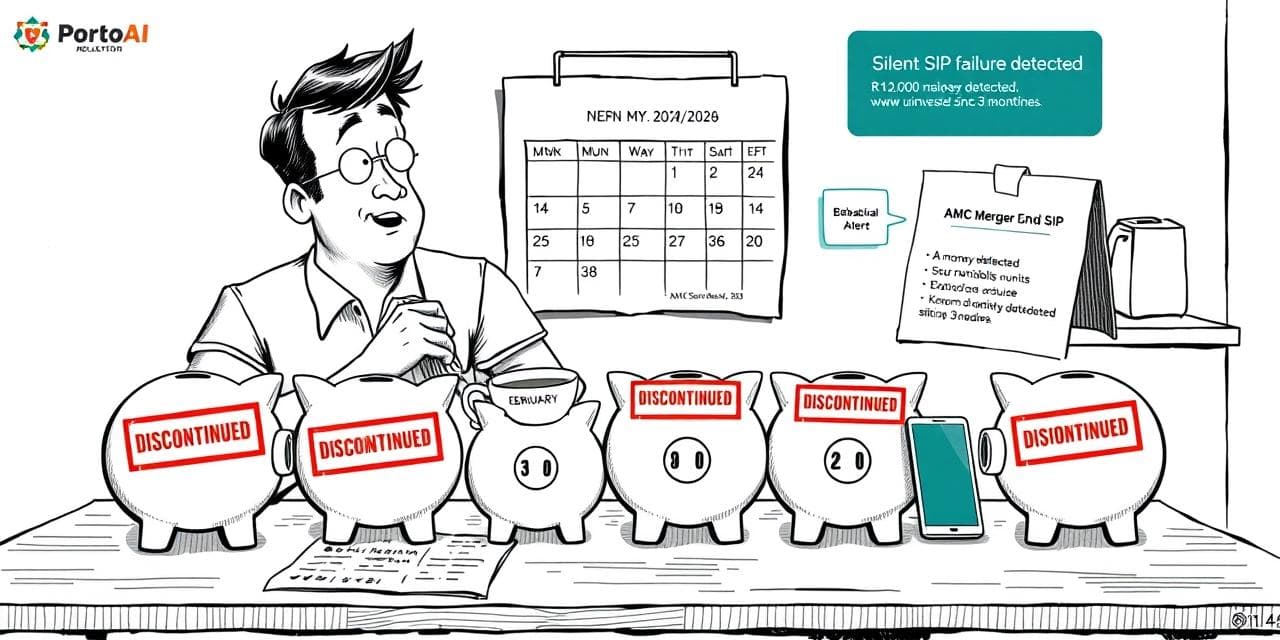

On February 26, 2026, SEBI published Circular No. HO/24/13/15(2)2026-IMD-RAC4/I/5764/2026 and eliminated an entire category of mutual funds.
No press conference. No market holiday. No trending tweet from a finance influencer.
44 schemes, covering millions of SIP investors, stopped accepting fresh money the same day the circular was published. Your children's fund. Your retirement corpus SIP. The scheme your bank auto-debits every month. The circular did not ask you first.
This is the biggest structural change to Indian mutual funds since SEBI's 2018 recategorization forced over 400 fund mergers. Most investors did not notice in 2018 either.
What SEBI Actually Changed This Time
The 2018 framework created 36 categories across five buckets. It worked for a while. Then fund houses found workarounds: launching sectoral funds under thematic labels, running Value Funds with barely 67% equity so they could also run arbitrage strategies, naming schemes after outcomes ("wealth creator", "growth optimizer") rather than mandates.
The February 2026 circular closes every gap.
Five buckets remain: Equity, Debt, Hybrid, Life Cycle, and Other Schemes. Within them, the rules have changed sharply.
Equity funds now require higher minimum allocations. Dividend Yield, Value, Contra, and Focused Funds must hold minimum 80% in equity, up from 65%. Fund managers running these categories at 66-70% equity now have until August 2026 to restructure or merge.
Sectoral and Thematic Funds are now distinct categories. Under the old framework, they shared one bucket. AMCs routinely exploited the ambiguity to launch thematic funds with loosely defined themes that functioned as de facto diversified funds but with a "sector" label for marketing. SEBI's new circular separates them cleanly.
Portfolio overlap is now a compliance number, not a suggestion. Sectoral and Thematic funds within the same AMC cannot share more than 50% portfolio overlap, calculated daily and averaged quarterly. Schemes that cannot stay below 50% after a three-year transition window must mandatorily merge. This will force more consolidations over the next three years.
Fund names cannot promise outcomes. Terms like "high return," "wealth creator," and "growth optimizer" are now banned from scheme names and marketing materials. A fund's name must reflect its regulatory category, nothing more.
The 44 Schemes That No Longer Exist
The most immediate impact: the complete elimination of Solution-Oriented Schemes.
SEBI removed the category entirely. No new children's funds. No new retirement funds. Not a reclassification to another name. Discontinued.
As of February 26, 2026: 29 retirement funds and 15 children's funds across every major AMC in India stopped accepting fresh subscriptions. SBI Magnum Children's Benefit Fund is among the named schemes confirmed to be in the affected pool.
SEBI's replacement is a new category called Life Cycle Funds, which use a glide-path model: aggressive equity when you are young, shifting automatically to debt-heavy allocation as you approach a target age or date. SEBI modeled this on the target-date fund structure common in US retirement accounts.
AMCs have until August 2026 to formally merge the 44 discontinued schemes into new Life Cycle Funds or other appropriate receiving schemes. The mergers require SEBI approval and individual notifications to unitholders before execution.
Is Your SIP Still Getting Invested?
This is the question most investors have not thought to ask.
Here is the problem: your bank does not know your fund has been discontinued. Your SIP mandate is a standing instruction to debit your account on the 5th, 10th, or 15th of every month and transfer the amount to your fund house. That instruction still runs.
What happens after February 26 depends on how your fund house has handled the transition:
Scenario A: The AMC has paused your SIP at their end, meaning the deduction happens but the installment is returned to your bank account within a few days. You do not see this unless you check your bank statement carefully for a credit that matches your SIP amount.
Scenario B: The AMC is processing installments into a temporary holding arrangement pending the merger, and your money sits uninvested earning nothing while the merger gets SEBI approval.
Scenario C: Your AMC sent you an email about this in early March. You opened it on your phone, saw "mutual fund communication" in the subject line, and archived it without reading.
Scenario C is the most common one.
Why Most Investors Will Do Nothing (and the Cost of That)
Status quo bias is the most documented inertia pattern in Indian retail investing. According to NSE's 2023 investor behavior analysis, over 68% of investors who received fund-change notifications from AMCs in 2018 took no action for at least 90 days after receiving them. Many never acted at all, staying in the renamed or restructured fund by default, regardless of whether the new mandate matched their goals.
Behavioral logic here is straightforward: doing nothing feels neutral. Changing something feels like a decision with consequences. Investors fear making the wrong decision more than they fear the cost of making no decision. So they wait. And while they wait, either money sits uninvested or it flows into a fund with a different mandate than what they originally intended.
For a children's education fund investor, the stakes are higher than a normal portfolio mistake. The original fund was chosen with a specific goal attached: money for a child's college education in 12-15 years. If the receiving scheme after the merger turns out to be a flexi-cap fund or a multi-cap fund with a different risk profile, the investor may not realize their goal-based allocation has been reassigned to a general equity pool.
That "children's fund" label created a psychological lock. Removing it breaks the lock, but investors treat the resulting confusion as a reason to wait, not a reason to act.
What the New Fund Mandates Mean for Your Portfolio
For investors outside the 44 discontinued schemes, the 2026 reclassification still changes something important: the funds you hold may now invest differently than they did six months ago.
A Value Fund that held 67% equity and 33% arbitrage positions was behaving more like a hybrid fund. Under the new 80% minimum equity rule, the same fund now holds 80-100% equity. Volatility profile: different. Correlation to Nifty: higher. Drawdown in a correction like January-February 2026: larger.
Your SIP amount is the same. Your risk level is not.
The fund's monthly factsheet, published by every AMC by the 10th of each month, shows the actual portfolio allocation. Compare the equity percentage in the December 2025 factsheet to the February 2026 factsheet for any Value, Contra, Dividend Yield, or Focused Fund you hold. If the equity percentage jumped by 10-15 percentage points in that window, the fund restructured to meet the new 80% threshold.
A fund that used to behave defensively now behaves aggressively. If you held it expecting limited downside, that expectation is no longer valid.
Not necessarily. Funds that previously used cash, arbitrage, and debt tactically during market corrections could reduce drawdowns. Removing that flexibility forces them to stay fully invested in equity even when valuations are stretched. This improves category purity from a classification standpoint. It does not automatically improve returns.
The 2018 recategorization showed this clearly: funds that shifted to meet new mandates underperformed in the year of the transition as they unwound positions and rebuilt portfolios. Expect a similar short-term disruption in 2026 for affected categories.
What Should You Do Before August 2026?
You have five months before AMCs must complete all mergers. That is enough time to act without panic. It is not enough time to forget.
First: identify your exposure. Log into Groww, Zerodha, or your AMC portals and list every fund where you have an active SIP. Note the category for each. If any is a Children's Fund or Retirement Fund, you are in the 44.
Second: verify the last two installments. For affected funds, check whether the unit count in your portfolio increased after your last two SIP dates. If not, the installment did not invest.
Third: wait for your AMC's merger communication. Do not preemptively redeem unless you need the money. Forced mergers are tax-neutral (they are not treated as redemptions for capital gains purposes). A premature redemption to "reinvest properly" triggers actual capital gains tax, defeating the purpose.
Fourth: evaluate the receiving scheme. When your AMC announces the merger details, the communication will name the receiving scheme. Read it. Check whether the new fund's category and risk profile still match the goal you originally assigned to that SIP.
Fifth: cancel the old SIP mandate and create a new one. Once the merger is complete, the old SIP mandate will not automatically transfer. You need to set up a fresh SIP in the receiving scheme if you want systematic investing to continue.
Check if your SIP portfolio has funds affected by SEBI's 2026 reclassification
Try PortoAI FreeWhat PortoAI Sees in Affected Portfolios
Investors running SIPs across multiple platforms have an additional blind spot: they cannot see their total mutual fund exposure in one place. A children's fund in Zerodha, a retirement fund in Groww, and a flexi-cap in the AMC's direct plan app sit in three different dashboards with no unified view.
PortoAI's portfolio analysis aggregates holdings across Zerodha and Groww to give you a single exposure view. The behavioral fingerprint engine tracks whether your actual asset allocation matches your stated goals. If a children's fund SIP stops investing and the money starts accumulating in your savings account instead, that shows up as a deviation from your target allocation, even if you do not manually notice it.
The behavioral alert is the specific feature that catches silent SIP failures. When systematic investment patterns break, the engine flags the gap. Most investors discover a stopped SIP three months later when they happen to check their portfolio and wonder why it did not grow.
That three-month lag costs compounding. The March 2026 SEBI reclassification is exactly the kind of external disruption that creates these invisible gaps.
The Bigger Pattern: SEBI Is Forcing Honesty on the Industry
The 2026 circular is not an arbitrary bureaucratic reshuffle. It is a response to documented behavioral failure at the product design level.
Solution-Oriented Schemes had a specific problem: the lock-in periods and "goal-based" labels were used in marketing to create emotional attachment to the product, but the underlying portfolios were often identical to standard equity or hybrid funds with higher expense ratios. Investors paid more for a label that added no unique investment strategy.
The new Life Cycle Funds, with their automatic glide-path rebalancing, are at least structurally differentiated from general equity funds. Whether they perform better or worse is an empirical question that will take years to answer. But they are genuinely different products, not just rebranded general funds.
For investors, the lesson from both the 2018 and 2026 recategorizations is the same: the fund name and the marketing label are not the product. The actual portfolio holdings, the mandate constraints, the benchmark, and the expense ratio are the product. SEBI can change the label. It cannot change the underlying behavioral mistake of buying a fund based on what it is called rather than what it actually holds.
If you want to understand what you actually own after the 2026 reclassification, start with the portfolio overlap analysis in PortoAI. It pulls your actual fund holdings from your Zerodha and Groww accounts and shows you the real stock-level exposure behind every SIP, regardless of what the fund is called.
The label SEBI gave it does not matter. What it holds does.
Internal reading:
- Understanding your actual SIP concentration
- How PortoAI tracks behavioral patterns across your full portfolio
- What to do after a major portfolio disruption
Frequently Asked Questions
Which mutual fund categories did SEBI eliminate in 2026?
SEBI's February 26, 2026 circular eliminated the Solution-Oriented Schemes category entirely. This includes all Children's Funds and all Retirement Funds. As of that date, AMCs can no longer accept fresh subscriptions in these categories. 44 schemes are affected: 29 retirement funds and 15 children's funds. Existing unitholders are not immediately impacted but will receive units in a receiving scheme after SEBI approves each individual merger.
Will my SIP stop if my mutual fund is discontinued by SEBI?
Fresh installments in solution-oriented schemes (children's funds and retirement funds) have already stopped as of February 26, 2026. If your SIP mandate is linked to one of these funds, the bank deduction may still happen but the fund house will reject or return the installment, or pause it pending the official merger. Check your AMC's investor communication immediately. Existing units remain invested until the formal merger takes place, which AMCs must complete by August 2026.
What happens to my money if a mutual fund scheme is merged?
When a fund is merged, your units in the old scheme are converted to units in the receiving scheme at NAV on the merger date. The conversion is tax-neutral: SEBI's historical treatment of scheme mergers means they are not treated as a redemption for capital gains tax purposes. Your cost of acquisition carries forward. However, verify that the receiving scheme's category and mandate match your original investment goals, since a children's fund merged into a flexi-cap changes your effective exposure.
Is ELSS still available after SEBI's 2026 reclassification?
Yes. ELSS continues under the 2026 framework but has been renamed to ELSS-Tax Saver Fund, with the minimum equity allocation raised from 65% to 80%. The tax exemption under Section 80C remains intact. If you have an existing ELSS SIP, it continues uninterrupted. The fund's portfolio will internally shift to meet the 80% equity mandate but you do not need to take any action.
What is the new Life Cycle Fund category SEBI introduced?
Life Cycle Funds are SEBI's replacement for Solution-Oriented Schemes. They use a glide-path approach: aggressive equity allocation when you are young, automatically shifting to a conservative debt-heavy allocation as you approach a target date or age. Exit loads are 3%, 2%, and 1% to discourage premature exits. They are structurally similar to target-date funds used in US 401(k) retirement plans.
How do I check if my mutual fund is affected by SEBI's 2026 reclassification?
Check your fund's category on the AMC website or your broker app. If it is listed as a Children's Fund or Retirement Fund, it is directly affected and fresh subscriptions have stopped. For other categories, check whether the fund name or mandate has changed, particularly Dividend Yield, Value, Contra, and Focused funds, which now require 80% equity allocation. AMCs are required to send unitholders formal communication before any merger.
Can the same AMC now offer both a Value Fund and a Contra Fund?
Yes. The 2026 circular specifically permits AMCs to run both a Value Fund and a Contra Fund simultaneously, which was not allowed under the 2018 framework. The condition: portfolio overlap between the two must stay below 50%, calculated as a quarterly average of daily overlap. Previously, AMCs had to choose one or the other.