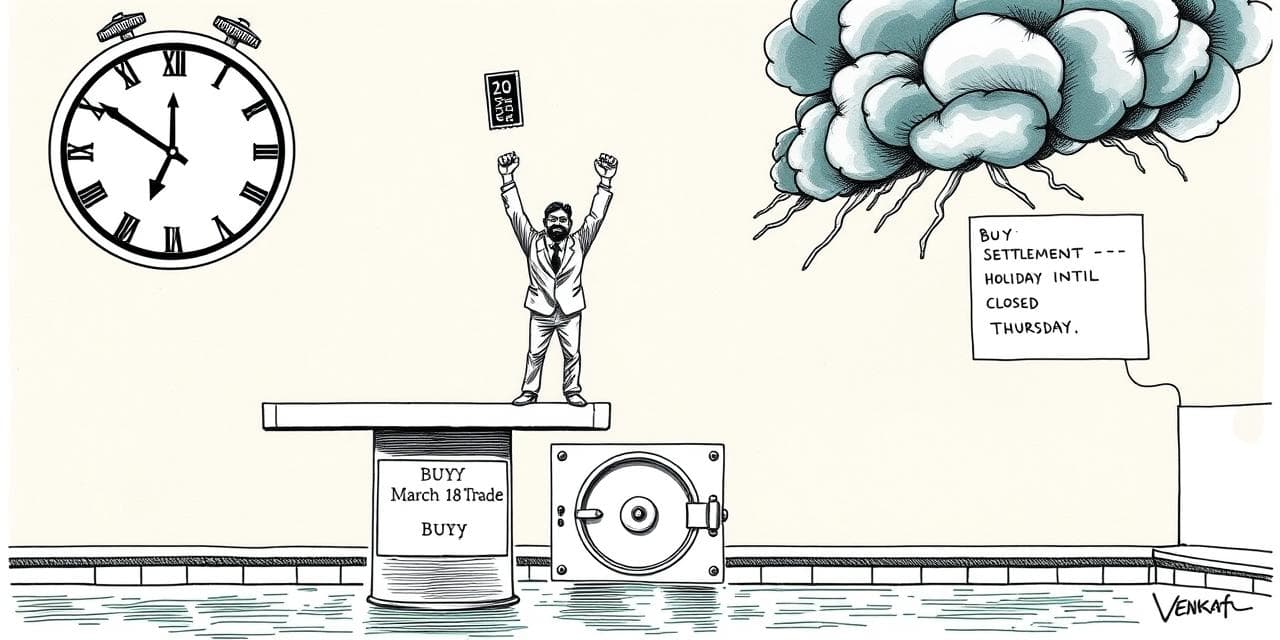

The Nifty has gained 1,500 points in two sessions. 938 points on Monday. 567 points on Tuesday.
Your broker app looks green. Your Telegram groups are calling a bottom. Your colleague who went all-in on Monday already messaged you his P&L screenshot.
You bought today. Or you are about to.
Here is what you probably do not know. At 11:30 PM tonight, the US Federal Reserve will release its March interest rate decision and the quarterly dot plot. Tomorrow, March 19, is a settlement holiday on account of Gudhi Padwa. Stocks you purchase today cannot be sold tomorrow.
You are stepping into the most compressed behavioral trap of the year with both feet.
What Actually Moves Indian Markets on Fed Day
Most Indian retail investors watch for two words: "hold" or "cut." Fed holds rates, market is calm. Fed cuts, market rallies. Fed hikes, market sells off.
That is the wrong frame entirely.
The actual rate decision for March 2026 is fully priced in. CME FedWatch shows a 92%+ probability of a hold at 3.50-3.75%. Markets have known this for weeks. The hold itself will move nothing.
What will move markets is the dot plot.
The dot plot is the Fed's Summary of Economic Projections, released every quarter. Each of the 19 FOMC members anonymously plots where they expect the federal funds rate to be at year-end. When more dots cluster toward "no cut" or "one cut" instead of "two cuts," the market reads it as the Fed staying tighter for longer. Dollar strengthens. US treasury yields rise. Capital flows away from emerging markets.
In December 2025, the dot plot showed two rate cuts projected for 2026. Analysts now expect tonight's dot plot to show just one, or even zero, because oil is at $104 per barrel and the Iran conflict shows no sign of de-escalating. Brent crude reached $116/bbl for the April 2026 contract last week. A 10% increase in crude prices adds 30 basis points to US inflation. The Fed cannot cut rates into rising inflation.
If the dot plot comes in at one cut or fewer, every emerging market will reprice. India included.
Why Tonight Is Different From Every Other Fed Night
The FOMC announces at 2:00 PM Eastern Time, which is 11:30 PM IST. Indian markets close at 3:30 PM IST. There is an 8-hour gap between the Indian market close and the Fed announcement.
That 8-hour window is the trap.
You buy today during Indian market hours, confident the market is recovering. The Fed announces at 11:30 PM. Powell's press conference runs until approximately 1:30 AM IST. By the time you wake up on March 19, US futures, SGX Nifty, and the rupee will have already priced in the reaction. Indian markets open March 19 at 9:15 AM and will gap in whatever direction the Fed signalled.
Here is the problem: stocks you purchased on March 18 are not in your demat account on March 19.
Zerodha officially confirmed in a bulletin: March 19, 2026, is a settlement holiday on account of Gudhi Padwa. India's T+1 settlement means purchases made on March 18 credit to your demat on T+1. Since March 19 is a settlement holiday, T+1 shifts to March 20. Your March 18 purchases will not be in your demat until Thursday.
If markets gap down on March 19 and you want to exit, you cannot. You are watching your position bleed with zero ability to act.
Not always. But look at the current context before dismissing the risk.
FIIs sold over ₹52,700 crore from Indian equities in the first half of March 2026 alone. A single session on March 13 saw ₹10,717 crore in FII selling. The selling was already happening before today's rally. DIIs absorbed it (₹12,000 crore of DII buying on March 4 alone), which is why the market bounced. If you missed the earlier analysis of why retail investors following FII exits is itself a behavioral mistake, the logic applies here in reverse: retail investors buying when FIIs are selling also requires a clearer thesis than "it looks green today."
If the dot plot tonight gives FIIs another reason to sell, DIIs may not be able to absorb a second sustained wave at these elevated levels. Nifty is still 12% below its September 2025 peak. Business Standard analysts note the index has not reclaimed its 50-day moving average, which means the technical downtrend remains intact.
You are buying into a market where FIIs are structurally selling, oil is structurally elevated, and the Fed tonight might confirm that dollar strength continues through 2026. The two-day rally is real. The risks underneath it are equally real.
What PortoAI's Behavioral Data Shows About Post-Rally Buy Days
PortoAI's overtrading detection tracks not just frequency of trades but the conditions under which users trade. One consistent pattern: retail investors place their highest-risk trades on days immediately following sharp market recoveries.
The behavioral fingerprint looks like this. Market crashes. Pain. Watching from the sidelines feels even worse than the loss. Then the market bounces 900 points. Relief. "I missed the bottom but I can still catch the recovery." Purchases made on the bounce day are often larger than normal, poorly planned, and entered without a clear exit strategy.
This is the anchoring bias at work. You are anchored to prices from before the crash and the recovery feels like a discount relative to those anchors, not relative to where fundamentals actually are.
PortoAI's portfolio analysis does not stop you from buying on a bounce day. What it does is show you the full picture: what percentage of your portfolio you are concentrating in a single session, whether this trade pattern matches previous impulse buys in your history, and whether your current sector concentration is amplifying your risk (buying bank or energy stocks on a day crude is at $104 is a specific kind of compounded risk).
The investors in PortoAI's user base who consistently outperform are not the ones who avoid all bounce-day trades. They are the ones who size those trades deliberately, set clear exit criteria before entering, and check their behavioral fingerprint for signs of FOMO rather than thesis-driven buying.
No. And this is the nuance that gets lost in every "do not panic buy" article.
Buying during a market correction is a legitimate strategy. Nifty PE at 18.5x is not cheap but it is not dangerous either. HDFC Bank and SBI are trading at deep discount to 3-year averages. If you are a long-term investor with a 3-5 year horizon, buying quality during a fear-driven correction creates wealth.
The mistake is not buying during a correction. The mistake is buying impulsively today, on a day when:
- You cannot exit tomorrow if things go wrong
- The single biggest macro event of the month happens after your market closes
- The underlying catalyst for the correction (oil at $104, Iran conflict, FII outflows) is still fully active
There is a difference between deliberately buying HDFC Bank at ₹1,580 because you have analysed its balance sheet and you understand the 18-month thesis, and buying because you saw the green candle and felt the urgency to act before the recovery gets away from you. PortoAI's behavioral fingerprint distinction is exactly this: thesis-driven versus impulse-driven entry.
What You Should Actually Do Before 9:15 AM Tomorrow
You cannot change trades already placed today. But you can prepare.
Tonight, before sleeping: Set a price alert on Zerodha or Groww for SGX Nifty. When the FOMC announces at 11:30 PM, SGX Nifty (the Singapore-listed futures proxy for Nifty) will react within minutes. If it drops more than 1.5% overnight, you are facing a gap-down tomorrow morning.
March 19 morning, before 9:15 AM: Read exactly two things. The Fed's statement (available at federalreserve.gov by midnight IST). The dot plot table. Count the dots below 3.50% for year-end 2026. If more than 8 members project no cut in 2026, that is materially hawkish. Act accordingly when your positions eventually settle.
March 20, when your purchases settle: Do not make exit decisions in the first 30 minutes of trading. The market on March 20 will be processing two days of accumulated news, the FOMC reaction plus any weekend developments. Wait for the first 30 minutes of price discovery to complete. Then decide with a clear head, not based on the gap-open.
If you have existing positions (bought before March 18), those are in your demat today and you can sell on March 19 if you choose. The settlement trap applies only to fresh purchases made today.
It depends on the dot plot outcome. If the Fed projects two cuts in 2026, that is dollar-negative and India-positive. FIIs who pulled money out in March might partially reverse flows. Nifty could extend the rally.
If the dot plot shows one cut or zero, UBS estimates continued pressure on Indian OMCs (BPCL, HPCL, IOC) as a hawkish Fed keeps the dollar strong, making crude imports more expensive in rupee terms. HPCL faces a 46% PAT cut in FY27 at current oil prices. A hawkish dot plot adds a currency dimension on top of that.
The probability of a hawkish dot plot tonight is not 100%. It is not even a majority consensus. But the asymmetry matters. If the dot plot is dovish, your dip-buy gains 2-3% more over the next week. If it is hawkish and you are locked out of selling tomorrow, you lose 3-5% overnight with no exit.
This is not a reason to avoid equity investing. It is a reason to size today's trades with the overnight risk in mind.
The Behavioral Pattern PortoAI Flags Before Market Opens
PortoAI's trading pattern detection runs before and after sessions. One of the patterns it identifies is called the "rally chase entry": a purchase made in the first two sessions of a recovery, with a trade size more than 1.5x the investor's median position size, with no stop-loss or exit price recorded in their notes.
This pattern appears with higher frequency on days like today. Not because investors are uninformed but because the emotion of watching green candles after two weeks of red creates a specific cognitive state that behavioral finance researchers call the recency override. Your brain re-weights the last two sessions of data (up 1,500 points) more heavily than the preceding 14 sessions (down 3,000 points). The recovery feels more real than the crash.
PortoAI does not stop that trade. But it shows you the pattern in your own history: how many times have you made a similar entry, what happened 7 days later, and whether this position is sizing appropriately given your total portfolio exposure. The reflection happens before you click buy, not three weeks later when you are reviewing a red P&L.
Connect your Zerodha or Groww account to see your own behavioral fingerprint. Knowing your patterns is the first edge in a market that actively exploits them.
Frequently Asked Questions
What is the FOMC and why does it matter for Indian stocks?
The FOMC (Federal Open Market Committee) is the US Federal Reserve's policy-setting body. It meets 8 times a year to decide the federal funds rate. When the Fed holds or cuts rates, it affects global capital flows. A dovish Fed keeps dollar liquidity loose and encourages foreign investors to seek higher returns in emerging markets like India. A hawkish Fed (signalling fewer cuts) strengthens the dollar and pulls capital away from India toward US treasuries, causing FII outflows from Indian equities.
What is the dot plot and why does it matter more than the rate decision?
The dot plot is the FOMC's Summary of Economic Projections, released quarterly. Each committee member plots where they expect the federal funds rate to be at year-end. Markets often react more sharply to the dot plot than to the actual rate decision because the decision is priced in weeks in advance. A dot plot showing fewer cuts than expected signals the Fed sees inflation staying elevated, which is bearish for Indian stocks.
Why can't I sell stocks bought on March 18 on March 19?
India operates on T+1 settlement. When you buy on March 18, shares credit to your demat on T+1, the next settlement day. March 19 is a settlement holiday for Gudhi Padwa. Since settlement operations are suspended, T+1 shifts to March 20. Your shares are not in your demat on March 19, making them unsellable. Zerodha confirmed this officially in a bulletin ahead of the holiday.
What happens to Indian markets if the FOMC dot plot is hawkish tonight?
If the dot plot shows fewer rate cuts in 2026 than markets expected, the US dollar strengthens. FIIs, who have already sold over ₹52,700 crore in the first half of March 2026, get another reason to continue selling Indian equities. Indian markets would likely gap down on March 19 opening. Retail investors who bought the dip on March 18 would face losses but be unable to exit until March 20.
How does crude oil at $104 affect the FOMC decision and India?
Crude oil above $100 per barrel increases inflationary pressure in the US economy. The Fed has less room to cut rates without risking inflation. This is why the March 2026 dot plot may show only one cut for the year, down from two in December 2025. Fewer cuts means sustained dollar strength, which is bearish for Indian equity inflows. For India specifically, every $10 increase in crude prices adds roughly 0.5% to the current account deficit as a percentage of GDP.
What should I do if I already bought stocks today before reading this?
Do not panic. Check if the purchase fits your original investment thesis independent of the current rally. Set a price alert on SGX Nifty before sleeping tonight. On March 20 when your purchases settle, wait 30 minutes after market open before making any exit decision. The market will be absorbing two days of accumulated news. Rushing an exit in the first 30 minutes of March 20 is another behavioral mistake that often locks in losses that would have recovered within the session.
See your own behavioral fingerprint: connect your Zerodha or Groww account to PortoAI and find out whether today's trade was thesis-driven or FOMO.
Try PortoAI Free