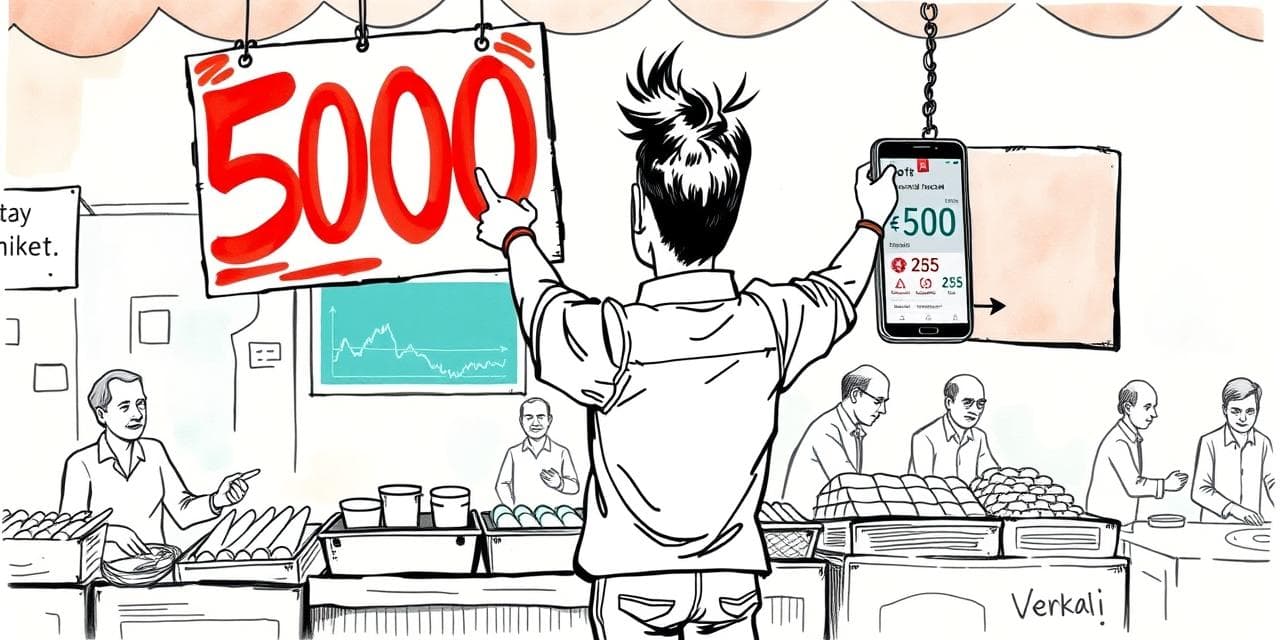

You have at least one stock in your portfolio that you will not sell below your purchase price.
Not because the business is strong. Not because the thesis is intact. Not because any analysis tells you to hold.
Because you paid a specific number for it, and selling below that number is not acceptable to you.
That constraint has a name. It is anchoring bias. It operates silently, it overrides fundamental analysis, and it costs Indian retail investors billions in aggregate opportunity cost each year. The number it fixates on, the price you paid, has zero predictive power over future returns. The market does not know what you paid. The stock does not know what you paid. Your reference point is entirely private, and it is running your investment decisions from inside a historical transaction that has already closed.
What Is the Price You Paid Actually Telling You?
Daniel Kahneman and Amos Tversky first documented anchoring in 1974, showing that people make numerical estimates by starting from an initial value and adjusting insufficiently toward new information. In their experiments, subjects gave different answers to identical questions depending on what number they saw first. The anchor contaminated the reasoning even when people understood the first number was irrelevant.
In financial markets, this effect is not abstract. Your purchase price is an anchor. The IPO issue price is an anchor. The 52-week high is an anchor. None of these numbers tell you what a stock is worth today. All of them are reference points from a different moment in time, set under different conditions, for different reasons.
Your brain does not naturally separate context from number. It does not say: "that ₹500 was the price when the company had a different debt level, a different management team, and a different competitive environment." It says: "₹500 is the reference point. Everything else is a deviation from ₹500 that needs to close."
This is how a number from your trade history becomes a decision-making engine that overrides current analysis.
Purchase price is not the only anchor. Research on anchoring in investment decisions shows that investors use whatever number was most salient when they formed their view. For equity investors in India, this is typically the purchase price or the highest price seen during the holding period. For F&O traders, it is often the entry price on a position or the level at which a previous trade made money.
Once the anchor is set, every piece of new information gets processed as a small adjustment from that reference point rather than as an independent signal. Earnings miss: "still waiting for ₹500." Promoter sells: "temporary, it will come back." Sector headwinds emerge: "these things cycle." The anchor absorbs the negative signals. "Return to purchase price" becomes the thesis, which is not a thesis at all. It is a hope built on a number.
How Does Anchoring Show Up in Indian Portfolios?
Break-even holding is the most common form of anchoring in Indian retail portfolios. You buy a stock. It falls. You decide not to sell until you recover your capital. That decision is made relative to your purchase price, not relative to what the stock is actually worth or what the business is doing.
One question matters at any point in a holding: "given what I know about this business today, is this the best place for this capital?" Not: "have I recovered my investment?"
These are completely different questions. One is backward-looking. One is forward-looking. A break-even hold means you are asking the first question, which means your portfolio is frozen in a prior reference frame while the business and market move forward.
This creates a measurable data pattern. In Indian retail portfolios, the average holding period for losing positions is three to five times longer than the average holding period for winning positions. Some of this is the disposition effect, which makes you reluctant to realize a loss. But anchoring makes it structurally worse by adding a specific price target to the hold: "I will exit at ₹500." That is not just reluctance. That is a plan built entirely around a historical number, with no connection to forward analysis.
A related pattern: you own a stock at ₹500. It falls to ₹350. Instead of evaluating the reason for the fall, you buy more because it is "cheaper now." Your justification anchors to the original price. The drop from ₹500 makes ₹350 look like a sale, regardless of what caused the drop.
Averaging down has a specific behavioral signature that PortoAI tracks: multiple buy events in a falling position with no corresponding thesis revision. When additional purchases are motivated by price relative to the original anchor rather than genuine fundamental reassessment, the behavioral fingerprint looks different from disciplined position-building. The buys are spaced as the price falls, not concentrated around a new analytical event.
This is not always the wrong move. Buying more of a strong business when its price falls for short-term reasons is rational. But the test is: would you buy this stock for the first time today, at ₹350, if you had no prior position? If the honest answer is no, the additional purchases were driven by anchoring, not by analysis.
Why Is the IPO Price Such a Powerful Anchor in India?
India's IPO market has been one of the most active globally over the past five years. Hundreds of companies raised capital through public offerings, and retail participation hit all-time highs. Millions of first-time investors entered the market through IPO allotments, often with the IPO issue price as the only valuation data point they had.
This created a specific anchoring problem at scale.
An IPO issue price is set in a specific context: the company, its bankers, and market conditions at the moment of the offering. The bankers' goal is to price the offering at the maximum the market will absorb while still delivering a listing gain to ensure demand. Once the company lists and begins trading, the issue price is historical data. The current price is determined by the market: by earnings updates, sector sentiment, institutional flows, and company execution.
A stock that listed at ₹240 and now trades at ₹150 is not "down ₹90 from fair value." The ₹240 was the bankers' number, calibrated to a specific fundraising window. The ₹150 is the market's current assessment. Calling ₹150 cheap relative to ₹240 is using a fundraising-era anchor as a valuation benchmark.
Yet this reasoning appears constantly in retail investor forums and WhatsApp groups. "It's trading below issue price, so it's cheap." In many cases, the stock is below issue price because the business did not deliver what the prospectus implied, or because the IPO was priced aggressively and the market has now repriced it to a more realistic level. "Below issue price" is not a thesis. It is an anchor.
Post-IPO data on Indian markets reinforces this. Stocks listing at a discount to issue price do not, on average, subsequently outperform comparable listed peers. Some do; many continue to fall. The issue price has no predictive power over future returns. It is simply the most salient number retail investors have from their initial transaction.
The 52-Week High Is Not a Return Address
A different anchoring trap affects investors who track market data regularly.
A stock trades at ₹400. Its 52-week high was ₹700. The interpretation: "it's down 43% from the high, significantly undervalued, a recovery play." This reasoning uses the 52-week high as the anchor for fair value.
A 52-week high is a price from a specific moment under specific conditions. If those conditions no longer hold, the high is not a target. It is a fact about the past.
Stocks reach 52-week highs for reasons. Those reasons change. The company may have guided down. The sector may have re-rated. Global interest rates may have repriced growth multiples. A single missed quarterly result can structurally reset a stock's trading range. None of this makes the 52-week high a return destination.
In F&O, this anchor is particularly costly because it generates trading theses with no fundamental basis. Traders see a stock far from its high and construct a recovery argument purely from the price distance. This type of reasoning contributes to the loss patterns SEBI documented in its September 2024 study, where 93% of individual F&O traders incurred losses over any three-year period. Not every F&O loss comes from anchoring, but the pattern of buying beaten-down names because they are "far from their high" is a frequent source.
Round numbers are a cousin of this problem. A stock at ₹98 feels different from a stock at ₹102. An investor might wait for ₹100 to buy or sell, not because ₹100 has any significance to the business, but because it is psychologically clean. Round numbers create invisible resistance and support levels that exist entirely in retail investor psychology.
How Does PortoAI Detect Your Anchor Traps?
Anchoring is invisible from inside your own head. You do not label your hold decision "anchored position." You label it "waiting for a recovery," or "long-term conviction," or "the thesis is still intact."
PortoAI's behavioral fingerprint analysis creates a different picture. When you connect your Zerodha or Groww account, PortoAI maps each holding against three variables: your average cost price, the current market price, and the stock's fundamental trajectory since your purchase date, proxied through earnings revisions and promoter activity.
Holdings where your cost price is more than 20% above the current price and where the fundamental trajectory has been negative are flagged as potential anchor traps. These positions have the measurable signature of anchored holds: the gap between your reference point and the current price is large, and the information since your purchase has not supported the case for continuing to hold.
Opportunity cost is what PortoAI adds on top of this detection. For each anchor trap identified, PortoAI calculates what the same capital would have earned in a Nifty 50 index fund from your original purchase date to today. The gap between the anchor trap's actual performance and the benchmark return is the real cost of the anchor.
For most retail investors who have held one or two anchor traps over two to three years, this number is between ₹40,000 and ₹3,00,000 in compounded opportunity cost. It is not just the mark-to-market loss on the stock. It is the return you did not earn while the capital was frozen in a decision driven by a historical number.
This connects to a broader pattern that makes retail portfolio P&L worse than the underlying market return: capital concentration in bad decisions while the index moves forward. Anchored positions are often the single largest source of this drag.
Can You Break an Anchor?
Zero-basing is the most effective technique for detecting and breaking an anchor: once a month, evaluate every holding as if you are deciding to buy it today.
Framing matters here. Do not ask "should I sell this?" That question triggers anchoring immediately because selling implies a comparison to your purchase price. Ask instead: "if I had this cash and no existing position, would I buy this stock at today's price?"
If yes, hold it. If no, the follow-up question is: "what is keeping me in?" If the honest answer is "because I want to recover what I paid," the anchor is doing the thinking, not the analysis.
This technique works because it forces a forward-looking evaluation. The purchase price disappears from the frame. The only question is whether this stock, at this price, is the best use of this capital right now. This is the same mental reframe that helps with confirmation bias in stock research: replacing backward-looking justification with forward-looking questioning.
Set exit criteria before you buy. Make them about business events, not price levels.
"I will exit if quarterly revenue growth falls below 10% for two consecutive quarters" is a business-based exit rule. "I will exit when it returns to ₹500" is an anchor-based exit rule.
Business-based rules protect against anchoring because they are triggered by company fundamentals, not by the gap between current price and your reference point. When the specified business event occurs, you exit, regardless of whether the price is above or below what you paid.
Most retail investors in India set no exit rules at all. A stock is bought and held until an emotional event forces a decision, often a large enough loss to produce panic selling, which is the opposite outcome the original anchor was supposed to create. Setting explicit, business-based exit criteria before purchase removes the anchor's authority.
Three words sum up the discipline: buy criteria, hold criteria, exit criteria. All three defined before the trade. None of them referencing your purchase price.
See your anchor traps in PortoAI
Try PortoAI FreeFrequently Asked Questions
What is anchoring bias in investing?
Anchoring bias is the tendency to fixate on an initial number and make all future decisions relative to it. In investing, the price you paid for a stock becomes the anchor. You evaluate every piece of new information about the company relative to your purchase price instead of asking whether the stock is worth buying at today's price.
How does anchoring bias affect Indian retail investors specifically?
Indian retail investors face three common anchors: the purchase price of a stock they are underwater on, the IPO issue price for a company that listed below offer price, and the 52-week high of a stock they missed. Each anchor generates bad decisions: holding losing positions past the point of rational analysis, treating IPO price as a buy signal, and refusing to buy good businesses at current prices because they were cheaper before.
What is an example of anchoring bias in the stock market India?
You bought a stock at ₹500. It trades at ₹280 today. The company missed earnings three quarters in a row. The promoter sold shares twice. You have held for 16 months because your goal is to get back to ₹500 and exit. The ₹500 number has no analytical basis after those events. You are holding because of your anchor, not because of the business.
How does anchoring bias affect IPO investing in India?
When an IPO lists below issue price, many retail investors treat it as a buying opportunity because the stock is cheaper than the IPO price. This is wrong. The IPO issue price was set by bankers optimizing for fundraising, not by market price discovery. A stock listing at ₹180 against an issue price of ₹240 is not automatically cheap. The issue price is the anchor. Actual value must be assessed on fundamentals.
Can PortoAI detect anchoring bias in my portfolio?
Yes. PortoAI's behavioral fingerprint analysis identifies holdings where your average cost price is significantly above the current market price and the stock's fundamentals have deteriorated since your purchase. These are the measurable signatures of anchor traps. PortoAI shows you the opportunity cost of that frozen capital: what the same amount would have earned in a Nifty index fund over the same period.
How do I fix anchoring bias in my investment decisions?
Three approaches work in practice. First, zero-base your portfolio monthly: for each holding, ask whether you would buy it at today's price if you had cash instead. Second, set business-based exit rules before you buy, not price-level targets like "I'll sell when it returns to ₹500." Third, replace the question "what did I pay" with "what is it worth today." These are different questions and only the second predicts future returns.