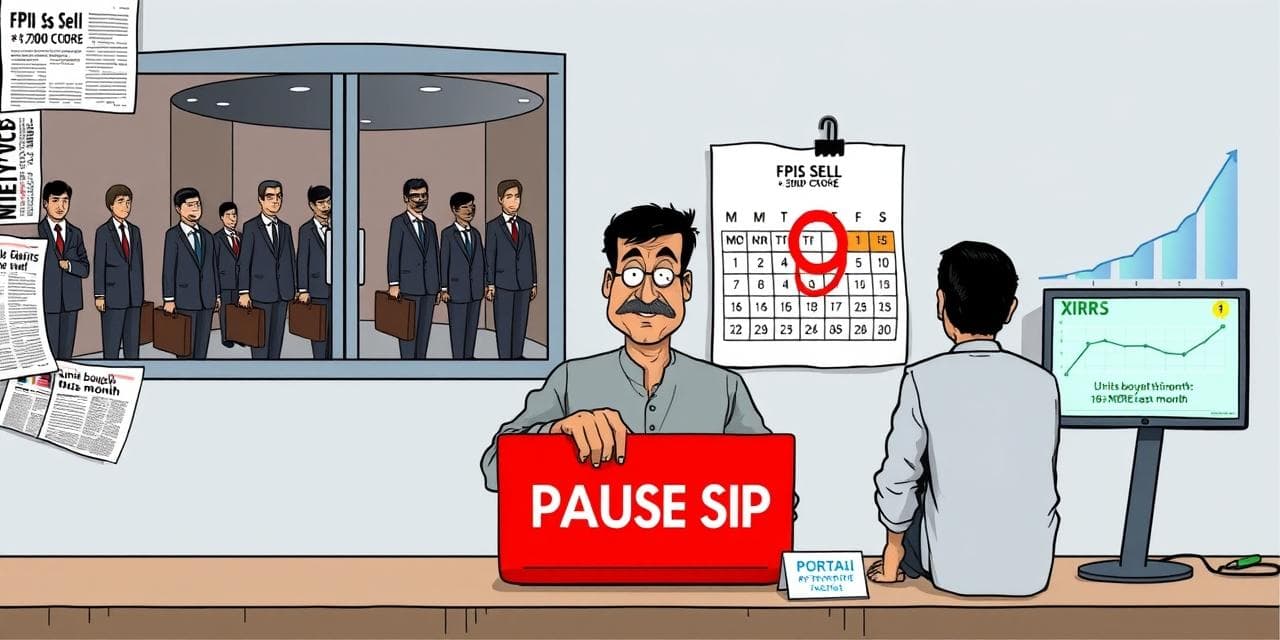

Nifty opens down 500 points today. Your portfolio shows a deep red number. Brent crude is above $110. FPIs dumped ₹6,434 crore of Indian stocks yesterday, and the day before, and the day before that. March 2026 is shaping up to be the worst month for foreign outflows since January 2025.
And you paused your SIP.
Seventy-six percent of Indian retail investors did exactly the same thing. In early March 2026, 76 SIPs were stopped for every 100 new ones started. In January alone, 55.46 lakh SIP accounts were discontinued. The data comes from AMFI's monthly tracker, and it tells you something precise: most Indian investors are wired to feel disciplined when they stop losses. Pausing a SIP during a crash feels like control.
It is not control. It is the most expensive behavioral mistake you can make in a falling market.
What Is Actually Happening in March 2026?
Facts before feelings.
FPIs have sold ₹77,214 crore worth of Indian equities across 12 sessions this March, averaging ₹6,434 crore every single session. Total FPI outflows in 2026: ₹1.04 lakh crore. The rupee hit a record low. Brent crude crossed $110 per barrel. Rising oil prices are now pressuring India's import bill, inflation trajectory and corporate margins, particularly in transport, FMCG and aviation.
Asian markets fell 1 to 2.5 per cent overnight. Sensex is staring at a 500-point gap-down. India VIX dropped 5.5% in the previous session but remains elevated at 18.72.
This is a real correction driven by real global events. The question is not whether the correction is real. The question is: what does this correction have to do with your financial plan?
Why Are FPIs Selling? (And Why It Has Nothing to Do with Indian Fundamentals)
Foreign Portfolio Investors do not sell Indian stocks because Indian companies stopped being good businesses. They sell because of macro and institutional pressures entirely disconnected from your financial goals.
In March 2026, FPIs are selling because:
Dollar strength. When US bond yields rise, dollar-denominated assets become more attractive. Emerging market equities face redemptions regardless of local fundamentals. Indian earnings are priced in rupees; dollar returns shrink when rupee weakens.
Crude oil and the import bill. A rupee-weak, oil-expensive India means FPI dollar returns erode further when repatriated. At Brent above $110, the math gets ugly.
Geopolitical risk premium. Strait of Hormuz disruptions, Middle East conflict escalation. Global risk-off moves capital to perceived safe havens: US Treasuries, dollar, gold. This is systematic, not a verdict on India.
Redemption pressure at home. Foreign fund managers face redemptions from their own investors. They sell whatever is liquid. Indian equities are liquid.
None of these reasons say Infosys is a worse business than it was last month. None say Reliance will earn less over the next five years. None say the Indian consumption story is broken.
Your SIP is in Indian equity mutual funds. Your time horizon is 10 to 20 years. FPIs are responding to events measured in weeks. You are using their behavior as the trigger for a decision about your 20-year wealth plan.
What Does Loss Aversion Actually Cost You?
The behavioral finance term is loss aversion. Nobel laureate Daniel Kahneman's research showed that the psychological pain of a ₹1 lakh loss feels approximately twice as intense as the pleasure of a ₹1 lakh gain. Your brain is wired to stop the bleeding. Pausing a SIP during a crash is your brain doing its job.
The problem: your brain's survival instinct is optimized for the Pleistocene, not Dalal Street.
Here is what happens when you stop your ₹5,000 monthly SIP after seeing a 15% correction:
- You exit at the low. You avoid further near-term pain.
- The market recovers. You wait for "the right time" to re-enter.
- The right time never feels right. You buy back higher.
- You paid the correction price on the way down AND missed the recovery units on the way up.
The compounding cost is not small. Stopping a ₹5,000 monthly SIP after 10 years means forgoing approximately 76% of the corpus achievable over 20 years. That is the actual cost of one panic exit, not a theoretical one.
Most of the damage to retail portfolios is not from bad stocks. It is from behavioral timing. Bad stock picks can be reversed. A repeated pattern of buying high and pausing low compounds against you for years.
Every correction comes with a specific reason why this one should be worse than the last. In March 2020, it was COVID. In 2022, it was US rate hikes and Russia-Ukraine. In 2023, it was the US regional banking crisis. In 2024, it was Middle East escalation. Now it is crude above $110 and FPI outflows at historic pace.
Each time, a majority of retail investors either stopped SIPs or redeemed near the bottom.
Each time, the investors who held accumulated more units at the cheapest prices of that cycle.
The current correction has Nifty down roughly 15% from its September 2025 highs. That is a meaningful drawdown. It is not structural damage to India's long-term growth story. India imports 85% of its crude, which is a known structural vulnerability that gets re-priced every oil cycle. It has been priced in before. It will be priced in again.
Here is the diagnostic most investors skip: what is your actual annualised return, not your raw portfolio loss?
Your Zerodha or Groww app probably shows something like "Portfolio down ₹1.2 lakh." That number looks terrible. But if you invested ₹5,000 a month for three years and your portfolio is down ₹1.2 lakh from the peak (not from your cost basis), your XIRR might still be positive. Or barely negative. Or recoverable within one quarter of holding.
Your XIRR is the metric that actually matters, not the P&L screen your broker shows you. The P&L screen compares current value to cost. The XIRR tells you your actual annualised return on every rupee across every time period you invested it. These are very different numbers.
Most investors who panic-stop SIPs have never calculated their XIRR. They see a red number on a screen designed to display a red number during corrections, and they stop.
This is the right question. And the data answers it.
AMFI's monthly data shows India's SIP inflows crossed ₹30,000 crore every month in 2026. The investors still contributing during this correction are buying Nifty units at 23,200 levels that they previously bought at 26,000+ levels. Each ₹5,000 this month buys 15 to 20% more units than the same amount bought six months ago.
A SEBI study analysing 1.2 million SIP accounts found that SIP investors outperformed lump-sum investors in 68% of cases over five years. The outperformance was highest in the years that followed a significant correction entry point because rupee cost averaging through the trough is when the mechanism does its best work.
You stop your SIP exactly when it is working hardest for you.
What PortoAI's Behavioral Fingerprint Shows About Correction Responses
Connect your Zerodha or Groww account to PortoAI, and the behavioral fingerprint analysis does not just look at what you bought or sold. It looks at when.
The pattern in the data is consistent: a significant share of retail investors who pause SIPs do so within 72 hours of a major market event. Nifty falls 800 points, and within three days, SIP cancellations spike. The timing tells you the decision was driven by the event, not by a change in financial circumstances.
PortoAI's portfolio analysis and XIRR tracking can show you your specific response pattern: do you consistently reduce equity exposure after market events, then buy back higher? That is a behavioral fingerprint. It is not a strategy. It is a documented way to destroy your long-term XIRR.
If your SIP portfolio has five funds, the analysis also shows you whether those five funds actually invest in five different things or effectively track the same underlying stocks. Many Indian investors discover their SIPs overlap 60 to 80%. During a correction, concentration risk shows up clearly. Before you stop your SIP, know what you are actually invested in.
What Should You Actually Do Right Now?
Four concrete actions.
Do not stop your SIP. The data is clear. The behavioral cost is quantified. Continue.
Calculate your XIRR today. Log in to your portfolio tracker and calculate your actual annualised return. If it is still positive, you have not lost money. You have experienced mark-to-market volatility, which is not the same thing. A correction looks far less scary when you replace the raw P&L number with a real XIRR.
Audit your fund overlap. A correction is the right time to check whether your SIPs are actually diversified or whether you are buying the same large-cap basket five different ways. PortoAI's sector concentration analysis surfaces this in minutes.
If you have surplus and stable income, consider a top-up. A one-time lump sum when Nifty is down 15% is the arithmetic inverse of a panic stop. Not mandatory, and not suitable if your emergency fund is thin. But for investors with surplus cash sitting in savings at 3.5%, this is the moment the math is working in your favor.
The One Scenario Where Stopping Your SIP Is Correct
There is one valid reason to stop your SIP: your income has changed, or your financial goal timeline has changed.
Lost your job? Stop the SIP. Redirect the cash to your emergency fund.
Need that ₹5,000 for a planned expense in the next six months? Stop the SIP.
Risk tolerance genuinely changed after full deliberation (not in the moment of a market crash)? Review your asset allocation.
But if you are stopping because the market is down and FPIs are selling and crude is above $110 and news channels are running red tickers, those are not financial reasons. They are behavioral ones. PortoAI's behavioral alert system can tell you whether your decision pattern correlates with market events or with genuine financial planning changes.
One is discipline. The other is expensive noise.
Connect your Zerodha or Groww account to PortoAI and see your behavioral fingerprint. Find out if your investment decisions follow a plan or follow market headlines.
Try PortoAI FreeFrequently Asked Questions
Should I stop my SIP when FPIs are selling?
No. FPIs sell for institutional reasons: dollar strength, EM rotation, redemption pressure. These have nothing to do with your personal financial goals or the long-term earnings trajectory of Indian companies. Stopping your SIP when prices fall locks in behavioral losses and removes you from the recovery.
Why are FPIs selling Indian stocks in March 2026?
FPIs sold ₹77,214 crore in the first 12 sessions of March 2026. The main triggers: Brent crude spiking above $110, a weakening rupee at a record low, rising US bond yields making Indian equities less attractive on a risk-adjusted basis, and broad emerging-market rotation. None of these affect the earnings power of the companies in your SIP portfolio.
What is the SIP stoppage rate in India right now?
In February and March 2026, India's SIP stoppage ratio reached 76%, meaning for every 100 SIPs started, 76 were paused or discontinued. In January alone, 55.46 lakh accounts were discontinued against 74.11 lakh new registrations. This is historically elevated and usually marks a buying opportunity for those who hold on.
Does continuing SIP during a market fall actually help?
Yes. A SEBI study analysing 1.2 million SIPs found that investors who continued through market cycles outperformed lump-sum investors in 68% of cases over five years. During a 10-15% correction, your fixed SIP amount buys more NAV units at a lower price. This is rupee cost averaging working exactly as designed.
How do I know if I am panic-stopping or making a rational decision?
Ask one question: has my financial goal or income situation changed? If not, and you are stopping because of market headlines, that is a behavioral response, not a financial one. PortoAI's behavioral fingerprint can show whether your recent decisions correlate with market panic events, so you can separate emotion from analysis.
What should I do with my SIP during this correction?
Continue it. If you have surplus funds, consider a one-time top-up. Check your XIRR to see your actual annualised returns, not the raw P&L number on your broker's app. A negative short-term XIRR during a correction is normal. Your 5 to 10-year XIRR is what determines whether you are actually losing money.