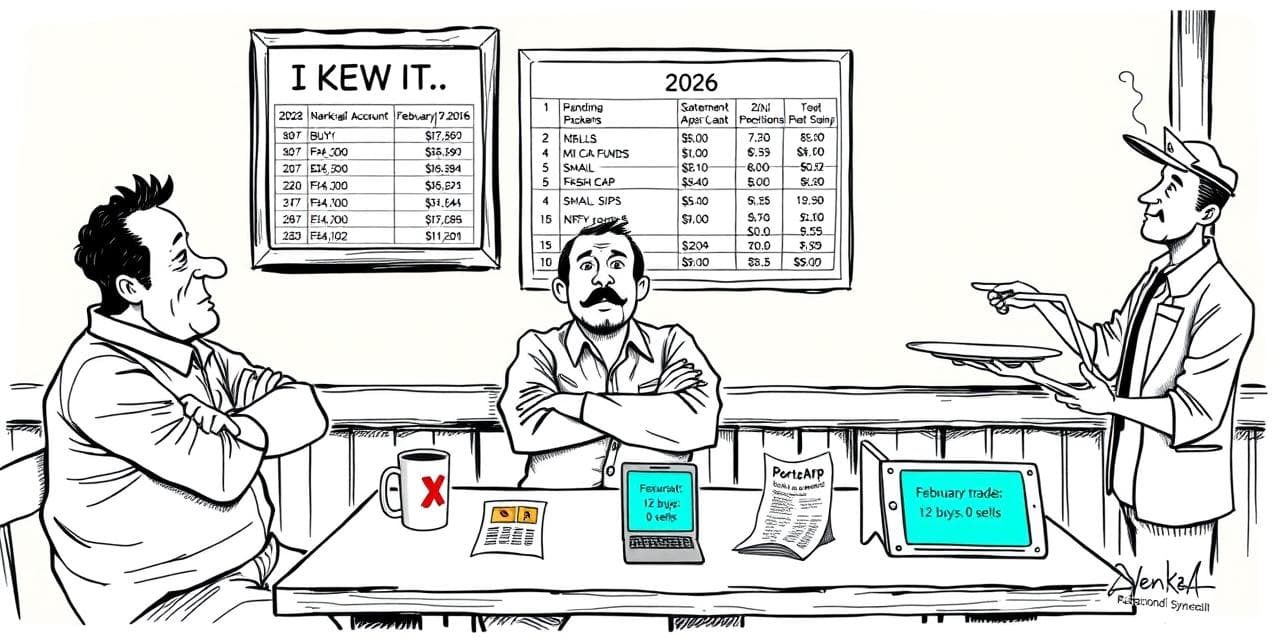

Open your WhatsApp right now. Count the number of people who "always knew" the market would crash.
Your uncle who forwarded a Kiyosaki article in January. Your colleague who mentioned "the market feels toppy" at a chai break in February. That one friend who says "I told you so" every time Nifty drops 500 points, regardless of whether they actually sold a single share.
Now open your broker app. Check your February trade history. Count the number of sell orders you placed before March 7, the day Nifty began its steepest leg down.
The WhatsApp forwards say one thing. Your trade log says another.
What Exactly Is Hindsight Bias, and Why Should You Care?
Psychologist Baruch Fischhoff identified this pattern in 1975 and gave it a clinical name: creeping determinism. The idea is straightforward. Once you know how something turned out, your brain rewrites the pre-event probability. A 10% chance event starts feeling like it was always a 70% certainty.
Fischhoff tested this with a clever experiment. He gave participants four possible outcomes for a historical conflict and told each group a different one had actually occurred. Every group rated their assigned outcome as the most predictable, even though they had no prior knowledge of the event.
Stock markets are the perfect breeding ground for this. Every crash, every rally, every SEBI circular produces an army of people who "saw it coming." None of them have brokerage statements to back it up.
The dangerous part is not the false memory. It is what happens next. If you believe you predicted this crash, you also believe you can predict the next one. That belief leads to concentrated bets, premature exits from recoveries, and the quiet, compounding destruction of returns.
Did You Actually See This Crash Coming? The Data Says No.
Here is what Indian retail investors were doing in February 2026, the month before Nifty fell 14% from its January peak.
AMFI's monthly data shows SIP contributions hit ₹29,845 crore in February, up 14.79% year-on-year. That is not defensive positioning. That is aggressive buying.
Break it down further:
- Mid-cap fund inflows: ₹4,003 crore. Mid-caps fall harder than large-caps in corrections. If investors expected a crash, this number would be near zero.
- Small-cap fund inflows: ₹3,881 crore. Small-caps are the first to get destroyed in a sell-off. Pouring nearly ₹4,000 crore into them weeks before a 14% correction is not the behaviour of someone who "knew."
- Active SIP accounts: 9.44 crore. Not a single meaningful wave of SIP cancellations before March.
- Liquid fund inflows: Flat. If people were moving to safety, liquid funds would have surged.
Aggregate behaviour tells the same story. BSE-listed companies had a total market capitalisation of ₹4,63,50,671 crore on February 27. By March 9, it was ₹4,38,35,042 crore. A ₹25 lakh crore loss in six trading days.
Someone who "knew" the crash was coming would have sold in February. The data shows almost nobody did.
Why Does Your Brain Rewrite What Happened?
Three mechanisms drive hindsight bias in market crashes.
Memory distortion. Your brain does not store memories like a hard drive. It reconstructs them every time you recall an event, blending in new information. After watching Nifty fall 3,300 points, that vague uneasy feeling you had in February gets reinterpreted as a concrete prediction. It was not. It was the same background anxiety every investor carries at all times.
Narrative construction. Humans need stories. "Iran attacked, oil spiked, markets crashed" is a clean narrative. It sounds inevitable in hindsight. But in real time, the consensus view in late February was that the Iran conflict would remain contained. Brent crude was at $88 on February 20. Nobody outside intelligence agencies predicted it would cross $115 in three weeks.
Social reinforcement. One person in your WhatsApp group says "I knew it." Three more pile on. Within a day, the entire group collectively "predicted" the crash. This is not evidence. This is social contagion. The group memory becomes a fiction that everyone believes because everyone repeats it.
PortoAI's behavioral fingerprint does not care about group narratives. It reads your actual trade timestamps, position sizes, and cash allocation changes. Your memory is editable. Your order log is not.
How Much Does Hindsight Bias Actually Cost You?
The false prediction is free. The overconfidence it creates is expensive.
Here is the chain reaction:
Step 1: "I predicted the crash." You did not, but you believe you did.
Step 2: "I can predict the recovery." Because you think you have a proven track record of market timing.
Step 3: You make a concentrated bet. Maybe you go all-in on Nifty at 22,000 because you "know" the bottom is in. Or you stay fully in cash because you "know" there is another leg down.
Step 4: The market does something you did not predict. It always does.
Step 5: You lose more than you would have with a diversified, rules-based approach.
Research on overconfident traders shows they trade 45% more frequently than their less confident peers and earn lower net returns. The extra trading generates transaction costs, STT charges, and worse entry points. On a Zerodha account with regular F&O activity, that overconfidence translates to ₹15,000 to ₹50,000 per year in unnecessary charges alone, not counting the P&L damage from bad timing.
The SEBI study from September 2024 found 93% of individual F&O traders lost money between FY22 and FY24. Aggregate losses exceeded ₹1.8 lakh crore over three years. Many of these traders entered positions because they believed they could predict the next move. Hindsight bias is the engine that fuels this overconfidence.
What Did the "Experts" Predict Before the Crash?
Check the analyst reports from February 2026. Not after the crash, before it.
- Nomura had a Nifty target of 24,600 for March 2026. They revised it sharply downward only after the crash had already happened.
- Most domestic brokerages were recommending mid-cap and small-cap funds in January, the exact categories that fell 20-30%.
- FPI selling accelerated in March, but February data showed FPIs were net buyers in certain sessions. Even institutional money did not see this coming clearly.
If professional analysts with teams of economists, direct access to policy makers, and sophisticated models could not predict the timing or magnitude of this correction, your WhatsApp uncle certainly did not.
The honest answer is that nobody predicted the specific combination of events: Iran escalation to full war, Strait of Hormuz blockade, oil crossing $115, rupee hitting 93.89, FPI selling exceeding ₹1 lakh crore. Each of these was a possibility. The probability of all happening simultaneously within three weeks was not in anyone's base case.
How Do You Actually Protect Yourself From Hindsight Bias?
Step one: stop lying to yourself about what you knew.
That sounds harsh. Here is a more practical framework.
Keep an investment journal with timestamps. Before every major allocation decision, write down your market outlook, your expected scenarios, and your probability estimates. Date it. When you look back six months later, you will discover your predictions were far less accurate than your memory claims. PortoAI's behavioral alerts serve as an automatic version of this journal, tracking your actual decisions against market events.
Compare your actions to your words. If you told five people the market would crash, check whether you sold any equity in your Groww or Zerodha account before the crash. Actions are the only reliable evidence of beliefs. Words are performative. PortoAI connects to your brokerage and creates a timeline of what you actually did, not what you remember doing.
Distrust consensus narratives after the event. When your entire WhatsApp group agrees the crash was "obvious," that is hindsight bias going viral. Before the crash, the same group was sharing bullish stock tips and debating which IPO to subscribe to.
Base your next decision on process, not prediction. If your portfolio allocation is rules-based (60% equity, 20% debt, 10% gold, 10% cash), you do not need to predict crashes. You rebalance when bands drift. The crash becomes an input to a process, not a test of your forecasting ability.
Set a cooling period before acting on conviction. The strongest "I knew it" feeling hits in the first 48 hours after a crash. That is also when cortisol levels spike 68%, impairing decision quality. PortoAI's cooling period feature forces a pause between your emotional conviction and your next trade, because conviction without evidence is how traders blow up accounts.
Your Portfolio Has a Memory. It Is More Honest Than Yours.
Markets are closed today for Ram Navami. Tomorrow, when trading resumes, Sensex weekly expiry hits on Friday instead of Thursday. Volatility will spike. The "I predicted the crash" crowd will turn into the "I know the bottom is in" crowd or the "I know there is another leg down" crowd.
Both groups will be equally confident. Both groups will be equally wrong on average.
The difference between a retail investor who compounds wealth and one who destroys it is not prediction accuracy. It is self-awareness. Knowing that you did NOT predict the crash is more valuable than pretending you did, because it keeps you humble enough to follow a process instead of a gut feeling.
PortoAI reads your Zerodha and Groww history and builds a behavioral fingerprint that shows your real patterns: when you panic-sell, when you overtrade, when you chase rallies. It does not care about your WhatsApp forwards or your Twitter threads about how you "saw this coming."
Your portfolio has a memory. It is the only honest record of what you actually believed.
Connect your Zerodha or Groww account. See what your portfolio says you actually did before the crash, not what you remember doing.
Try PortoAI FreeFrequently Asked Questions
What is hindsight bias in stock market investing?
Hindsight bias is the tendency to believe, after an event has occurred, that you always knew it would happen. In stock markets, this shows up as investors claiming they predicted a crash or a rally after the fact. Psychologist Baruch Fischhoff identified this in 1975 and called it creeping determinism. The danger is not the false memory itself but what it causes next: overconfidence in your ability to predict the next crash, leading to poorly timed trades.
Did Indian retail investors predict the March 2026 crash?
No. AMFI data shows retail SIP contributions hit ₹29,845 crore in February 2026, just days before the crash began. Mid-cap fund inflows were ₹4,003 crore and small-cap inflows were ₹3,881 crore, both risk-on categories. If retail investors had genuinely anticipated a 14% Nifty correction, they would have shifted to liquid funds or reduced equity exposure. The data shows the opposite: investors were buying aggressively into what became the sharpest correction since COVID.
How does hindsight bias cost money in investing?
Hindsight bias creates a false sense of predictive ability. After believing you predicted one crash, you become overconfident about predicting the next move. This leads to concentrated bets, premature exits from recoveries, and higher trading frequency. Overconfident traders trade 45% more frequently and earn lower net returns because of higher transaction costs and worse timing. On a typical Zerodha F&O account, this overconfidence adds ₹15,000 to ₹50,000 per year in unnecessary charges.
How can I check if I have hindsight bias in my trading?
Look at your actual trade history from February 2026. Did you sell equity positions before the crash? Did you increase cash allocation? Did you buy puts or hedge your portfolio? If you did none of these things but now believe you knew the crash was coming, that is hindsight bias. PortoAI connects to your Zerodha or Groww account and creates a behavioral fingerprint that shows exactly what you did versus what you now remember doing.
What is the difference between hindsight bias and confirmation bias?
Confirmation bias makes you seek information that supports your existing beliefs before an event. Hindsight bias makes you rewrite your memory after an event to believe you predicted it. Both are dangerous for investors but they operate at different points in the decision timeline. A trader with confirmation bias reads only bullish research before buying a stock. The same trader with hindsight bias later claims they always knew the stock would crash when it does. PortoAI tracks both patterns in your portfolio behaviour.
Can anyone actually predict stock market crashes?
Consistently, no. Professional analysts with sophisticated models, direct access to policy makers, and teams of economists failed to predict the timing and magnitude of the March 2026 correction. SEBI data shows 93% of individual F&O traders lost money between FY22 and FY24. If prediction worked, these numbers would look very different. The most reliable approach is rules-based allocation and rebalancing, which does not require prediction at all.
How does PortoAI help with hindsight bias?
PortoAI connects to your Zerodha or Groww account via read-only API and analyses your actual trading history. It creates a behavioral fingerprint showing when you panic-sold, when you overtrade, and when your actions contradicted your stated beliefs. It is an honest record of what you actually did, not what you remember doing. When it detects patterns like overconfidence-driven trading spikes after a crash, it triggers a cooling period alert before your next trade.