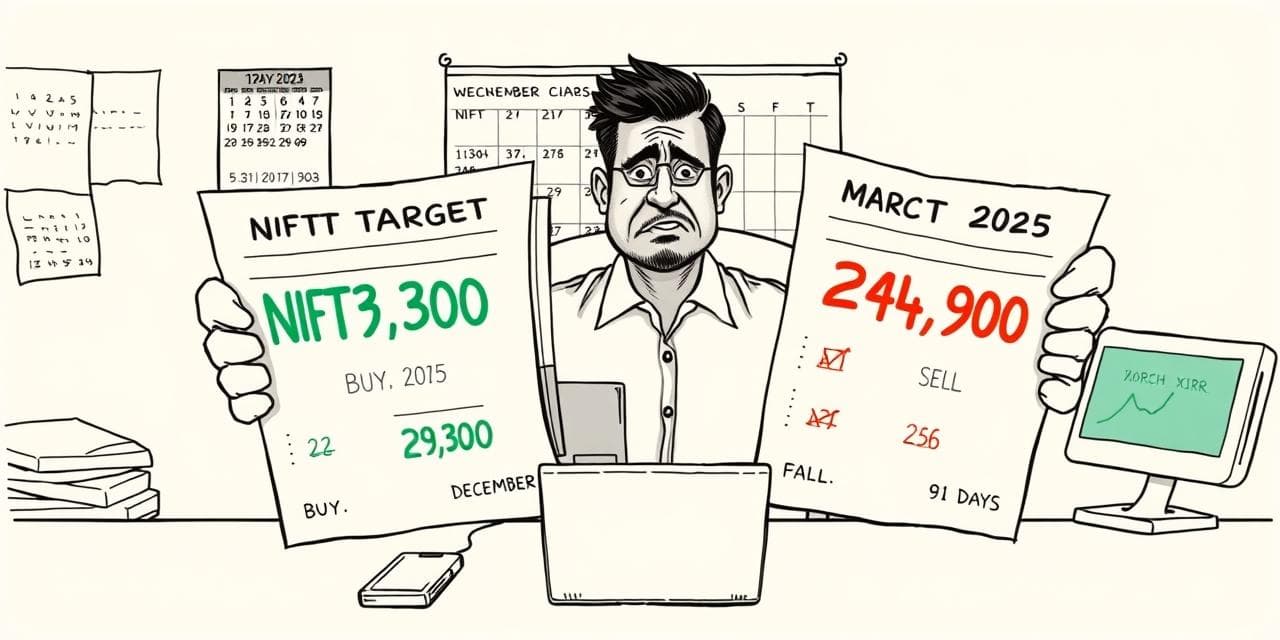

Three Months. One Brokerage. Two Completely Different Numbers.
In December 2025, Nomura published a bullish India note and set a Nifty 50 target of 29,300 for December 2026. The report cited earnings momentum, domestic consumption resilience, and India's structural growth story. Fund managers quoted it. News channels ran the headline. Some retail investors bought on the back of it.
On March 16, 2026, Nomura published a new India note and cut the same target to 24,900. A 15% reduction. The reasons this time: Brent crude above $115 after Hormuz disruptions, a likely 7.5% compression in FY27 earnings consensus, and a weaker rupee at ₹92.45.
Same brokerage. Same analyst team. 91 days apart. A 4,400-point swing.
If you sold after the December upgrade and bought in, then sold again after last week's cut, you paid brokerage, STT, and capital gains twice, in the wrong direction both times. If you are still holding and reading the March 16 headline and wondering whether to sell now, this article is specifically about you.
What the Target Cut Actually Says
Read Nomura's own note before treating it as a sell signal.
The 24,900 figure is their base case. Their bear case is 21,000 (only if the Hormuz disruption becomes a full Strait closure and crude stays above $120 for six months). Their bull case is 29,100 (if tensions de-escalate by June and crude reverses to $95). Nomura explicitly wrote in the same note that a further 5% correction from current levels "should present a buying opportunity from a long-term perspective."
This is not a brokerage telling you to sell. It is a brokerage updating a model under changed macro inputs and noting that their previous estimate was too high given current oil. Model revisions are legitimate. Retail panic responses to them are not.
Citi made a smaller cut the same day, trimming its December 2026 target to 27,000 from 28,500. ICICI Direct has not revised its 29,120-30,000 range. Three major institutions, three different numbers, all published this week, all based on the same set of facts.
Which number are you trading on?
Why Your Brain Is Doing This Right Now
You have been watching Nifty fall for weeks. ₹52 lakh crore ($639 billion) in market cap wipeout is in every headline. Your portfolio XIRR has turned negative on a trailing 12-month basis for positions you added near the peak. Rupee hit a record low of ₹92.45. And now a global brokerage with 400 analysts has a number lower than what the market is at.
Every input is pointing the same direction. That is the problem.
This is recency bias, and it operates at full strength after a sustained correction. The human brain is wired to extrapolate recent trends forward. After three weeks of bad news, it does not read "Nomura cuts target" as "a model update under changed assumptions." It reads it as confirmation. More evidence. Another domino.
None of this is irrational in isolation. Acting on it without checking whether you have done this before is where things go wrong.
PortoAI's behavioral fingerprint shows exactly what your order history looked like during the last correction. Most investors who are convinced they make rational decisions under stress discover, when they look at their actual data, that they increased trade frequency by 2-3x in the two weeks following a 5%+ correction. They added to losing positions without a defined plan. They trimmed winners because they felt "safe" relative to the red in the rest of their portfolio.
The data does not lie. The conviction that you are different does.
How Accurate Are Analyst Nifty Targets?
Analyst Nifty targets have a specific track record that is worth understanding before you trade on one.
Nomura raised its Nifty target four times between January 2025 and December 2025, each time citing improving fundamentals. The December 2025 target of 29,300 implied a 20% upside from where Nifty was trading. Nifty went the other direction.
This is not a criticism of Nomura. Geopolitical events (specifically a military conflict affecting a critical oil chokepoint) are not predictable from fundamentals. December's note was made in good faith based on available data. March's cut reflects genuinely changed data.
Retail investor behaviour around these targets is the problem, not the targets themselves.
When a major brokerage raises its target, retail sentiment turns bullish and inflows into equity increase. When the same brokerage cuts, the same investors reduce positions. This means retail investors are systematically buying near the revision-triggered highs and selling near the revision-triggered lows. Exactly backwards.
The SEBI 2024 study found that 93% of F&O traders lost money over three years. The mechanism is different for equity investors, but the underlying pattern is the same: reacting to external signals rather than operating from a defined personal framework.
What Does Your Own Data Show?
Here is the question Nomura cannot answer for you: what is your actual portfolio XIRR right now, and does it change the investment thesis you had when you bought your largest positions?
These are not the same question as "is Nifty going to 24,900 or 29,100?"
Your portfolio XIRR during a correction often looks worse than it is, because you are calculating it at the trough. An investor who ran SIPs through the 2020 COVID crash and into the 2021 recovery had a terrible-looking XIRR at the March 2020 bottom and an excellent one 18 months later. The XIRR at the trough told them nothing useful about whether to continue.
What your data does tell you: whether your current behavior is consistent with your own historical patterns, or whether you are doing something different right now specifically because the news is bad. PortoAI's analysis compares your current activity to your own baseline. Not to a benchmark. Not to a brokerage's target. To you.
If you are placing more trades than usual this week, that is a data point. If you are reducing your largest equity position specifically because of a headline you read, that is a data point. If you are checking your portfolio six times a day when your average is once, that is a data point.
None of these are about Nomura's model. All of them are about what you do when markets are difficult.
Is Now a Good Time to Buy, or Should I Wait for 22,000?
This is the question driving every forum and every WhatsApp group right now. And it is the wrong question.
"Waiting for 22,000" means you have decided Nomura's bear case will happen. You have picked the lowest probability scenario in Nomura's own model as your base case. You are building a buying plan around an outcome that would require the Hormuz Strait to close entirely and crude to stay above $120 for two quarters. It could happen. It is also the scenario Nomura assigned the lowest probability to.
The more useful question: if Nifty is at 23,000-23,500 today and your long-term equity investment thesis was built at Nifty 24,000-26,000, has that thesis changed? If the answer is no, the data supports continuing your SIP and not making concentrated portfolio changes based on a single week's analyst reports.
If the answer is yes, because the oil shock genuinely changes your view on specific holdings in your portfolio, that is a legitimate reason to rebalance. Portfolio concentration analysis is different from headline-driven selling. One is surgical. The other is panic.
Nomura also said something retail investors buried under the 24,900 headline: their scenario range of 21,000 to 29,100 reflects how genuinely uncertain the outcome is. A target cut under uncertainty is not a sell recommendation. It is honesty about what a model can and cannot tell you.
What to Do Today (Not Someday)
Open your Zerodha or Groww history right now and count how many trades you placed in the past ten days. Compare it to the ten days before the Nomura headline appeared. If the number went up, you are trading on recency bias, not on analysis.
Connect your portfolio to PortoAI. The behavioral fingerprint will show you your overtrading pattern during the last three corrections. It will show which positions you exited near troughs and re-entered near peaks. It will show whether your "I'm going to wait for 22,000" instinct has been profitable in your personal history or whether it is the same thought you had before missing the last recovery.
The Nomura target cut is real information. It updated a model under genuinely changed inputs. What it is not is a cue for retail investors to change behavior that was working before the headline.
The market does not know you read the report. Your own order history does.
Frequently Asked Questions
What is Nomura's new Nifty target for December 2026?
Nomura cut its December 2026 Nifty 50 target from 29,300 to 24,900 on March 16, 2026. The revision reflects a 15% reduction, driven by the US-Iran conflict's impact on Brent crude (now above $115 per barrel), disruptions at the Strait of Hormuz, and a likely 7.5% compression in FY27 earnings consensus. Nomura's own note included a scenario range: 21,000 bear case to 29,100 bull case, and explicitly flagged that a further 5% fall should be treated as a buying opportunity.
Should I sell my mutual funds when Nomura cuts its Nifty target?
No. Analyst targets are 9-12 month price forecasts used by institutional investors to rebalance portfolios systematically. They are not retail sell signals. Nomura raised its Nifty target to 29,300 just three months ago in December 2025. Retail investors who bought on that upgrade and sell on this downgrade are trading on a lagging indicator with a track record of being revised multiple times a year.
Why do analysts keep changing their Nifty target?
Analyst targets are dynamic and model-driven. They change when key inputs change: earnings estimates, interest rate assumptions, geopolitical risk premiums, or currency assumptions. Nomura revised its target because Brent crude shifted from a price shock to a quantity disruption (Hormuz), forcing a model update. These revisions reflect changing data, not permanent market truth. A target is an estimate, not a forecast you can trade on reliably.
What is recency bias in investing?
Recency bias is the tendency to overweight recent events when making decisions about the future. In investing, it shows up as expecting a rising market to keep rising (buying at peaks) and expecting a falling market to keep falling (selling at troughs). After a 10%+ Nifty correction, recency bias makes every news item, including an analyst target cut, feel like confirmation that the fall will continue indefinitely.
What is Nomura's bear case for Nifty in 2026?
Nomura's explicit bear case puts Nifty at 21,000. Their base case is 24,900. Their bull case is 29,100. These three scenarios reflect different assumptions about how the US-Iran conflict resolves and what oil does. The market is currently trading around the base case. Retail investors who sell based on the bear case scenario are priced for an outcome with the lowest probability in Nomura's own model.
How does PortoAI help during a market correction?
PortoAI's behavioral fingerprint tracks your order history to detect overtrading spikes, revenge trading after losses, and position changes made under market stress. During a correction, the most dangerous moves are the ones made in response to headlines rather than portfolio data. PortoAI shows you your own pattern during previous corrections so you can compare current behavior against your own baseline.
See what your portfolio data shows during market corrections. Connect your Zerodha or Groww account to PortoAI and get your behavioral fingerprint in minutes.
Try PortoAI Free