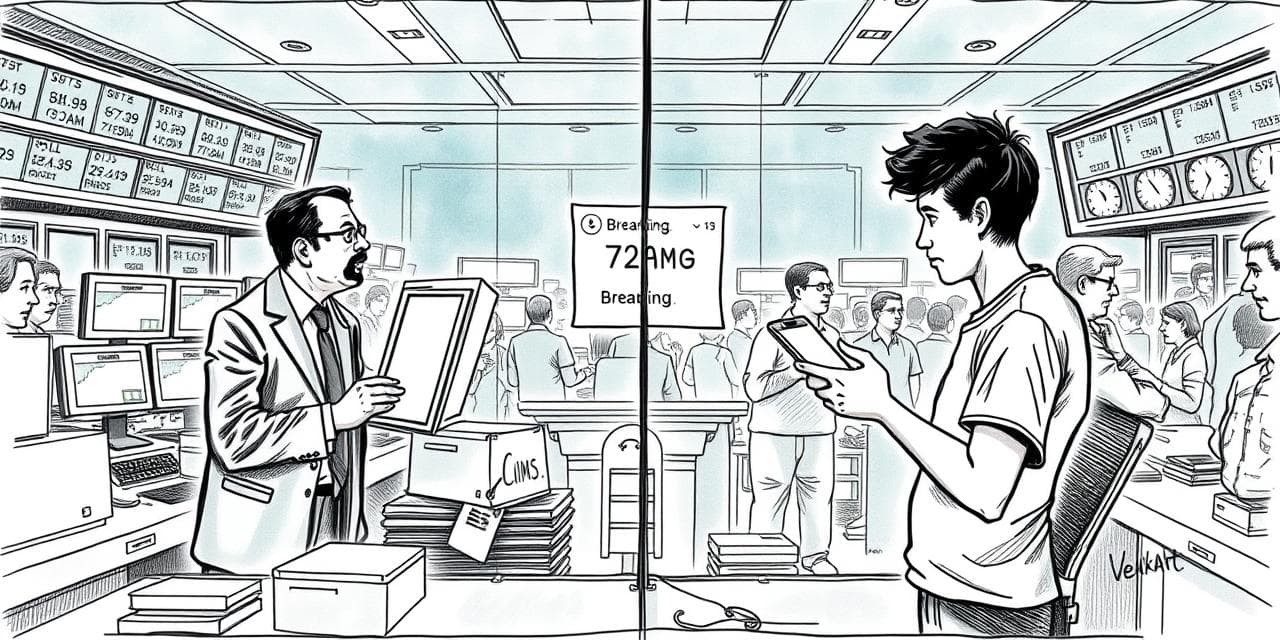

At 6:49 AM New York time on March 23, 2026, someone placed 6,200 oil futures contracts worth $580 million.
At 6:50 AM, the trade was done.
At 7:04 AM, Donald Trump posted on Truth Social that the US and Iran had "very good and productive conversations" about ending the war.
At 7:06 AM, oil prices crashed 11%. The S&P 500 surged. Gift Nifty jumped 650 points.
At 7:15 AM, your phone buzzed with a breaking news notification.
You found out 26 minutes after the money moved. And you think trading on news gives you an edge.
Who Traded $580 Million Before the Rest of the World Knew?
The Financial Times flagged it first. Between 6:49 and 6:50 AM New York time, roughly 6,200 Brent and WTI futures contracts changed hands. Notional value: $580 million. This was 15 minutes before Trump's Truth Social post about ceasefire talks with Iran.
That is not a coincidence. That is not a lucky guess.
Unusual Whales, a market analytics platform, flagged an even larger position: approximately $1.5 billion in S&P 500 futures purchased five minutes before the announcement. And $192 million in oil futures sold simultaneously. Someone knew oil would crash and stocks would rally. They positioned accordingly.
A US Senator called it "mindblowing corruption" and alleged insider trading. Nobel laureate Paul Krugman used the word "treason." The SEC has not commented. The trades remain under scrutiny.
None of this matters to you if you are a long-term investor. All of it matters if you traded on the same headline 15 minutes later.
Why Were You the Last Person to Find Out?
Here is the information chain for a geopolitical event affecting Indian markets:
- The source (White House, Trump's inner circle) knows before anyone.
- Connected traders with direct feeds and proximity to decision-makers act within seconds.
- Algorithmic systems detect the post programmatically and execute trades in microseconds.
- Institutional desks at Goldman, Morgan Stanley, and Citadel reposition within 30 seconds.
- Bloomberg and Reuters terminals flash the headline at minute one.
- CNBC and business news channels run it as breaking at minute three.
- Moneycontrol and ET push notifications land on Indian phones at minute 10 to 15.
- WhatsApp groups light up at minute 15 to 30.
- You open your broker app, read the headline, and decide to trade.
By step 9, the price already reflects the news. You are not trading on information. You are trading on a notification about something that already happened.
This is information asymmetry. It is structural. It is permanent. And every time you trade on a news headline, you are on the wrong end of it.
What Did March 23 Actually Cost Retail India?
Let us reconstruct the week.
March 19 (Wednesday): Iran fires missiles at Israeli military bases. Brent crude hits $113. Sensex drops 1,200 points. India VIX spikes to 27.17, the highest since June 2024.
March 20 (Thursday): Rupee breaches ₹93 against the dollar for the first time in history. FPIs have now sold ₹88,180 crore worth of Indian equities in March alone. Retail investors on Reddit and WhatsApp groups are asking: "Should I exit equity completely?"
March 23 (Monday): Trump issues a 48-hour ultimatum to Iran to reopen the Strait of Hormuz or face strikes on power plants. Iran rejects it. Brent hits $120 intraday. Sensex crashes 1,836 points. ₹11 lakh crore wiped out in a single session.
March 23 (later that evening US time): Trump posts about "productive conversations" with Iran. Oil crashes 11% to $99.94. S&P 500 surges.
March 24 (Tuesday): Gift Nifty opens 650 points higher. Sensex rallies 1,500 points at open.
If you panic-sold on March 23 afternoon and did not buy back by March 24 morning, you locked in a loss at the bottom and missed the sharpest single-day recovery of the year. If you did not sell on March 23 but bought the dip on March 24 thinking the worst was over, you are now exposed if ceasefire talks collapse this week.
Both paths lose. Because both paths are reactive.
Does Your Brain Have a Chance Against Algorithmic Traders?
No. Here is why.
A 2014 study published in the Proceedings of the National Academy of Sciences (PNAS) measured cortisol levels in London traders during periods of market volatility. The findings: cortisol rose 68% over eight days of increased volatility, and elevated cortisol directly impaired financial decision-making. Traders with higher cortisol took fewer risks when they should have taken more, and more risks when they should have pulled back.
Your brain on a 1,800-point crash day is not your normal brain. It is flooded with stress hormones that reverse your risk preferences. You become loss-averse when selling (holding losers too long) and risk-seeking when buying (catching falling knives).
An algorithm does not have cortisol. It does not check WhatsApp. It does not feel the urge to "do something" when Sensex drops 800 points in the first hour. It executes a predefined strategy in microseconds, then moves on.
You are not competing against other retail investors. You are competing against systems that traded $580 million before you knew there was news.
What Does Reactive Trading Look Like in Your Portfolio?
PortoAI connects to your Zerodha or Groww account and reads your trade-level data. When we analyse portfolios of users who traded during the March 2026 volatility, patterns emerge:
Pattern 1: News-cluster trades. Trades executed within 2 hours of a major news event (Iran strike, Trump post, RBI statement). These trades have a hit rate below 40% because the news is already priced in by the time retail executes.
Pattern 2: Position size spikes. On normal days, a trader buys 1 lot of Bank Nifty options. On crash days, the same trader buys 3 to 5 lots. The conviction is not higher. The panic is higher. Larger positions during volatility means larger losses when the trade goes wrong, which it does more often during news-driven moves.
Pattern 3: Round-trip losses. Sell on Monday's crash. Buy back on Tuesday's rally at a higher price. Net result: you paid the bid-ask spread twice, paid brokerage and STT twice, and locked in the exact bottom as your exit price. The market is flat over the two days. Your portfolio is down 3 to 5%.
PortoAI's behavioral fingerprint tracks all three patterns automatically. It does not tell you what to buy. It tells you when your trading behaviour has shifted from disciplined to reactive.
Is the Indian Market Rigged Against Retail Investors?
Not rigged. Structurally disadvantaged.
SEBI's September 2024 study found that 93% of individual F&O traders lost money between FY22 and FY24. Aggregate losses exceeded ₹1.8 lakh crore over three years. The top 3.5% of profitable traders accounted for the overwhelming majority of profits.
Those profitable 3.5% are not smarter. They have better infrastructure, faster execution, and access to information before it becomes a push notification on your phone.
Consider the March 23 timeline again. The $580 million oil trade was executed by someone with direct access to either the White House decision-making process or someone adjacent to it. The $1.5 billion S&P futures position was placed by someone with algorithmic execution capabilities. Both trades were profitable within minutes.
You, checking your Groww app during lunch break, are not in this game. You are the product of this game.
FPI outflows of ₹88,180 crore in March tell the same story. Foreign institutions sold steadily throughout the month while the rupee weakened from ₹87 to ₹93.94. They had macro models, currency hedges, and risk management frameworks. Retail India watched the red numbers on their portfolio screen and asked WhatsApp groups what to do.
This is not a conspiracy. It is a structural reality of how information flows in financial markets. And every time you trade on a headline, you are volunteering to be on the losing side of this asymmetry.
What Should You Actually Do During Weeks Like This?
Stop reacting. Start measuring.
Step 1: Audit your March trades. Open your Zerodha or Groww trade history. Count how many trades you made between March 19 and March 24. Compare that to your average weekly trades in February. If March is 2x or more, you overtrade during volatility. PortoAI's overtrading detection does this calculation automatically.
Step 2: Calculate your news-reaction cost. For every trade made within 2 hours of a major news event (Iran strike, Trump post, oil price spike), check the P&L. Sum it up. This is the price you paid for being reactive. For most retail traders, this number is negative.
Step 3: Check your sector concentration. During war-driven volatility, defence and oil stocks surge while everything else drops. If you bought defence stocks on March 10 and are still holding, check whether your portfolio is now dangerously concentrated in one sector. PortoAI's sector concentration analysis flags this before it becomes a problem.
Step 4: Set a cooling period. Before your next trade during a volatile week, wait 24 hours. Not 1 hour. Not "after lunch." Twenty-four hours. PortoAI's cooling period feature enforces this automatically when it detects reactive trading patterns.
Step 5: Review your SIP. The 76% SIP stoppage rate in February shows that most retail investors pause systematic investing during exactly the periods when rupee-cost averaging works hardest for them. If you stopped your SIP this month, you missed buying Nifty at 22,500, a level it has not seen since October 2024. PortoAI tracks whether your SIP discipline holds during drawdowns.
The Real Question Is Not "What Will Trump Do Next?"
Markets will open on March 27 after the Ram Navami holiday. By then, the Iran ceasefire talks may have progressed, collapsed, or stalled. Crude oil could be at $90 or $120. Nifty could gap up 500 points or gap down 800.
None of that is within your control.
What is within your control: whether you trade on the next headline or let your portfolio's data tell you what to do. Whether you react to a notification that arrives 15 minutes after the money has already moved, or whether you look at your own trading patterns, your own sector exposure, your own behavioural fingerprint and make decisions based on what your portfolio actually says about you.
Someone traded ₹4,800 crore before you even knew there was news. They will do it again. The question is whether you will keep paying the cost of being last in line, or whether you will stop playing a game where the other side has a 15-minute head start.
Connect your Zerodha or Groww account. See if your March trades were reactive or disciplined.
Try PortoAI FreeFrequently Asked Questions
What happened with the suspicious trades before Trump's Iran post?
On March 23, 2026, roughly 6,200 Brent and WTI futures contracts worth $580 million changed hands between 6:49 and 6:50 AM New York time, exactly 15 minutes before Trump posted on Truth Social about productive conversations with Iran. On top of that, approximately $1.5 billion in S&P 500 futures were bought five minutes before the post. A US Senator has called it mindblowing corruption and alleged insider trading.
How does information asymmetry hurt Indian retail investors?
Indian retail investors receive market-moving news through broker app notifications, WhatsApp forwards, and TV channels, all of which operate on a delay of minutes to hours after the event. Institutional traders with direct feeds, algorithmic systems, and proximity to decision makers act in milliseconds. By the time a retail investor reads a headline and opens their trading app, the price has already moved.
Should I trade based on geopolitical news like Iran war updates?
No. Data from March 2026 shows that Nifty moved 3,300 points in four trading sessions based on Iran headlines. Retail investors who sold the crash on March 23 missed the 1,500-point bounce on March 24. Those who bought the bounce risked another crash if ceasefire talks fail. Trading on geopolitical news requires you to be faster than algorithmic systems that execute in microseconds.
What is reactive trading and why does it lose money?
Reactive trading is buying or selling in response to breaking news, price alerts, or market headlines. It loses money because by the time you react, professional traders have already priced in the information. A PNAS study found that cortisol levels spike 68% during volatile markets, impairing financial decision-making. You are not trading on information. You are trading on emotion triggered by stale information.
How can PortoAI help me avoid reactive trading mistakes?
PortoAI connects to your Zerodha or Groww account and analyses your actual trading history. It detects patterns like trades clustering within hours of major news events, position sizes spiking during volatile sessions, and revenge trades after news-driven losses. When it spots reactive trading, it triggers a cooling period alert before your next trade.
How much did FPIs sell in Indian markets during March 2026?
Foreign Portfolio Investors sold over ₹88,180 crore worth of Indian equities in March 2026, driven by the Iran war, surging crude oil, and a weakening rupee that hit ₹93.94 against the dollar. This sustained foreign selling compounded the pressure on Indian markets and contributed to Nifty falling 15% year-to-date.