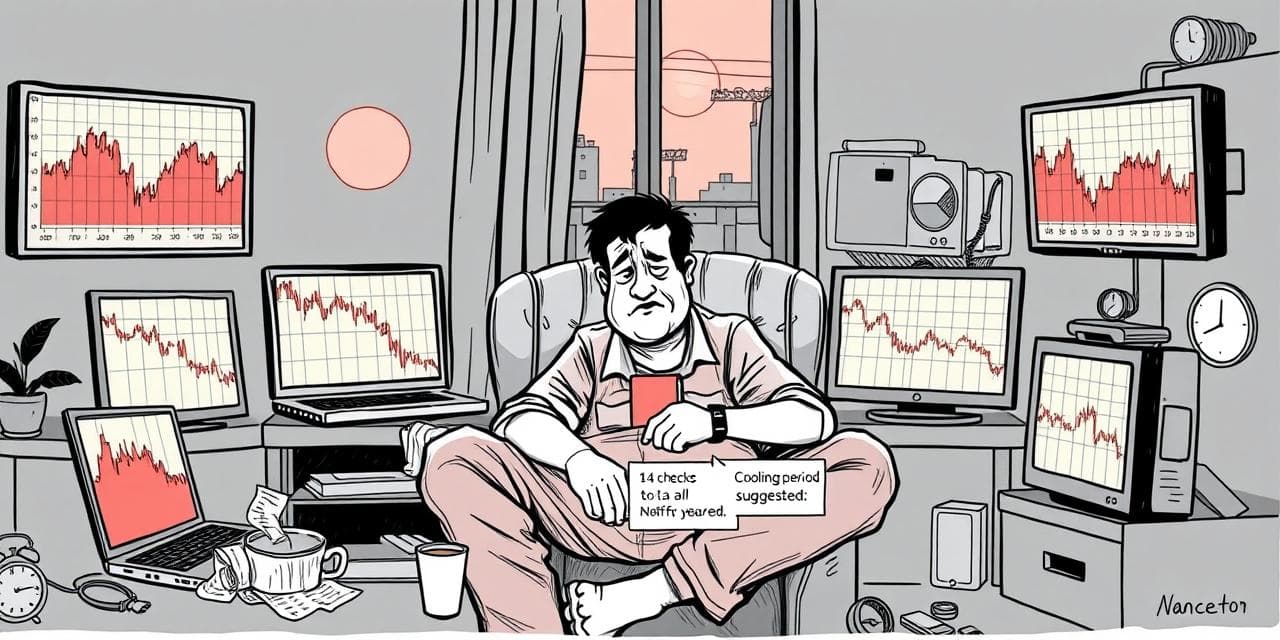

Fourteen per cent. That is how much Nifty has fallen from its January 5 high of 26,373. FPIs have pulled out over ₹1 lakh crore in March alone. Crude is above $110. The rupee hit 93.89. On March 23, Sensex crashed 1,836 points in a single session.
You know all this. You know it because you checked.
You checked at 9:15 AM when the market opened. You checked at 10:30 when someone in your WhatsApp group sent a screenshot of their P&L. You checked at lunch. You checked during the 2 PM selloff. You checked after close. You checked the US futures before bed.
Fourteen times. Maybe more.
Here is what you did not check: whether the act of checking is the thing that is actually destroying your returns.
What does the research say about portfolio checking frequency?
In 1997, Richard Thaler, Amos Tversky, Daniel Kahneman, and Alan Schwartz published a study in The Quarterly Journal of Economics titled "The Effect of Myopia and Loss Aversion on Risk Taking." Two of these researchers later won the Nobel Prize in Economics.
Their finding was blunt. Investors who received the most frequent feedback about their portfolios took the least risk and earned the least money.
Read that again. The people with the most information performed the worst.
The mechanism is simple. Losses feel roughly twice as painful as equivalent gains feel good. This is loss aversion, one of the most replicated findings in behavioral economics. Now combine it with checking frequency. If you check your portfolio daily, you see losses on roughly 47% of trading days (markets are slightly positive over time, but nearly half the days are red). If you check monthly, you see losses on about 38% of months. If you check annually, you see losses on roughly 27% of years.
Same portfolio. Same underlying returns. But the daily checker experiences loss 47% of the time. The annual checker experiences it 27% of the time. The daily checker's brain is bathed in twice as much loss signal, even though the actual investment result is identical.
Thaler and Kahneman called this myopic loss aversion. "Myopic" because the investor is short-sighted, zooming into a timeframe too narrow for their actual investment horizon. "Loss aversion" because each peek amplifies the pain of temporary drawdowns.
The result? The frequent checker becomes more risk-averse. They shift toward "safer" assets. They sell equities after a bad week. They miss the recovery. And over 20 years, they earn significantly less than the person who checked once a quarter and went about their life.
How does this apply to March 2026 specifically?
March 2026 is the worst possible month for your checking habit.
Consider the timeline. On March 2, Nifty fell 2% as the US-Iran conflict escalated. On March 9, it dropped another 3% after Trump threatened to attack Iran's power plants. On March 19, HDFC Bank's chairman resigned and the stock crashed 8.5%, dragging Nifty down over 3%. On March 23, another 601-point fall. Four separate crash days in one month.
If you checked daily, you experienced each of these as a distinct loss event. Four separate punches to your loss aversion system. Four separate cortisol spikes. Four separate moments where your brain screamed "sell everything and stop the pain."
If you checked monthly, you would see one number: Nifty down roughly 10% in March. One loss event. One emotional reaction to manage. One decision to make.
The daily checker faced four fear-triggering moments. The monthly checker faced one. Same market. Same portfolio. Radically different psychological experience.
A 2014 study published in the Proceedings of the National Academy of Sciences found that cortisol, the stress hormone your body releases when you see a portfolio loss, directly impairs financial decision-making. Traders with elevated cortisol levels took fewer risks and made worse choices. Your body does not distinguish between "I checked my portfolio and saw red" and "I am in physical danger." The cortisol response is the same.
Every time you open Zerodha Kite and see a red day-change number, your adrenal glands release cortisol. Open it 14 times, and you get 14 cortisol pulses. Your brain is not processing 14 data points. It is processing 14 threats.
Is your broker app designed to make you check more?
Yes. This is not a conspiracy theory. It is a business model.
Zerodha earns revenue from brokerage on F&O trades. Groww earns from mutual fund distribution commissions and equity brokerage. The more frequently you open the app, the more likely you are to trade. The more you trade, the more they earn.
Push notifications about market movements. Home screen widgets showing live P&L. Daily "market summary" emails. Portfolio value changes shown to the rupee. Day-change highlighted in red or green. These are engagement mechanics. They serve the broker's revenue model, not your long-term wealth.
Compare this to how a pension fund operates. The managers of EPFO or NPS do not check the portfolio's daily returns. They rebalance quarterly or annually based on predetermined rules. They do not receive push notifications about Nifty's intraday moves. And over decades, they outperform the vast majority of retail investors who check daily and trade on emotion.
You are not competing with a pension fund manager on skill. You are competing on temperament. And your broker app is engineered to destroy your temperament.
What is the actual cost of checking during a crash?
A 2021 NBER working paper ran a large-scale field experiment. Investors were randomly assigned to receive portfolio updates at different frequencies. The ones who got the most frequent updates invested less in equities and earned lower long-term returns.
The cost is not abstract. Let's put rupee numbers on it.
Suppose you have ₹20 lakh in equities. Nifty falls 14% in March. Your portfolio is now worth roughly ₹17.2 lakh. If you check once a month, you see one ₹2.8 lakh decline. Painful, but manageable. You stay invested.
If you check daily, you see the decline unfold across 15-20 red days. Each red day adds a fresh wound. By day 10, your cumulative cortisol load makes the pain feel unbearable. On March 23, when Sensex drops 1,836 points, you sell. You lock in the ₹2.8 lakh loss.
On March 24, GIFT Nifty opens 650 points higher on reports of US-Iran de-escalation talks. If the recovery continues, Nifty could retrace 5-8% over the next month. The monthly checker, who never sold, captures that recovery. You, the daily checker who sold on March 23, do not.
The difference is not 14%. The difference is 14% plus the recovery you missed. That is the real cost of checking.
How do you know if you are a compulsive checker?
Answer honestly:
- Do you open your broker app within the first 30 minutes of waking up?
- Do you check your portfolio value during lunch, even when you have no intention of trading?
- Do you look at your phone every time someone in a WhatsApp group shares a market screenshot?
- Have you added a Zerodha or Groww widget to your phone's home screen?
- Do you check US market futures before sleeping?
- Have you opened the app more than 5 times today?
If you answered yes to three or more, you are not monitoring your portfolio. You are feeding an anxiety loop. Each check gives you a brief sense of control ("at least I know what's happening"), followed by increased anxiety (because what's happening is bad), followed by another check to regain the feeling of control. This is the same dopamine-cortisol cycle that drives social media addiction, except the stakes are your retirement corpus.
The research calls this portfolio monitoring addiction. The Indian version has its own flavour: Zerodha's console page showing your "day P&L" in large red font. Groww's notification that says "Your portfolio is down ₹23,456 today." MoneyControl's push alert every time Nifty drops 200 points.
You are not making decisions. You are consuming fear content about your own money.
What should you actually do during this crash?
Step 1: Delete the home screen widget. The live P&L widget turns your phone into a permanent anxiety machine. Remove it. The portfolio will still be there when you choose to look.
Step 2: Set a portfolio review day. Pick one day per week, say Sunday evening. On that day, and only that day, review your portfolio. Check your actual XIRR, not the day-change number. A 14% crash in Nifty does not mean your portfolio is down 14%. If you have been investing via SIP for three years, your true return may still be positive.
Step 3: Replace checking with a system. This is where most advice fails. "Just don't check" is useless when your phone is right there. You need a replacement behaviour. Use PortoAI's behavioral summary instead of your broker app. One AI-generated weekly review that shows your XIRR across Zerodha and Groww combined, flags actual risk signals (like sector concentration or overtrading patterns), and filters out daily noise. One check per week. Data, not drama.
Step 4: Use a cooling period before any sell decision. PortoAI's cooling period feature detects when you are about to make a rapid, emotion-driven trade and suggests a 24-hour pause. This is not a restriction. It is a speed bump. The research shows that the impulse to sell during a crash peaks within 2-3 hours of seeing a large loss and fades significantly after 24 hours. A one-day delay between the impulse and the action eliminates most panic sells.
Step 5: Understand what your portfolio actually lost. Open the app once. Note your overall XIRR. Close the app. If your XIRR is still positive, you have not "lost" anything. You are holding through a temporary drawdown, which is exactly what every successful long-term investor does. If your XIRR is negative, you need to assess whether your original investment thesis still holds, not whether today was a red day.
Why does PortoAI track your monitoring behaviour?
Because your checking frequency IS a risk signal.
PortoAI's behavioral fingerprint tracks more than just trade patterns. It tracks how your interaction with your portfolio changes during volatile periods. When you go from checking once a week to checking 14 times a day, that behavioural shift predicts panic selling better than any market indicator.
Think of it this way. India VIX at 24 tells you the market is volatile. But your personal checking frequency going from 2x per week to 14x per day tells you that YOU are about to do something expensive. The market's volatility is a fact. Your response to it is the variable you can control.
The cooling period alert triggers when your login frequency and trade velocity spike together. It does not block you from trading. It shows you your own pattern: "You have opened the app 11 times today. Your last 3 trades were within 45 minutes of each other. Historical data shows that trades made in this state lose money 73% of the time. Do you want to wait 24 hours?"
No other tool in India does this. Not Zerodha Console. Not Groww's insights tab. Not Tickertape. Not Smallcase. They all show you what the market did. None of them show you what you are doing to yourself.
The one number that matters this week
Nifty's 14% fall from the January high is not your number. Your XIRR is your number.
If you started investing via SIP in 2023, your XIRR right now is likely between 8% and 15%, depending on your allocation. That is despite the crash. The monthly SIP bought units at higher prices in 2024 and lower prices in 2025-2026, which is exactly how rupee cost averaging is supposed to work.
You would know this if you checked once a month. You would not know this if you checked 14 times today, because all you saw was red.
The March 2026 crash will end. Every crash does. The US-Iran tension will resolve or markets will price it in. FPIs will return when crude stabilizes. The Nifty will make new highs. The question is not whether you will participate in that recovery. The question is whether you will have sold at the bottom because you could not stop checking.
Put the phone down. Set a review day. Let your money compound in silence.
PortoAI connects to Zerodha and Groww, shows your true XIRR, and flags when your behaviour turns from monitoring to panic. One weekly summary instead of 14 daily anxiety checks.
Try PortoAI FreeFrequently Asked Questions
What is myopic loss aversion in investing?
Myopic loss aversion is a behavioral bias identified by Nobel laureates Richard Thaler and Daniel Kahneman. It occurs when investors evaluate their portfolio too frequently, which makes them overreact to short-term losses. The more often you check, the more losses you see, the more risk-averse you become, and the worse your long-term returns. Investors who check daily earn significantly less than those who check monthly or quarterly.
How often should I check my portfolio during a market crash?
Research from Thaler, Tversky, Kahneman, and Schwartz shows that investors who check less frequently take better risks and earn more money. During a crash, checking weekly or monthly is far better than checking daily. If you cannot resist opening your broker app, set a specific day and time for portfolio review and delete the app widget from your home screen.
Does checking my portfolio more often lead to panic selling?
Yes. A 2021 NBER study confirmed that investors who receive more frequent portfolio updates invest less in equities and earn lower returns. Each time you see a red number on your screen, your brain processes it as a fresh loss, even if it is the same loss you saw an hour ago. This repeated exposure amplifies loss aversion and increases the probability of panic selling.
Why does my Zerodha app show losses differently than my actual returns?
Broker apps show day-change by default, not your total return. When Nifty falls 600 points in one session, your app shows a large red number that represents one day's movement, not your overall investment journey. If you have been investing via SIP for three years, your actual XIRR may still be positive even during this crash. PortoAI shows your true XIRR across Zerodha and Groww so you see the real picture, not the daily noise.
Can AI help me stop checking my portfolio obsessively?
Yes. PortoAI's cooling period feature detects when you are making rapid, emotion-driven decisions and suggests a pause before you act. The behavioral fingerprint also tracks patterns like increased login frequency and trade velocity, flagging when your behaviour shifts from disciplined monitoring to anxiety-driven compulsion. Instead of checking your broker app 14 times, you get one AI-generated summary that separates signal from noise.
What is the cortisol effect on investment decisions?
A 2014 study published in the Proceedings of the National Academy of Sciences found that elevated cortisol levels, the stress hormone released when you see portfolio losses, directly reduce risk tolerance. Traders with higher cortisol took fewer risks and made worse decisions. Every time you open your broker app during a crash and see red, your body releases cortisol, which biologically pushes you toward selling.