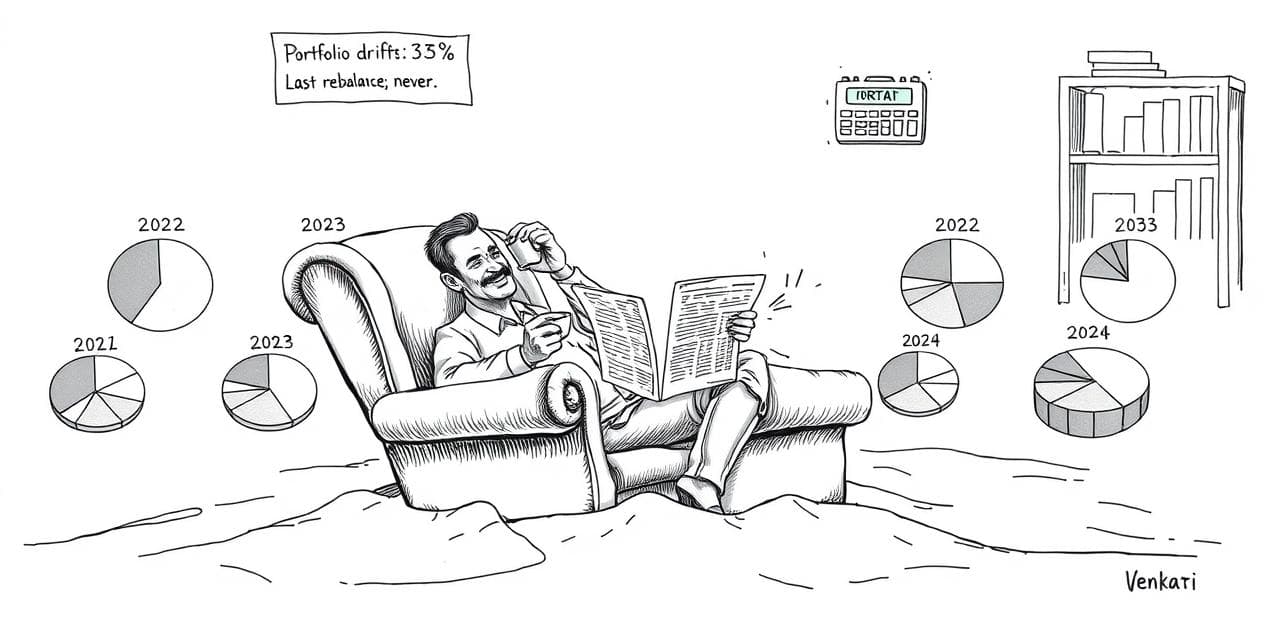

When was the last time you actually looked at your portfolio?
Not opened the app to check the current value. That doesn't count. When did you last evaluate whether each holding still belongs there? Whether your original thesis for buying Tata Motors at ₹480 still applies now that it trades at ₹620? Whether the three large-cap SIPs you started in 2022 have drifted into 70% overlap?
If your honest answer is "I don't remember," you are not exercising patience. You are exhibiting status quo bias, one of the most expensive and least discussed behavioural patterns in Indian retail investing.
What is status quo bias, and why does it cost you money?
In 1988, economists William Samuelson and Richard Zeckhauser ran a series of experiments that proved something uncomfortable: when people are presented with a decision that has a default option, they overwhelmingly stick with the default. Not because it was better. Because it was already there.
They called it status quo bias. The irrational preference for the current state of things, regardless of whether the current state is optimal.
In investing, this bias has a specific and measurable cost. Your portfolio is not a static object. Markets move. Sectors rotate. Companies issue new guidance, lose market share, face regulatory action. The allocation you set 18 months ago is not the allocation you hold today, because price movements have changed the weightings.
Say you built a 60/40 equity-debt portfolio in January 2024. By March 2026, after Nifty's run-up and subsequent correction, your actual allocation might be 72/28 or 53/47, depending on which months hit hardest. Neither of those is the portfolio you designed. Both carry risk profiles you never approved.
The investor who reviews and adjusts is managing risk. The investor who doesn't open the allocation tab is drifting. Status quo bias makes the second investor feel like they are being disciplined. They are not. They are frozen.
This is not the same as the disposition effect, where you actively sell winners and hold losers. Status quo bias is quieter. You do nothing at all. You hold everything, winners and losers alike, not out of analysis but out of inertia.
Why does your brain prefer doing nothing?
Three psychological mechanisms drive status quo bias in portfolio decisions.
Loss aversion is the first. Daniel Kahneman and Amos Tversky established that the pain of a loss is roughly twice as powerful as the pleasure of an equivalent gain. When you consider selling a stock to rebalance, your brain frames the potential downside ("what if it goes up after I sell?") more heavily than the potential upside ("what if I reallocate to something better?"). The safest emotional choice is to do nothing. So you do nothing.
Decision fatigue is the second. The average Indian investor on Zerodha holds 8-12 stocks and 3-5 mutual funds. Reviewing each position, checking fundamentals, comparing alternatives, calculating tax implications: this is real work. Your brain, which conserves energy by default, offers a shortcut: "Everything is probably fine. I'll check next month." Next month becomes next quarter. Next quarter becomes next year.
Regret avoidance is the third, and the most dangerous. If you rebalance and the change turns out poorly, you feel active regret: "I made a bad decision." If you do nothing and the portfolio drifts, you feel passive regret, which research shows is psychologically much easier to tolerate. "The market did it, not me." This asymmetry means your brain systematically favours inaction, even when inaction is the worse financial choice.
A 2024 study published in the International Journal of Finance and Management Research found that behavioural biases, including status quo bias, significantly affect the decision-making quality of Indian retail investors, with less financially literate investors being more susceptible.
How does status quo bias look in an Indian portfolio?
Here are three patterns that PortoAI's portfolio checkup flags routinely.
Pattern 1: The forgotten SIP. You started a SIP in Axis Bluechip Fund in 2021 because a colleague recommended it. The fund was in the top quartile that year. In 2023, the fund manager changed. In 2024, the fund underperformed its benchmark by 2.3%. You are still running the same SIP in March 2026. Not because you evaluated the new fund manager and decided to stay. Because you never checked.
Your SIPs may also be more concentrated than you think. Most large-cap funds in India hold the same top 20 stocks in different proportions, and running five SIPs does not mean you are diversified. Status quo bias prevents you from even discovering the overlap.
Pattern 2: The dead stock. You bought 50 shares of Vodafone Idea at ₹12 in 2020, convinced the government bailout would turn the company around. The stock is at ₹7 in 2026. The position is worth ₹350. It sits in your demat account, costing you nothing in absolute terms but occupying mental bandwidth and distorting your view of portfolio performance. You haven't sold because selling would mean admitting the thesis was wrong. Status quo bias keeps the dead stock alive.
This is distinct from averaging down gone wrong, where you actively add to a losing position. With status quo bias, you simply leave it there. No action. No review. No decision.
Pattern 3: The drifted allocation. You decided in 2023 that your risk tolerance warranted 30% in mid-and-small caps, 50% in large caps, and 20% in debt. Markets moved. Your mid-cap holdings rallied 40%. Your large-cap funds returned 12%. Your debt returned 7%. Without rebalancing, your actual allocation is now 38% mid-and-small, 46% large, 16% debt. You are carrying 27% more mid-and-small-cap risk than you signed up for. When the next correction hits and your portfolio falls harder than Nifty, the reason will not be the market. It will be the rebalancing you never did.
How do you tell the difference between patience and paralysis?
Patience is a decision. Paralysis is the absence of one.
Here is a test. For every holding in your portfolio, answer these three questions:
-
Why did I buy this? State the original thesis in one sentence. "Reliance because the Jio platform creates a digital ecosystem moat." "Parag Parikh Flexi Cap because of global diversification and low expense ratio." If you cannot articulate the thesis, you are holding the position out of inertia, not conviction.
-
Has the thesis changed? Check the last two quarterly results. Read the management commentary. Has the company's competitive position shifted? Has the fund's strategy or manager changed? If yes, your thesis needs re-evaluation regardless of whether the price has gone up or down.
-
Would I buy this today at the current price? This is the most powerful status quo bias test. If you would not buy the stock at today's price with today's information, holding it is not patience. It is inertia. The fact that you already own it should not change your analysis. Your purchase price is irrelevant to the forward decision, and thinking otherwise is anchoring bias compounding your status quo bias.
If you failed any of these questions for any holding, that is not a character flaw. It is status quo bias doing exactly what Samuelson and Zeckhauser described: making the default option feel safer than any alternative.
The fix is not willpower. The fix is a system that removes the decision barrier.
How does PortoAI break the status quo bias loop?
Status quo bias persists because the review process is manual, effortful, and emotionally loaded. You have to open the app, pull up each holding, look up fundamentals, compare against benchmarks, calculate tax implications, and then make a decision that might prove wrong. Every step is a friction point. Every friction point is an opportunity for your brain to say "not today."
PortoAI eliminates the friction by connecting directly to your Zerodha and Groww accounts and running the review automatically. The portfolio checkup identifies:
Allocation drift. If your equity-debt split has moved more than 5% from your stated target, PortoAI flags it. You don't need to remember what your target was or calculate the current split. The system does both.
Stale positions. Holdings that have not been reviewed in 90+ days get flagged. This is not a judgment on the holding itself. It is a nudge to confirm that your thesis still applies. If it does, great. If it doesn't, now you know.
Sector concentration. Your portfolio may have quietly drifted into 35% financial services exposure because HDFC Bank, ICICI Bank, Bajaj Finance, and SBI are in four of your five funds. PortoAI's SIP overlap analysis catches this before a sector-specific downturn makes it obvious.
Behavioural fingerprint patterns. PortoAI tracks whether you tend to avoid portfolio changes during volatile periods, which is when rebalancing is most needed. If your behavioural fingerprint shows a pattern of freezing during drawdowns, the system flags it. The pattern becomes visible, which makes it breakable.
The academic literature is clear: status quo bias is strongest when the decision requires effort and the default option is "do nothing." PortoAI flips this by making "do nothing" the option that requires effort. When an alert arrives saying your mid-cap allocation has drifted 8% above target, ignoring it is now a conscious choice, not a passive one. That shift, from unconscious inaction to conscious decision, is where the bias breaks.
Your portfolio hasn't been reviewed in a while. Connect your Zerodha or Groww account and let PortoAI show you what drift looks like in your actual holdings.
Try PortoAI FreeYou set up your portfolio with a plan. Status quo bias erodes that plan slowly, silently, one unreviewed month at a time. The cost doesn't show up as a single bad trade. It shows up as a portfolio that no longer matches the risk you intended, the goals you set, or the market that exists today.
The fix is not to become a compulsive trader. Overtrading is its own expensive problem. The fix is a quarterly review, triggered automatically, that forces you to confirm each holding still earns its place. Not because you feel like it. Because the system makes it happen.
Open your portfolio right now. Pick one holding you haven't thought about in three months. Ask yourself: would I buy this today? If the answer is no, that gap between what you hold and what you would choose is the exact cost of status quo bias.
Frequently Asked Questions
What is status quo bias in investing?
Status quo bias is the irrational preference for keeping your portfolio unchanged, even when market conditions, your risk profile, or your financial goals have shifted. First identified by Samuelson and Zeckhauser in 1988, the bias causes investors to confuse inaction with patience. In Indian markets, this shows up as holding the same stocks and mutual funds for years without reviewing whether they still serve your original investment thesis.
How does status quo bias affect my mutual fund SIPs?
Status quo bias causes SIP investors to keep running the same monthly contributions into funds they selected years ago, without checking whether those funds still perform, whether they overlap with other holdings, or whether their asset allocation has drifted from the original plan. A SIP set in 2021 during a bull market may now overweight sectors that have underperformed, but the bias prevents you from reviewing and adjusting.
What is the difference between patience and status quo bias?
Patience is a deliberate decision to hold an investment because your original thesis remains valid and the fundamentals haven't changed. Status quo bias is holding an investment because changing it feels uncomfortable, even when the reasons you bought it no longer apply. The test: can you state your thesis for each holding right now? If not, that's not patience.
How often should I rebalance my portfolio in India?
Most financial research suggests reviewing your portfolio allocation quarterly and rebalancing when any asset class drifts more than 5-10% from your target allocation. In India, tax considerations (STCG at 20% for equity held under 1 year, LTCG at 12.5% above ₹1.25 lakh) should factor into the timing, but they should not be an excuse for never rebalancing. The cost of permanent drift typically exceeds the tax cost of rebalancing.
Can AI help overcome status quo bias in investing?
Yes. AI tools like PortoAI connect to your Zerodha and Groww accounts and automatically flag when your portfolio has drifted from your target allocation, when holdings have been inactive for extended periods, or when sector concentration has quietly built up. Automated alerts remove the emotional barrier of self-initiating a portfolio review, which is the core mechanism through which status quo bias operates.
Why is doing nothing with my portfolio risky?
Doing nothing allows your portfolio allocation to drift with market movements. A 60/40 equity-debt split can become 72/28 after a bull run, exposing you to far more equity risk than you intended. It also means you continue holding positions whose investment thesis may have changed: a fund manager departure, a regulatory shift, a company losing competitive advantage. The risk of inaction compounds quietly until a market correction makes the drift painfully visible.