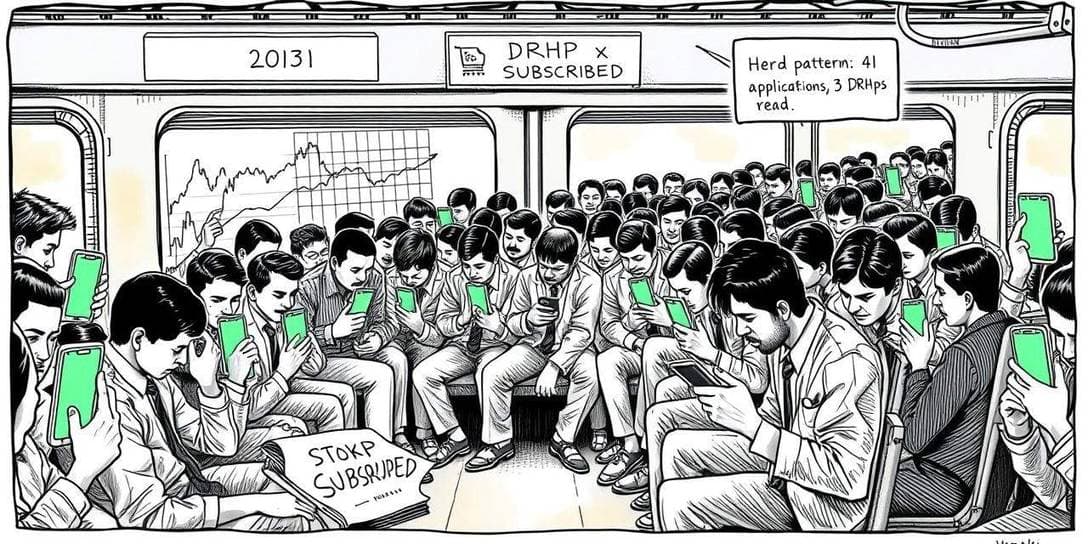

The average SME IPO in India received 213,000 retail applications in FY 2024-25.
In FY 2015-16, that number was 299.
Companies issuing these IPOs have not become 712 times more valuable. Due diligence required has not become 712 times easier. A DRHP still runs 200-plus pages of dense legal and financial text. What changed is one thing: the signal that retail investors use to decide whether to apply.
That signal is not the business. It is the crowd.
The Numbers That Should Make You Pause
According to research published in the RBI Bulletin using Prime Database Group data, the explosion in SME IPO retail participation since 2020 is not driven by a corresponding improvement in SME business quality or transparency. The data shows:
- Average retail applications per SME IPO: 299 in FY 2015-16, rising to 213,000 in FY 2024-25
- 243 SME IPOs were listed on Indian exchanges in 2024, raising over Rs 9,000 crore
- Average listing gains on SME IPOs grew to 76.8% vs the historical 5-10% range in 2015-2021
That last number looks impressive until you follow it forward. Top 10 most retail-subscribed SME IPOs of 2024 are down an average of roughly 40% from their 52-week highs. Listing gain and long-term return are not the same number. Retail investors who missed allotment and bought on listing day often received neither.
HOAC Foods India was subscribed 2,013 times. Kay Cee Energy was subscribed 1,052 times. Both of these numbers indicate that for every single share available to retail investors, more than a thousand applicants competed for it. Most did not get allotted. Many of those who didn't applied again in the next IPO. And the next one.
This is not investing. It is a lottery habit with a financial packaging.
Oversubscription measures how many people wanted in. It does not measure whether the business deserves to be in your portfolio. When 500 people apply for one share, it creates the appearance of consensus: "everyone is applying, there must be something there." That consensus is self-referential. Applicant 500 is using the 499 others as their research. Applicant 1 may have used the 100 people who said they were applying on a Telegram channel.
A 500x subscribed IPO can fall 50% within six months if the underlying business does not generate free cash flow, expand margins, or scale in the way the issue price implies. Oversubscription at listing is a mood reading, not a business valuation.
Why Does Oversubscription Feel Like Social Proof?
Robert Cialdini's concept of social proof, the human tendency to look at what others are doing when uncertain what to do ourselves, applies cleanly to IPO behavior in India.
Three conditions make social proof especially powerful:
- Uncertainty about the right decision
- Similarity between yourself and the people you're observing
- Scarcity, the sense that not acting will result in missing out
IPO applications score maximum points on all three. Most retail applicants cannot independently value a company issuing an IPO. They look at what others are doing. Fellow Zerodha users, Reddit members, Telegram group members: people just like them. And the subscription window creates a hard deadline. Apply now or miss the listing gain entirely.
Under these conditions, following the crowd is not irrational. It is a predictable response to a deliberately engineered environment. IPO mechanisms are designed to sell shares, not to filter for business quality. Book-building sets a price that maximizes issuer fundraising. Subscription frenzy is a distribution mechanism, not a quality signal.
When the crowd is the signal, and the crowd is itself following other crowds, no one in the chain has done the original analysis. Oversubscription numbers are laundered noise presented as consensus.
Reliance Power: A Lesson the Crowd Keeps Forgetting
In January 2008, Reliance Power opened its IPO at a retail price of Rs 450 per share. Subscribed 72 times. Bids worth Rs 7.5 lakh crore were placed for a company raising Rs 11,700 crore. Reportedly, the subscription window sold out in the first minute.
According to Zee Business records, Rs 10,000 invested at the IPO price and held for ten years became Rs 1,636. An 84% loss in real terms, excluding inflation.
Reliance Power was not a scam in the conventional sense. It was a company that issued stock at a price its business could not justify, supported by a promotional infrastructure that made the oversubscription look like market validation. Markets were not validating the business. Markets were reflecting retail FOMO at industrial scale.
Sixteen years later, the conditions that produced Reliance Power's IPO frenzy, Telegram channels, social media amplification, retail brokerage apps, and short subscription windows, are stronger than they have ever been. The scale is different. The mechanism is identical.
Every IPO cycle produces its Reliance Power equivalents. They do not announce themselves as such. They arrive with 800x subscriptions and finfluencer endorsements.
The mechanics are straightforward, and understanding them demystifies why the "everyone is applying" signal does not protect you.
When a highly oversubscribed IPO lists, several things happen simultaneously. Allotted investors who applied purely for listing gains sell immediately. This creates heavy selling pressure at or near the listing price. Investors who didn't get allotment and tracked the subscription numbers frantically buy on listing day, believing they are buying into confirmed demand. They are actually buying the shares that the lucky allottees are selling. The allottees capture the listing pop. The FOMO buyers absorb it.
Once this initial transfer is complete, the remaining buyer base is whoever believes in the business at the listing price. If the issue price already reflected optimistic assumptions, the business must perform above those assumptions just to hold the listing level. Most do not. The stock drifts down. The cycle completes.
A peer-reviewed study published in the journal Applied Financial Economics via Taylor & Francis in 2025 found that finfluencer-backed IPOs show significantly higher initial returns driven by retail herding and overreaction, with subsequent mean reversion as fundamentals reassert. The initial pop is real. The sustainability is not.
The SME Segment Makes This Worse
Mainboard IPOs have disclosure requirements, track records, and institutional investor scrutiny that provide partial quality filtering. SME IPOs have lower disclosure bars, shorter required track records, and smaller float, which means institutional participation is limited and price discovery after listing depends heavily on retail behavior.
Post-listing liquidity in SME stocks is thin. A company that raised Rs 30 crore in its IPO has a small free float. A single large buyer or seller can move the price dramatically. Market makers on BSE SME and NSE Emerge provide some liquidity support for three years post-listing, but after that the company is on its own. Retail investors who bought at listing highs and held for two years are in a market with very limited exit options if the story has not played out.
The combination of thin liquidity, high initial valuations, low disclosure standards, and short lock-in periods for promoters creates a structural incentive for promoters to maximize the IPO price. Their equity is locked in for six months initially, but after that they can exit. Your allotment is permanent unless you sell. The asymmetry matters.
Understanding the allotment mechanism changes how you think about the subscribe decision.
For retail individual investors (RII) applying at the minimum lot size, SEBI's rules require that when an IPO is oversubscribed in the RII category, allotment is done by computerized lottery. The maximum allotment per applicant is one lot until all applicants have received one lot. After that, remaining shares are distributed by lot among those who applied for larger sizes.
At 500x oversubscription in the RII category, roughly 1 in 500 retail applicants at minimum lot size receives shares. Your probability of getting allotted is 0.2%. You are not investing in a business. You are buying a lottery ticket with an unpredictable payout date.
The rational case for this lottery strategy is: your capital is only locked for three to five business days (application to refund), the listing gain probability is better than most lotteries, and the downside is close to zero if you sell on listing day. This logic holds if you actually sell on listing day. It does not hold if you hold beyond listing day because of the disposition effect and the anchoring of your purchase price to the issue price.
Most retail IPO applicants do not have a written rule about when they will sell. They apply, get excited if allotted, and make the exit decision emotionally in real time.
What Does Your IPO Application History Say About You?
Count the number of IPOs you applied for in the last 12 months.
Now count the number you read the DRHP for. Not the GMP tracker. Not the subscription numbers. The actual document.
The gap between those two numbers is your herd exposure score. Every application made without reading the DRHP is an application made on crowd signal. You are outsourcing your financial decision to everyone else who is outsourcing their decision to everyone else. The chain terminates at the GMP (grey market premium) or the influencer who is compensated, directly or indirectly, for creating application volume.
When you connect your Zerodha or Groww account to PortoAI, the behavioral fingerprint analysis looks at your IPO application history alongside your post-listing outcomes. If you applied for 20 IPOs and held positions in 15 of them past listing day, and the P&L on those held positions is negative, that is a specific behavioral signature: you apply for the lottery, get allotted, develop attachment to the position, and convert a short-term trade into an accidental long-term hold in a poor business.
PortoAI shows you that sequence, not as a moral judgment, but as a pattern with a cost attached to it in rupees.
How to Evaluate an IPO Without the Herd
The alternative to herd-based IPO applications is not ignoring IPOs. It is applying the same framework you would use for any other stock purchase:
One: Read the DRHP's objects of the issue. This section tells you what the company is doing with your money. If more than 30% goes toward repaying promoter debt or paying offer expenses rather than growing the business, pause. You are funding an exit, not a business.
Two: Check the promoter's background. DRHP disclosures include cases against the promoter. SME IPOs in particular have had several instances of promoters with prior fraud or default history. This is disclosed. It is just not in the GMP.
Three: Compare the valuation to listed peers. If the IPO is priced at 40x PE and its listed comparable trades at 18x PE, you need a specific reason for that premium. The subscription number is not a reason.
Four: Decide your exit before you apply. "I will sell on listing day if allotted" is a valid thesis. "I will hold if the business grows to X over Y years" is also valid. "I will sell when I feel like it" is how allotted lottery tickets become unintended long-term positions in weak businesses.
PortoAI's IPO Research feature runs the first three checks automatically: it evaluates the use of funds, promoter history, peer valuation, and sector context before you apply. It does not give you a buy or sell recommendation. It gives you a structured way to form your own view without deferring to the crowd.
This is how you break the FOMO cycle that runs through most Indian retail IPO decisions. Not by never applying, but by applying with a thesis instead of a lottery ticket.
The 712x Is a Behavioral Data Point, Not a Market Metric
India's SME IPO market has grown enormously. That growth reflects genuine capital formation happening outside the large-cap universe. Many of these companies are real businesses with real customers and real cash flows.
The problem is not the market. The problem is the signal retail investors are using to participate in it.
Oversubscription measures crowd interest. Crowd interest measures social contagion. Social contagion does not measure business value. When you apply because 800x subscription makes it feel safe, you have chosen the least informative signal available and weighted it most heavily.
Every behavior that costs Indian retail investors money at scale, overtrading driven by excitement, holding losers past the point of analytical justification, chasing momentum into crowded trades, has the same root mechanism: the crowd replaces individual analysis as the decision input.
IPO oversubscription is simply one of its more visible forms. The subscription number is public, dramatic, and emotionally compelling. It does exactly what it looks like it does: it makes you apply.
The fix is not contrarian posturing. It is not refusing to apply for any oversubscribed IPO on principle. The fix is adding one step before the application that takes five minutes: opening the DRHP, reading the objects of the issue and the financial summary, and deciding whether this specific business at this specific price makes sense for you, independent of how many others have already pressed subscribe.
Check if your IPO application history shows a herd pattern. Connect your Zerodha or Groww account to PortoAI and see your behavioral fingerprint across past IPO decisions.
Try PortoAI FreeFrequently Asked Questions
Is oversubscription a good sign for an IPO?
Not by itself. Oversubscription tells you how many people applied, not whether the business is good. India's most oversubscribed SME IPOs of 2024, including HOAC Foods at 2,013x and Kay Cee Energy at 1,052x, attracted hundreds of thousands of retail applications. Many of those names are significantly below their 52-week highs. Oversubscription measures crowd behavior, not business quality. Use it as one data point alongside the DRHP, promoter track record, and peer valuation.
Why do oversubscribed IPOs fall after listing?
When an IPO is heavily oversubscribed, most applicants don't receive an allotment. Those who do get allotment often sell on listing day to capture the listing gain. That selling pressure, combined with investors who missed the allotment buying on listing day out of FOMO, creates a brief price spike followed by a correction as excitement fades and only fundamental buyers remain. If the business does not justify the issue price valuation, the stock drifts lower from listing day onward.
How is allotment done in oversubscribed IPOs in India?
For retail investors applying at the minimum lot size, allotment is done by computerized lottery when an IPO is oversubscribed in the RII category. SEBI requires that every qualified applicant at minimum lot size has an equal probability of receiving one lot before anyone receives a second. At 500x oversubscription, roughly 1 in 500 retail applicants receives shares. Your capital is locked for three to five business days during the process, and if not allotted, it is refunded in full.
Are SME IPOs safe to invest in?
SME IPOs carry higher risk than mainboard IPOs for several reasons: smaller companies with shorter track records, lower liquidity post-listing (market maker support ends after 3 years), quicker promoter lock-in expiry, and less stringent disclosure requirements. Average listing gains grew to 76.8% recently vs the historical 5-10%, which attracts more speculative retail capital and amplifies post-listing volatility. Apply a stricter personal due-diligence standard because the regulatory safety net is thinner than on mainboard.
What is the difference between SME IPO and mainboard IPO?
A mainboard IPO lists on BSE/NSE with a minimum post-issue paid-up capital requirement of Rs 10 crore, three years of audited financials, and stricter SEBI disclosure norms. An SME IPO lists on BSE SME or NSE Emerge with a lower financial threshold and targets companies raising up to Rs 25 crore (extended for some). Institutional investor participation is lower in SME IPOs, which means retail behavior dominates price discovery post-listing. The due diligence burden shifts to you.
Can PortoAI analyze an IPO before I subscribe?
Yes. PortoAI's IPO Research feature evaluates an IPO's financials, promoter history, use of funds, peer valuation, and sector context before you apply. It gives you a structured view of whether the business justifies the issue price, independent of the oversubscription signal. Connect your Zerodha or Groww account and the behavioral fingerprint analysis also shows you your past IPO application patterns alongside post-listing outcomes, so you can see whether your previous IPO decisions were based on research or crowd behavior.