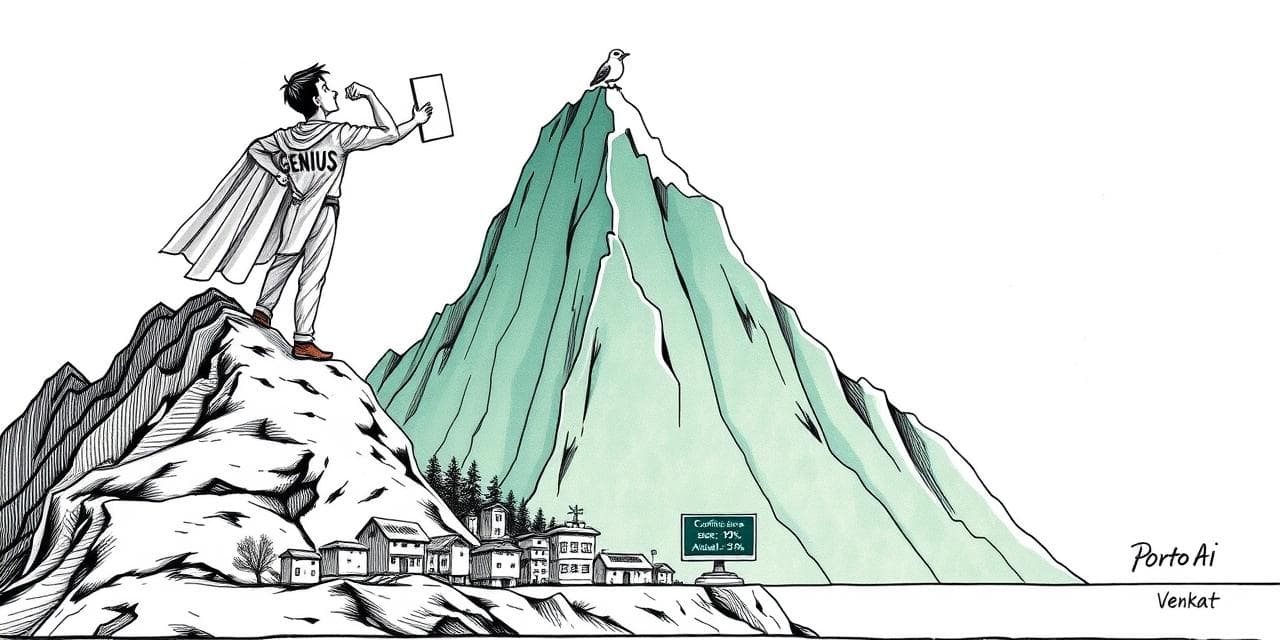

You made ₹2 lakh in your first six months of trading. You told your friends. You started a WhatsApp group called "Market Warriors." You moved from mutual funds to direct equity. Then from equity to options. You stopped reading analyst reports because you were doing better than the analysts.
You were not getting better at investing. The market was going up.
This is the Dunning-Kruger effect, and it has destroyed more Indian retail portfolios than any single stock crash. A study on cognitive biases in Indian stock markets identifies overconfidence as one of the dominant behavioural biases affecting investment decisions. The bias is simple: people with limited competence in a domain overestimate their ability. In investing, bull markets create the perfect conditions for this overestimation to flourish, because the market rewards bad decisions as generously as good ones. Everything goes up. Everyone feels like a genius.
Then the market stops going up. And the genius disappears.
Why Does the First Bull Run Create the Most Dangerous Investors?
India opened 7.7 crore new demat accounts in 2021. Most of these accounts were opened by investors who had never experienced a bear market. Their entire frame of reference was a market recovering from March 2020 lows and reaching all-time highs through 2021.
Think about what that teaches you. Every dip was a buying opportunity. Every stock you picked recovered. Holding through volatility worked. Averaging down worked. The lesson was: trust your instincts, because your instincts are profitable.
Except your instincts were not profitable. The market was profitable. You were a passenger who thought they were driving.
This is not a metaphor. Research on the Dunning-Kruger effect in trading shows that early market success is the strongest predictor of future overconfidence-driven losses. The mechanism is precise: profits you attribute to your skill become the justification for taking larger, more concentrated, less researched bets.
The progression follows a predictable four-stage pattern.
Stage 1: Unconscious incompetence. You open a Zerodha account, buy Reliance and TCS because you recognize the names, and make money because Nifty rose 20% that year. You don't know what you don't know. You think investing is easy because your limited experience confirms it.
Stage 2: Peak overconfidence. You have a year of profits. You start trading weekly options on Bank Nifty because a YouTube channel made it look simple. You move from 2 trades a month to 15 trades a week. You tell colleagues at lunch that you "understand market psychology." This is the peak of the Dunning-Kruger curve. Maximum confidence, minimum competence.
Stage 3: The crash. A correction wipes 30% of your portfolio. You average down. The market falls further. You hold. It falls further. You start selling at losses to meet margin calls. The total damage is 3x what it would have been if you had respected your own ignorance.
Stage 4: Conscious competence (for the survivors). Some investors learn from the crash. They start tracking their actual XIRR returns against benchmarks. They discover their "skill" was the market and begin building a genuine process. Many never reach this stage. They leave the market with losses they attribute to "bad luck," never connecting the outcome to overconfidence.
What Does Overconfidence Look Like in Your Trade Data?
You cannot self-diagnose overconfidence. That is the entire point of the bias: overconfident people believe they are not overconfident. The only reliable diagnosis comes from your trade history, analysed objectively.
PortoAI's behavioral fingerprint tracks five specific metrics that correlate with Dunning-Kruger driven behaviour.
If you traded 5 times in January, 12 times in February, and 23 times in March, and each month was profitable, you have a textbook overconfidence ramp. Your brain has learned that more trades equals more money. In reality, you got lucky on all 23 trades in March because the sector you were trading happened to be in a momentum phase.
PortoAI's overtrading detection catches this acceleration pattern before it becomes catastrophic. The system compares your current trade frequency against your own historical baseline, not against an arbitrary threshold. If you are trading 3x your normal frequency, something has changed in your behaviour, and it is usually not a sudden improvement in your analysis.
An overconfident investor doesn't just trade more often. They bet bigger. After a string of wins, the position that was 5% of the portfolio becomes 15%. The stop-loss that was at 8% becomes "I'll hold, it always comes back." The concentration that was distributed across 12 stocks collapses into 4, because you have "high conviction" on these names.
This is measurable. Your portfolio's sector concentration relative to your stated risk tolerance reveals whether conviction is driving your allocation or overconfidence is. If you went from holding stocks across 6 sectors to holding 70% in one sector over the span of 3 months, that is not conviction. That is the Dunning-Kruger effect in real time.
New investors use stop-losses because they are afraid. Overconfident investors stop using them because they "know" the stock will recover. This is one of the most expensive behavioural shifts PortoAI detects. Stop-loss removal after a profitable streak is a leading indicator of large drawdowns. You are removing your safety mechanism precisely when you need it most: right before the market proves you wrong.
How Do You Know the Difference Between Skill and a Bull Market?
Simple. Compare your returns against the benchmark for the same period.
If Nifty 50 TRI returned 25% and your portfolio returned 22%, your stock-picking activity subtracted 3% of value. You would have done better with a ₹500 SIP into a Nifty index fund. The effort, the stress, the market-watching, the YouTube tutorials: all of it produced negative alpha.
Most Indian retail investors have never done this comparison. A SEBI study from September 2024 found that 93% of individual F&O traders lost money between FY22 and FY24, with aggregate losses exceeding ₹1.8 lakh crore. These are not people who thought they were losing money. Many of them believed they were profitable because they counted their winning trades and forgot their losing ones.
This selective memory is the Dunning-Kruger effect's favourite tool. You remember the ₹40,000 you made on Tata Motors. You forget the ₹1.2 lakh you lost on three options trades the same month. Your brain presents a highlight reel, and you mistake it for the full movie.
Absolute returns lie. If you invested ₹5 lakh over 18 months at different times and your portfolio shows ₹5.6 lakh, you might think you made ₹60,000. But when did you invest each tranche? If you put ₹3 lakh at the top and ₹2 lakh at the bottom, your time-weighted return could be excellent. If you put ₹4 lakh at the top and ₹1 lakh at the bottom, your actual return is mediocre despite the same absolute number.
XIRR accounts for the timing and size of every cash flow. PortoAI calculates this automatically from your Zerodha or Groww data. The number is usually lower than what investors expect, and that gap between expectation and reality is the Dunning-Kruger effect measured in percentage points.
The F&O Escalation Trap: Where Overconfidence Becomes Expensive
The most dangerous manifestation of the Dunning-Kruger effect in Indian markets is the equity-to-F&O escalation. It follows a specific pattern.
Month 1-6: Investor buys equity, makes money in a bull market. Month 7-12: Investor decides equity returns are "too slow." Moves to futures for bigger returns. Month 13-18: Investor discovers options. Weekly Bank Nifty expiry becomes a Thursday ritual. Month 19-24: Investor has lost more in F&O than they ever made in equity. But they keep going because "the next trade will recover it."
This is not a hypothetical. It is the median trajectory of F&O account blowups. PortoAI's casino mode alert triggers when it detects this escalation pattern: increasing trade frequency, shrinking holding periods, rising margin exposure, and the characteristic "double down after loss" pattern that distinguishes gambling from trading.
Because markets charge tuition in real rupees. "Learning by doing" in F&O means paying ₹50,000 per lesson, and the lessons are: you should have learned this in simulation first.
The Dunning-Kruger effect makes "learning by doing" feel rational. You believe your equity experience transfers to options. It does not. Options pricing involves Greeks, time decay, implied volatility, and liquidity dynamics that equity investing never taught you. But overconfidence convinces you that your 12 months of equity profits qualify you for a derivative instrument that most professional traders also lose money on.
What Separates Overconfident Investors From Genuinely Skilled Ones?
Skilled investors share three characteristics that overconfident investors lack entirely.
They track what went wrong, not just what went right. A skilled investor keeps a trade journal with entry thesis, exit thesis, and post-mortem. They review their losing trades with the same attention they give their winners. An overconfident investor screenshots their winning positions for WhatsApp but never mentions the four losers from the same week.
They compare against benchmarks, not against zero. A skilled investor knows that making 15% in a year when Nifty returned 18% means they destroyed value. An overconfident investor celebrates the 15% because it is a positive number and the FD rate is 7%.
They know what they don't know. A skilled investor can articulate the three biggest risks to their portfolio. An overconfident investor says "the market always goes up long term" and treats that statement as a risk management strategy. It is not. It is a prayer.
How Does PortoAI's Behavioral Fingerprint Detect Overconfidence Before It Costs You?
PortoAI connects to your Zerodha or Groww account via read-only API and analyses your actual trade history. No self-reporting. No questionnaires. Just data.
The behavioral fingerprint looks for the specific signature of overconfidence:
Rising trade frequency after profitable periods. If your trading activity spikes after wins but stays flat after losses, you are not responding to market conditions. You are responding to dopamine. The system flags this asymmetry and shows you the correlation between your mood-driven trades and your worst losing streaks.
Position size inflation. When your average position size grows 2x or 3x over a quarter without a corresponding increase in your total portfolio value, you are betting bigger without earning the right to. PortoAI tracks this ratio and alerts you when it crosses your historical baseline.
Sector concentration drift. Overconfident investors migrate toward concentration. They find a sector that worked, assume it will keep working, and pile in. PortoAI's sector concentration analysis surfaces this drift before the inevitable sector rotation catches you off guard.
The "cooling period" trigger. When PortoAI detects a pattern consistent with emotional trading, whether from revenge trading after losses or overconfident betting after wins, it triggers a cooling period recommendation. This is not a block. It is a data-backed intervention that says: your behaviour in the last 48 hours matches the pattern that historically costs you money. Pause.
Five Questions to Ask Yourself Right Now
You cannot diagnose the Dunning-Kruger effect from the inside. But these five questions get close.
-
What is your XIRR for the last 12 months, compared to Nifty 50 TRI? If you don't know, that is the first problem. If you do know and it is below the benchmark, your confidence is unearned.
-
How many of your last 20 trades had a written thesis before you entered? Not "I heard it's good" or "the chart looked right." A written statement of why, with a target price and a stop-loss. If fewer than 5, you are trading on impulse and calling it analysis.
-
Have you ever admitted to someone that a trade was a mistake while you were still in it? Overconfident investors hold losers and say "it's a long-term investment now." Honest investors say "I was wrong" and exit.
-
Did your trade frequency increase in the last quarter? If yes, was it because you identified more opportunities, or because the previous quarter was profitable and you felt emboldened?
-
Can you name three things about investing that you do not understand well? If you cannot, you are either an expert (unlikely) or you are at the peak of the Dunning-Kruger curve (very likely).
The Real Cost Is Not the Money You Lost
The money is recoverable. The lost time is not.
An investor who spends 3 years overtrading based on misplaced confidence could have spent those 3 years learning, building a process, and compounding returns through disciplined SIPs. The opportunity cost of overconfidence is not just the ₹3 lakh you lost in F&O. It is the ₹8 lakh your portfolio would be worth today if you had invested that same capital systematically and never touched it.
PortoAI's portfolio analysis shows you both numbers: what happened, and what would have happened if you had followed a disciplined approach instead. That gap, between your actual returns and your potential returns, is the most honest price tag on overconfidence.
See what your trade history reveals about overconfidence. Connect your Zerodha or Groww account to PortoAI.
Try PortoAI FreeFrequently Asked Questions
What is the Dunning-Kruger effect in stock market investing?
The Dunning-Kruger effect in investing is a cognitive bias where traders with limited experience overestimate their ability to pick stocks, time the market, or manage risk. It peaks after early wins in a bull market, when rising prices make every decision appear brilliant. The investor mistakes market conditions for personal skill, leading to concentrated bets, excessive trading, and rejection of expert advice.
How does the Dunning-Kruger effect affect Indian retail investors?
India opened 7.7 crore demat accounts in 2021 alone, mostly during a historic bull run. Many new investors made money on their first trades simply because nearly everything was rising. This created a generation of investors who equate market participation with market expertise. When corrections come, these overconfident investors tend to average down aggressively, overtrade in F&O, and ignore stop-losses, resulting in outsized losses.
Can AI detect overconfidence in my trading behaviour?
Yes. PortoAI's behavioral fingerprint tracks patterns associated with overconfidence: rising trade frequency, increasing position sizes after wins, shrinking diversification as you concentrate in fewer stocks, and reduced use of stop-losses. These metrics are invisible to you in real time but clearly visible in your historical data. The system flags when your behaviour shifts from disciplined to reckless.
What are the signs of Dunning-Kruger effect in my portfolio?
Five warning signs: you increased your trading frequency after early profits; you stopped using stop-losses because your picks always work out; you moved from mutual funds to direct equity to F&O within months; you dismiss professional analysts as too conservative; and you added margin trading before understanding basic risk management. If three or more apply, overconfidence is driving your decisions.
How do I avoid the Dunning-Kruger effect in investing?
Track your actual XIRR, not just absolute returns. Compare against Nifty 50 total return index for the same period. If you underperformed the benchmark, your stock-picking added negative value despite feeling productive. Journal every trade with your thesis and review it quarterly. The gap between what you expected and what happened is the most honest measure of your skill.
Why do new investors lose money after a bull run ends?
New investors who entered during a bull run learned behaviour that only works in rising markets: buying dips, averaging down, holding through volatility, ignoring valuations. When the market regime changes, these habits become liabilities. SEBI's 2024 study found 93% of individual F&O traders lost money between FY22 and FY24, a period that included both rally and correction phases.