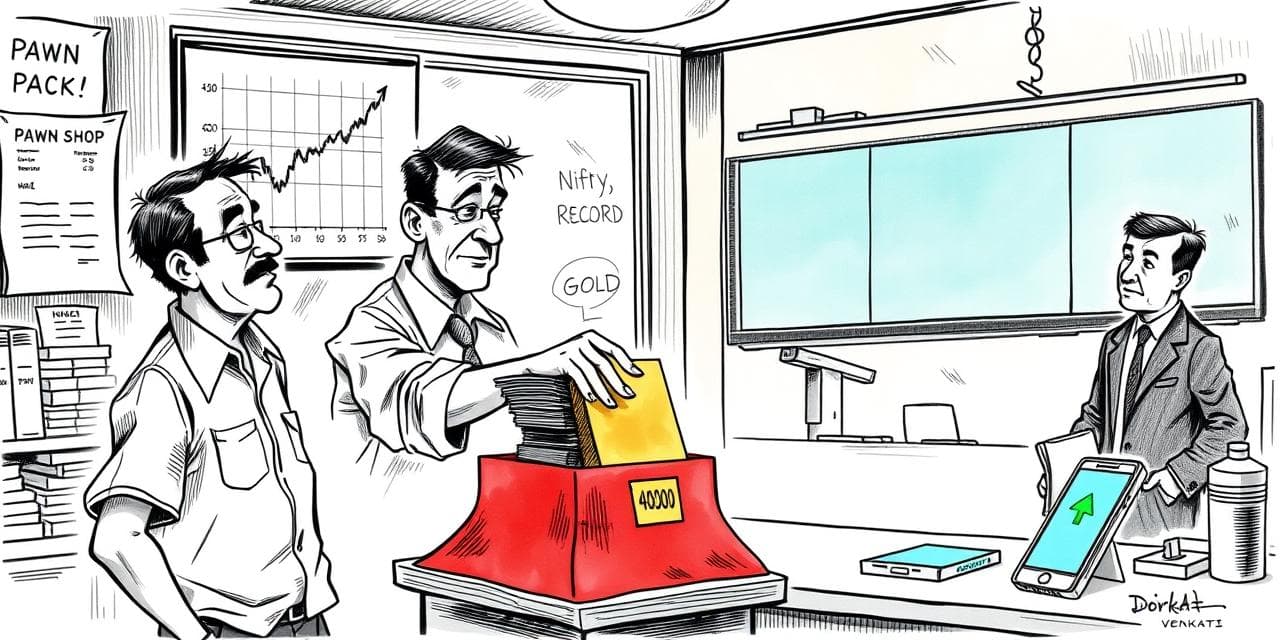

You sold Nifty stocks after a 12% crash. Then you opened Groww and bought a gold ETF at ₹1.71 lakh per 10 grams, the highest price in the history of gold in India.
You called it "rebalancing."
Your portfolio data calls it something else: you sold the asset that was cheap and bought the asset that was expensive. The exact trade you tell yourself you would never make.
In January 2026, Indian investors put ₹24,040 crore into gold ETFs, beating equity mutual fund inflows (₹24,029 crore) for the first time ever. Not by a large margin. By ₹11 crore. But the symbolism was loud enough: India chose gold over stocks.
By February, gold ETFs accounted for 54% of all ETF inflows. In March, with the Iran war escalating, Brent crude above $110, and FPIs pulling out ₹1.04 lakh crore, the gold rush accelerated further. Gold ETF folios crossed 12.1 million.
The question is not whether gold is a good asset. It is. The question is whether buying gold at a record high because your stocks are red is a good decision. It is not.
Why are Indian investors panic-buying gold in March 2026?
Three behavioral forces are operating simultaneously, and none of them have anything to do with gold's fundamentals.
Recency bias. Gold has rallied roughly 35% over the past year. Nifty has fallen about 12% from its peak. Your brain sees two trend lines and extrapolates both forward: gold will keep rising, stocks will keep falling. This is the same logic that made you buy small-cap funds in January 2024, right before the correction. The asset that just performed well feels like the safe choice. Performance chasing dressed up as prudence.
Loss aversion. Daniel Kahneman and Amos Tversky demonstrated that a ₹1 lakh loss hurts roughly twice as much as a ₹1 lakh gain feels good. Your equity portfolio is red. Every time you open your broker app, you feel that asymmetric pain. Gold is green. Buying gold is not just a financial decision; it is an emotional painkiller. You are not diversifying. You are medicating.
Herd signal. When Business Standard reports that gold ETF inflows beat equity inflows for the first time, and when your WhatsApp group shares screenshots of gold returns, buying gold starts to feel like consensus. 12.1 million gold ETF accounts reinforce the herd signal: "everyone" is doing this.
These are not investment reasons. These are behavioral patterns that PortoAI's behavioral fingerprint is designed to detect.
What does the data actually say about gold versus stocks?
Here is the number that matters more than today's gold price: over 20 years, gold and Nifty 50 have delivered nearly identical returns, both in the range of 14-15% CAGR. Gold: roughly 15.1% CAGR over 20 years. Nifty 50: roughly 14% CAGR.
The difference? Timing of entry.
If you bought gold after a major rally and equities after a major crash, you captured the best of both. If you did the opposite, buying gold at peaks and equities at peaks, you captured the worst.
Right now, Indian retail investors are doing the worst version: buying gold after a 35% surge and selling (or avoiding) equities after a 12% decline. The math is not complicated. You are buying high and selling low, in two asset classes simultaneously.
Consider this scenario from PortoAI portfolio data patterns. An investor with ₹10 lakh in equities on January 1, 2026, saw that portfolio fall to roughly ₹8.8 lakh by mid-March. Panicking, they sold ₹3 lakh of equity holdings and bought a gold ETF. If gold corrects even 10% from its ₹1.71 lakh peak (and gold has corrected 10-15% multiple times after geopolitical spikes), that ₹3 lakh becomes ₹2.7 lakh. Meanwhile, the ₹3 lakh in equities they sold could recover to ₹3.6 lakh in a post-crisis rebound. Net cost of the rotation: ₹90,000 on a ₹3 lakh position.
That is not rebalancing. That is panic with a brokerage receipt.
Have you checked what gold does AFTER a geopolitical spike?
Gold rises during crises. Nobody disputes that. But what happens after the crisis fades?
After the 2020 Covid panic, gold hit $2,075 per ounce in August 2020. By March 2021, it had fallen to $1,680, a 19% correction. Investors who bought gold at the peak of pandemic fear locked in losses for over a year.
After Russia invaded Ukraine in February 2022, gold spiked to $2,050. By September 2022, it was back at $1,630, a 20% drop. The investors who bought the "war premium" gave it all back.
The pattern is consistent: gold spikes on fear, then retraces when the fear subsides. The Iran war premium currently baked into gold at $5,400+ and ₹1.71 lakh is real, but it is a premium, not a floor. If Trump's 5-day pause extends into a negotiation, or if the Strait of Hormuz reopens, that premium unwinds.
The investors who will lose money are the ones who bought gold because of the war, not the ones who owned gold before the war. PortoAI's portfolio analysis can show you exactly when you added gold to your portfolio: was it a planned allocation from 2024, or a panic purchase from March 2026?
Is your "10-15% gold allocation" actually 10-15%?
Financial advisors recommend 10-15% of your total portfolio in gold as a strategic hedge. That is sound advice. But here is what is actually happening.
An investor who had zero gold allocation in December 2025 reads three articles about gold's record run. They see their equity portfolio bleeding. They open a gold ETF in January. They add more in February. By March, gold is 25-30% of their portfolio.
That is not a strategic hedge. That is concentration risk in a different asset class. The same mistake as having 40% of your equity portfolio in banking stocks. The underlying behavioral pattern is identical: chasing recent performance until one asset dominates your portfolio.
PortoAI's sector concentration detection works the same way for this. If your portfolio suddenly shifts from 100% equity to 60% equity and 30% gold in three months, that is not rebalancing on a schedule. That is your fear making allocation decisions.
The fix? Decide your gold allocation percentage in a non-crisis month. Write it down. Stick to it regardless of what gold prices or stock prices are doing. If 10% gold is right for you, it was right in November 2025 (when gold was ₹1.2 lakh) and it is right now (at ₹1.71 lakh). What changed is not the allocation logic. What changed is your fear level.
What should you actually do with your portfolio right now?
Stop. Before you open another gold ETF order, do three things.
First, check your actual allocation. Not what you think it is. What it actually is. Connect your Zerodha or Groww account to PortoAI and look at the real numbers. How much of your portfolio is in equities? How much in gold? How much in cash? If gold has already grown from 5% to 20% of your holdings because of the price rally, you may already have more gold exposure than you intended, without buying a single new unit.
Second, check your trading pattern. PortoAI's overtrading detection looks at your order frequency across months. If your March 2026 trading activity is 3x your normal monthly average, that is a behavioral red flag. More trades during a crisis means more emotional decisions.
Third, separate your timeline from the news cycle. The Iran war might last weeks, months, or resolve tomorrow with a phone call. Your SIP runs for 10-20 years. Your equity allocation is built for a decade, not a news cycle. If you are changing a 10-year allocation because of a 10-day war headline, the mismatch in timeframes should bother you.
The real cost: you pay twice
Here is what most gold-rush investors miss. You do not just lose on the gold side. You lose on both sides.
When you sell equities at a crash low to buy gold at a record high, you crystallize a real equity loss. If markets recover (and Indian markets have recovered from every crash in history), you miss the rebound on the capital you moved out.
Simultaneously, if gold corrects from its war premium (and it has corrected after every geopolitical spike in the last 25 years), you also lose on the gold you bought at the top.
The investor who sat still, kept their SIP running, and did nothing, ends up ahead of the investor who "rebalanced" into gold during March 2026. Not because doing nothing is always right. Because doing something emotional during a crisis is almost always wrong.
SEBI's data tells this story repeatedly. 93% of individual F&O traders lost money between FY22 and FY24, and a significant driver was reactive trading during volatile periods. The AMFI data shows that investors who maintained SIPs through the 2020 and 2022 corrections outperformed those who stopped and switched to gold or debt.
The investors who got gold right: what did they do differently?
The investors who are genuinely benefiting from gold at ₹1.71 lakh are not the ones buying now. They are the ones who bought in 2023 and 2024, when gold was between ₹55,000 and ₹75,000 per 10 grams and nobody was talking about it.
They had a fixed 10% allocation. They used gold SIPs, buying small amounts each month regardless of price. They did not check gold prices daily. They did not read articles about gold's record high and feel the urge to pile in.
Their gold returns look spectacular today, not because they timed the war, but because they had a plan and stuck to it. The behavioral difference between them and the March 2026 gold buyers is not knowledge. It is discipline.
PortoAI's behavioral fingerprint tracks this pattern across your entire trade history. It shows you whether your asset allocation changes happen on a schedule (healthy) or in response to market events (reactive). If your biggest gold purchase in three years happened the same week Nifty hit its lowest point in three months, the data tells a story your rationalizations cannot override.
March 2026 will be remembered for the Iran war, for FPIs pulling ₹1 lakh crore, for gold crossing ₹1.71 lakh. But for your portfolio, the defining event is not what the market did. It is what you did in response.
Did you buy gold because it was part of your plan? Or because your stocks were red and gold was green?
Your data knows the answer. And if you do not have access to that data yet, that is the first problem to solve.
Connect your Zerodha or Groww account to PortoAI. See your real allocation, your trading patterns, and whether your March decisions were strategic or emotional.
Try PortoAI FreeFrequently Asked Questions
Should I buy gold ETF now when gold is at record high?
Buying gold at an all-time high because your equity portfolio is red is a behavioral mistake, not a financial strategy. Data shows gold ETF inflows peaked in January 2026 at ₹24,040 crore, the exact month Nifty began its sharpest correction. Investors who buy assets after a massive run-up and sell assets after a crash are doing the opposite of buy-low-sell-high. If gold was not in your portfolio before the war started, adding it now means you are buying insurance after the house is already on fire. A 10-15% strategic gold allocation makes sense, but timing it to a geopolitical crisis does not.
Are gold ETF inflows higher than equity mutual fund inflows in India?
Yes. In January 2026, gold ETF inflows hit ₹24,040 crore, surpassing equity mutual fund inflows of ₹24,029 crore for the first time in Indian market history. This was driven by geopolitical fears from the US-Iran conflict, Brent crude crossing $100, and Nifty falling over 10% from its highs. By February, gold ETFs accounted for 54% of all ETF inflows in India, and gold ETF accounts crossed 12.1 million.
Is gold a better investment than stocks in India long term?
Over 20 years, both gold and Nifty 50 have delivered roughly 14-15% CAGR in India, largely mirroring each other. But equities pull ahead on longer horizons because of compounding corporate earnings and dividends. The real risk is not which asset class wins, but how you time your entry. Buying gold after a 35% rally and selling stocks after a 12% crash guarantees you lock in the worst of both worlds.
How much gold should I have in my portfolio?
Most financial advisors recommend 10-15% of your total portfolio in gold as a strategic hedge. This allocation should be set during calm markets, not during a crisis. If your gold allocation was zero before March 2026 and you are now dumping 30-40% into gold ETFs, you are making a fear-driven tactical bet, not a strategic allocation. PortoAI's portfolio analysis shows your actual allocation across equities and gold, so you can see whether your shift is measured or panic-driven.
Why are Indian investors buying gold during the Iran war?
Three behavioral forces are driving the rotation. First, recency bias: gold has risen 35% while stocks have fallen 12%, so the brain extrapolates both trends forward. Second, loss aversion: the pain of watching a red equity portfolio is twice as intense as the pleasure of equivalent gains, pushing investors toward anything that is green. Third, herd mentality: when financial media reports record gold ETF inflows, it creates social proof that makes buying gold feel safe and rational, even at an all-time high. These are the same behavioral patterns that caused retail investors to pile into small-cap stocks at the 2024 peak.
What is the tax on gold ETF in India 2026?
Gold ETFs held for more than 12 months qualify for long-term capital gains tax at 12.5% on gains above ₹1.25 lakh. Short-term gains (held less than 12 months) are taxed at your income tax slab rate. If you are panic-buying gold ETFs near the financial year end and selling them within months when the crisis subsides, you will pay the higher short-term tax rate, further eroding any gains.
What happens to gold price after a war or geopolitical crisis?
Gold consistently spikes during geopolitical crises and then corrects when the crisis subsides. After the 2020 Covid panic, gold hit $2,075 and fell 19% by March 2021. After Russia invaded Ukraine, gold spiked to $2,050 and dropped 20% by September 2022. The war premium built into current gold prices at $5,400 and ₹1.71 lakh is real, but if the Iran situation de-escalates, that premium unwinds. Investors who buy gold at the peak of war fear historically give back a significant portion of those gains.