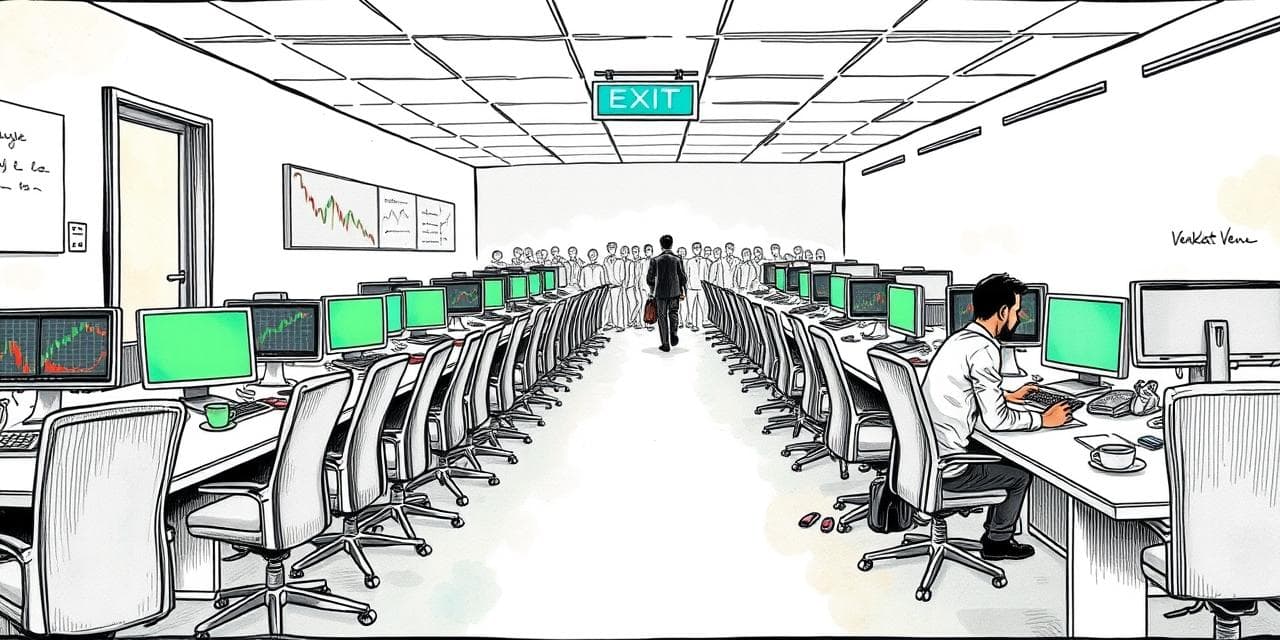

Groww reported a drop of 2.2 lakh active investors in February 2026. That is the first decline since March 2023. Zerodha's active client base shrank by over 1 lakh, falling to 79.5 lakh. Angel One recorded a similar drop to 76.5 lakh.
Meanwhile, 22.6 lakh new demat accounts were opened that same month. The slowest growth since May 2023, but still, new accounts. People are still arriving. The existing ones are leaving.
This is not a platform issue. Nobody switched from Zerodha to Groww or from Groww to Angel One. They just stopped showing up.
You probably know someone who did this. You might be doing it yourself.
Why Do Retail Investors Go Silent During Corrections?
The answer is not complicated. It hurts to look.
Nifty fell over 14% from its September 2025 peak of 26,277 to below 22,600 by late March 2026. FPIs pulled more than ₹88,180 crore from Indian equities in March alone, taking the 2026 total past ₹1 lakh crore. Brent crude crossed $110 per barrel. The rupee touched a record low near ₹94 against the dollar.
Every time you opened your broker app, the number was redder than the last time you checked. So you stopped checking.
This is not laziness. It is a documented behavioral response called the ostrich effect, named after the myth that ostriches bury their heads in sand to avoid predators. Researchers Dan Galai and Orly Sade published a study showing that investors check their portfolio significantly less often when markets are falling. The pain of seeing losses is stronger than the satisfaction of monitoring gains.
Your brain is protecting you from discomfort. The cost of that protection is that your portfolio drifts without supervision.
What Happens to Your Portfolio When You Stop Watching?
Nothing good.
Here is what changed in most Indian retail portfolios between January and March 2026, whether the investor was watching or not:
Sector concentration shifted. If you held IT stocks alongside banking, the IT names fell harder (Nifty IT dropped over 18% from peak). Your portfolio's sector mix is now different from what you intended, and you have not rebalanced because you have not looked.
Unrealised losses grew. Positions that were at a 5% loss in January might be at 20% now. The tax implications changed. What was a small position to trim became a significant unrealised loss that affects your tax loss harvesting options before March 31.
SIPs continued into drift. If your SIP is buying the same fund it was buying in September, and that fund's top holdings have rotated, you are investing in a different portfolio than you think. Most investors do not check fund composition after starting a SIP. PortoAI's SIP overlap analysis shows how this silent drift compounds across multiple funds.
Dividends and corporate actions happened. Record dates passed. Rights issues were announced. Delistings were processed. You missed them. Not because they were hidden, but because you were not looking.
Going inactive feels like pressing pause. It is not. It is choosing to let your money make decisions without you.
Is This the First Time Retail India Disappeared During a Crash?
Not even close. This is the pattern:
In 2020, the COVID crash sent Nifty down 38% in five weeks. Retail investors pulled back. Demat account openings actually surged later that year (because lockdowns gave people time to start trading), but active participation collapsed during the actual crash. The investors who stayed in and bought during March-April 2020 captured a 98% Nifty rally within 12 months.
In 2022, the rate-hike cycle and Russia-Ukraine war caused a prolonged drawdown. Active client growth at discount brokers flattened. SIP stoppage ratios spiked. Six months later, Nifty was at new highs. The investors who cancelled SIPs during the dip missed the cheapest units they would have bought all year.
In 2008, the Sensex crashed 60.91%. Thirty-six months later, it had returned 114.49%. Most retail investors who exited never came back at the same prices.
The cycle is always the same. Retail buys during rallies (when markets feel safe), goes inactive during corrections (when markets feel dangerous), and returns during the next rally (buying at higher prices). It is a buy-high-go-silent-buy-higher loop.
How Much Does Going Inactive Actually Cost?
Quantifying the cost of inactivity requires comparing two scenarios: your portfolio with you watching versus your portfolio without you.
Missed rebalancing. A portfolio that was 60% equity and 40% debt in September 2025 is now roughly 50-50 after the correction. If you had rebalanced by buying equity at lower prices, you would have captured the discount. You did not, because you were not looking. The opportunity cost shows up over the next 3-5 years as the equity recovery plays out from a lower base than you could have had.
Missed tax harvesting. March 31 is four days away. If you are sitting on unrealised short-term losses alongside realised gains, you could legally reduce your tax bill by harvesting those losses before the financial year ends. But the market is closed today (Ram Navami) and closed again on March 31 (Mahavir Jayanti). You have two trading days left: March 27 and March 30. If you have not logged in since February, you are probably going to miss this window entirely.
SIP cancellation at the worst prices. SEBI shortened SIP cancellation processing to 2 working days in December 2024 (down from 10 days). This was meant to improve customer experience. In practice, it removed a friction layer that used to protect panicking investors from their own impulses. In the old system, by the time your cancellation was processed, the market might have bounced and you would have changed your mind. Now, the cancellation goes through before your cortisol levels return to normal.
BusinessToday reported in early March 2026 that SIP cancellations spiked following the market correction. The SIP stoppage ratio (SIPs cancelled divided by SIPs started) has moved in the opposite direction of market performance. When markets fall, more people cancel. When markets rise, more people start. This is the exact opposite of what the SIP mechanism is designed to deliver.
PortoAI tracks your XIRR across Zerodha and Groww and shows you the real return impact of your activity patterns, including the cost of periods where you went inactive and let positions drift.
What Should You Do If You Have Been Inactive?
Log in. Not to trade. Not to panic-sell. Not to do anything dramatic. Just look.
Here is a five-step checklist for the investor who has not checked their portfolio since the crash began:
1. Check your sector concentration. If one sector is now more than 30% of your equity portfolio, you have a concentration problem. PortoAI flags this automatically when you connect your Zerodha or Groww account, even if you have not logged in for weeks.
2. Check your unrealised tax positions. You have two trading days left in FY26. If you have both gains and losses, the tax-loss harvesting math might save you real money. If you do nothing, you will pay more tax than necessary.
3. Check your SIP status. Did you pause or cancel any SIPs in the last 60 days? If yes, calculate what those cancelled SIPs would have bought at the lower NAVs this month. That is the cost of your cancellation.
4. Check your overall allocation. Has equity drifted below your target allocation? If you were 70% equity in September and you are now 55% without having sold anything, the market did the selling for you. Whether you should rebalance depends on your time horizon, but you cannot make that decision if you are not looking.
5. Check your behavioral patterns. This is the hard one. Is going inactive during corrections something you do every time? Pull up your Zerodha or Groww login history. If you logged in 40 times in August 2025 (when markets were green) and 3 times in March 2026 (when they were red), you have a pattern. PortoAI's behavioral fingerprint makes this pattern visible across your entire trading history, not just the last few months.
Markets Are Closed Today. Use the Silence.
Ram Navami gave you something the market does not usually offer: a forced break from the noise. No Nifty ticker moving. No F&O expiry pressure. No breaking news about FPI outflows scrolling across your screen.
Use it to look at your portfolio with intention, not with fear. The investors who disappeared from Zerodha and Groww will mostly come back. History guarantees that. They will come back when Nifty recovers, when their WhatsApp groups turn bullish again, when someone at work mentions a stock that doubled.
They will come back at higher prices.
The question is not whether you should still be in the market. If your investment horizon is more than 5 years, the question answers itself every time. The question is whether you are managing what you own or just hoping it works out.
Hoping is not a strategy. Your broker dashboard going dark is not risk management. And your portfolio does not care whether you are watching.
Connect your Zerodha or Groww account. See what your portfolio did while you weren't watching.
Try PortoAI FreeFrequently Asked Questions
Why are investors leaving Zerodha and Groww in 2026?
The primary driver is the market correction. Nifty fell over 14% from its September 2025 peak, and FPIs pulled more than ₹1 lakh crore from Indian equities in 2026. When portfolios turn red, retail investors stop logging in. Groww lost 2.2 lakh active users in February 2026 alone, and Zerodha's active base shrank by over 1 lakh to 79.5 lakh. This is not a platform problem. It is a behavioral pattern that repeats in every correction.
Should I stop investing in the stock market during the 2026 crash?
Historical data says no. After the 2008 crash (Sensex down 60%), markets returned 114% within 36 months. After the 2020 COVID crash (Nifty down 38%), recovery took 10 months. Investors who stayed invested through corrections consistently outperformed those who exited and re-entered later. The SIP stoppage ratio spikes during corrections, which means most retail investors do the opposite of what the data recommends.
What happens to my portfolio if I stop checking my broker app?
Your holdings keep moving. Stock prices change, dividends get credited, corporate actions happen, and your sector concentration shifts as different stocks move at different rates. Going inactive does not freeze your portfolio. It just means you are making a decision by not making a decision. If your portfolio was overweight in one sector before the crash, it may be even more skewed now, and PortoAI's portfolio analysis catches this drift automatically.
Is the retail investor exodus from Indian markets permanent?
No. Historically, retail investors leave during corrections and return during rallies, buying at higher prices than they sold at. After the 2020 crash, demat accounts surged from 4 crore to over 21 crore by 2025. The same investors who cancel SIPs in red markets restart them in green ones. This buy-high-sell-low cycle is the most expensive behavioral pattern in Indian retail investing.
What is the ostrich effect in investing?
The ostrich effect is a behavioral bias where investors avoid checking their portfolios during market downturns because seeing losses is psychologically painful. Named after the myth that ostriches bury their heads in sand, this pattern was documented by researchers Dan Galai and Orly Sade. The cost is that portfolios drift without supervision: sector allocations skew, tax-harvesting windows close, and SIPs get cancelled at the worst possible prices.
How does SEBI's 2-day SIP cancellation rule affect investors?
In December 2024, SEBI shortened SIP cancellation processing from 10 working days to 2. While designed to improve customer experience, this removed a friction layer that previously gave panicking investors time to reconsider. In the old system, a 10-day processing window meant the market might recover before your cancellation went through. Now, impulsive cancellations execute almost immediately, making it easier to act on fear rather than strategy.