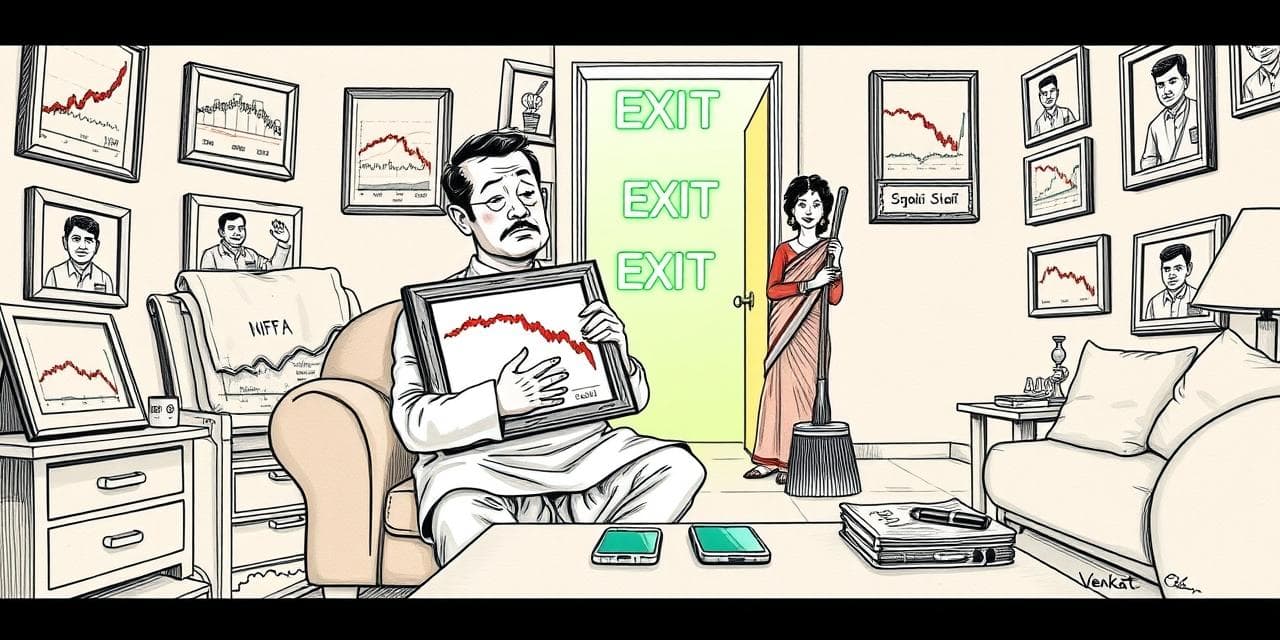

Name one stock in your portfolio you would never buy today at its current price.
You already know which one. It has been sitting there for months, maybe years. The thesis broke a long time ago. The quarterly numbers stopped improving three results ago. If a friend described this exact stock to you as a new recommendation, you would tell them to avoid it.
But you will not sell it. It is yours.
This is the endowment effect, and it is one of the most expensive biases in investing because it does not feel like a bias at all. It feels like conviction. It feels like patience. It feels like holding your ground when the market is wrong.
Except the market is not wrong. You are just overvaluing something because you own it.
Richard Thaler first described the endowment effect in 1980, and it earned him a Nobel Prize in 2017. The core finding is simple: people demand significantly more to give up an object they own than they would pay to acquire the same object. In the original experiments, the gap was roughly 2x. Mug owners wanted $7 to sell. Non-owners would only pay $3 to buy.
In your Zerodha or Groww portfolio, the gap is much wider.
What Does the Endowment Effect Look Like in an Indian Portfolio?
The endowment effect hides behind words that sound responsible. "Long-term investing." "Holding through volatility." "Conviction buy." These phrases are sometimes genuine. More often, they are post-hoc justifications for a position you cannot bring yourself to exit.
Three patterns reveal it in Indian portfolios specifically.
The IPO allotment trap. A CEPR study examined 1.5 million retail investors across 54 Indian IPOs between 2007 and 2012. The researchers used SEBI's randomized allocation mechanism as a natural experiment. When IPOs are oversubscribed, shares are allocated by lottery. Winners get shares. Losers get nothing. Both groups had identical information and intent to buy.
The finding: winners were 60% more likely to still hold the stock at the end of the first trading day compared to losers. Not because the stock was fundamentally better for them. Because they owned it.
This study is devastating for anyone who thinks their IPO holdings are rational. If a coin flip determined whether you got shares, and that coin flip alone made you 60% more likely to hold, your "analysis" of the company is not driving the decision. Ownership is.
The family stock. Every Indian investor has one. Dad recommended Tata Motors in 2015. Your uncle swears by BPCL. Your college roommate convinced you to buy some smallcap during the 2021 bull run. These stocks carry emotional weight beyond their fundamentals because they represent relationships, not just positions.
Selling the stock feels like rejecting the advice. Rejecting the person. So you hold, even as the company's business deteriorates, because selling would mean admitting that the relationship-based recommendation was wrong.
The first purchase. Your very first stock holds a special place. You remember the day you bought it. You remember the price. You remember how it felt to own a piece of a real company. That emotional significance makes the stock almost impossible to sell rationally. It becomes a portfolio heirloom, not a financial instrument.
How Much Is the Endowment Effect Actually Costing You?
Here is a number most Indian investors have never calculated: the opportunity cost of holding a stock you would not buy today.
Suppose you hold ₹2,00,000 worth of a stock that has returned 4% annually over the past three years. A Nifty 50 index fund returned roughly 12% annualized over the same period. The annual gap is 8 percentage points. Over three years, that ₹2,00,000 could have been ₹2,81,000 instead of ₹2,25,000. You lost ₹56,000 not because you made a bad trade, but because you refused to exit a mediocre one.
Now multiply that by every endowment-effect position in your portfolio.
SEBI's 2024 derivatives study documented ₹1.8 lakh crore in aggregate losses for individual F&O traders between FY22 and FY24. A portion of those losses trace back to this exact pattern: traders holding positions past their expiry logic because they had already committed capital and attention. The position became "theirs," and letting it expire worthless felt worse than closing it early at a smaller loss.
The endowment effect does not always look dramatic. It looks like a slow bleed, a position returning 3% when the rest of your portfolio returns 14%. The difference compounds quietly, and because you never technically "lost money," you never feel the urgency to act.
Why Does Owning Something Change How You Value It?
Three psychological mechanisms drive the endowment effect in investing. Understanding them does not cure the bias, but it makes the pattern recognizable when PortoAI flags it in your data.
Yes. Research published in PNAS on how stress hormones affect financial decision-making shows that losses trigger cortisol responses, and these are amplified when the loss involves something perceived as "part of you." Selling a stock you have held for two years fires the same neural pathways as giving away a personal possession. Your brain does not distinguish between a share of Reliance and a watch your father gave you, not entirely.
This is why you feel genuinely uncomfortable when someone suggests you should sell a long-held position. The discomfort is not analytical. It is visceral.
Absolutely. The more work you put into acquiring a stock, the more you overvalue it. If you researched for a week, read the annual report, discussed it on a forum, and then placed the buy order, you have invested not just money but cognitive effort. Selling the stock means all that effort was wasted, or so it feels.
Indian IPO investors experience this acutely. The process of applying, waiting for allotment, checking the status, the excitement of receiving shares, these steps build psychological ownership even before listing day. The CEPR study found that even lottery-based allocation created strong attachment. Imagine how much stronger the attachment is when you actively chose the stock.
It does. The longer you hold a position, the harder it becomes to sell, regardless of performance. A stock held for six months feels like a recent purchase. A stock held for three years feels like a permanent part of your portfolio. Five years? It might as well be a fixed deposit you never think about.
This duration effect explains why the oldest positions in your portfolio are often the ones most disconnected from your current investment strategy. You started with a different risk appetite, a different income level, a different goal. The stock stayed. Your strategy moved on.
The "Would I Buy This Today?" Test That Actually Works
Every financial advisor gives the same generic advice: "Ask yourself if you would buy this stock today." The problem is that when you actually try this exercise, the endowment effect corrupts the answer. You think about the stock with all the knowledge and emotional attachment you have accumulated. The test stops being hypothetical.
Here is a version that works better.
Open your portfolio. Pick any stock. Now answer these four questions on paper, not in your head:
- What was your original thesis? Write it in one sentence. "I bought X because Y."
- Is that thesis still intact? Not "is the company still operating" or "has the stock recovered from its low." Is the specific reason you bought it still true?
- If you had the cash value of this holding right now, would you buy this exact stock at this exact price? Be honest. If someone handed you ₹2,00,000 in cash and said you could put it anywhere, would this stock be your first choice?
- What would need to happen for you to sell? If you cannot name a specific price or event that would trigger a sale, you do not have an exit plan. You have an emotional attachment.
Most investors fail at question 3. They realize they would never buy the stock today, but they still cannot bring themselves to sell. That gap between "I would not buy" and "I will not sell" is the endowment effect measured in your own words.
PortoAI's behavioral fingerprint automates a version of this test by comparing your holding period patterns, position sizing changes, and portfolio concentration against your stated investment objectives. When the data shows you holding a stock far longer than your typical winning positions, with no additional buying and no strategic reason for the hold, the system flags it as a potential endowment-effect position.
How PortoAI Detects Endowment-Effect Positions in Your Data?
Your broker app shows you green and red. PortoAI reads the behavioral pattern underneath.
Three specific signals indicate endowment-effect holding:
Holding period asymmetry. If your average holding period for profitable positions is 4 months but your average holding period for underperforming positions is 14 months, something other than analysis is driving the difference. PortoAI's portfolio analysis surfaces this asymmetry as a concrete number, not a vague feeling.
Stale positions with no activity. A stock sitting in your portfolio for 18 months with zero additional buys, zero partial sells, and no stop-loss means you are neither building nor managing the position. You are ignoring it. That is not patience. It is avoidance, the behavioral signature of a position you own but cannot evaluate objectively.
Concentration drift. When one stock was 5% of your portfolio but has grown to 15% (or shrunk to 1%) without any rebalancing action, the endowment effect is preventing you from taking what should be a routine portfolio maintenance step. PortoAI's sector concentration analysis flags this drift before it becomes a risk event.
The combination of these signals is what separates PortoAI from a simple portfolio tracker. Zerodha Console shows you holdings. Groww shows you returns. PortoAI shows you why you are holding what you are holding, and whether the reason is analytical or emotional.
What Happens When You Finally Sell an Endowment-Effect Stock?
Every investor who has done it reports the same experience. The days before selling feel agonizing. The moment after selling feels like nothing.
That is the endowment effect in reverse. The imagined pain of selling was enormous. The actual experience was trivially small. Your brain manufactured a sense of loss that did not exist because the stock was underperforming anyway. Selling a ₹1,50,000 position that was returning 2% annually and redeploying into something returning 11% is not a loss. It is a correction.
But you will never discover this if you never sell. The endowment effect is self-reinforcing: the longer you hold, the harder it gets to sell, the longer you hold. Breaking the cycle requires external data, not more willpower.
This is precisely what a behavioral alert from PortoAI is designed for. Not to tell you what to buy or sell, because PortoAI does not give stock tips. To show you the behavioral pattern that is keeping you in a position your own analysis would reject if you were evaluating it fresh.
Five Stocks Where Indian Investors Exhibit Maximum Endowment Effect
Not specific tickers, but categories. If you recognize your portfolio in this list, the endowment effect has a grip on at least one of your positions.
-
The IPO listing-day hold. You got allotment, it listed at a premium, you did not sell on day one, and now it is below your cost. You are waiting for it to "come back to listing price." That reference point is arbitrary, created by your ownership, not by the company's value.
-
The index heavyweight that stopped outperforming. You bought HDFC Bank or Infosys or Reliance because they were market leaders. They still are. But your specific entry price and the index return since your purchase date tell a different story. You hold because the name feels safe, not because the returns justify the allocation.
-
The multibagger memory. A stock that once doubled from your buy price but has since given back most of the gains. You remember the peak. You anchor to it. You hold because selling at a lower multiple feels like a loss relative to a number that existed only briefly in your portfolio.
-
The dividend comfort. A PSU stock or utility paying a 3% dividend yield. The dividend feels like income. It feels earned. But the total return, including capital appreciation, trails the Nifty by 500+ basis points annually. The dividend is a psychological anchor keeping you in a suboptimal position.
-
The inherited wisdom. A stock your parent, spouse, or mentor recommended. Selling it requires confronting the possibility that the recommendation was wrong, which feels disrespectful or disloyal. This is not investing. It is obligation disguised as conviction.
Connect your Zerodha or Groww account. PortoAI's behavioral fingerprint will identify which positions you are holding because of ownership, not analysis. No stock tips, just your own data showing you what your emotions won't.
Try PortoAI FreeFrequently Asked Questions
What is the endowment effect in stock investing?
The endowment effect is a cognitive bias where you overvalue a stock simply because you own it. You would not buy it at its current price, but you refuse to sell it because ownership has made it feel more valuable than it objectively is. Nobel laureate Richard Thaler first described this bias in 1980. In investing, it causes you to hold positions that no longer fit your portfolio, costing you both capital and opportunity.
How does the endowment effect differ from loss aversion?
Loss aversion is about fearing losses more than valuing equivalent gains. The endowment effect is about ownership itself inflating perceived value. You might hold a stock at breakeven, not fearing a loss, yet still refuse to sell it because it is "yours." Loss aversion asks "will I lose money?" The endowment effect asks "can I part with something I own?" Both lead to holding too long, but for different psychological reasons.
Does the endowment effect affect Indian IPO investors?
Yes. A CEPR study of 1.5 million Indian IPO investors found that people who received shares through random allotment were 60% more likely to still hold them at the end of the first trading day compared to those who did not receive allotment. Mere ownership, even through a lottery, created attachment. Indian retail investors who apply for every IPO are especially prone because the effort of applying amplifies the sense of ownership.
Can AI detect the endowment effect in my portfolio?
PortoAI's behavioral fingerprint analysis identifies endowment effect patterns by comparing your average holding period for losing stocks versus winning stocks, tracking how often you sell positions that no longer match your stated strategy, and flagging stocks where your cost basis is far from current price yet you have taken no action. These patterns reveal attachment-driven holding that you cannot see from inside the bias.
How do I overcome the endowment effect in investing?
The most effective technique is the "would I buy this today" test. For every stock you hold, ask: if I had the cash equivalent instead, would I buy this stock at its current price today? If the answer is no, you are holding it because you own it, not because it deserves a place in your portfolio. PortoAI surfaces this question by flagging holdings where your behavior contradicts your own portfolio strategy.
Is the endowment effect stronger for stocks I researched myself?
Yes. The effort you invested in researching, analyzing, and deciding to buy a stock amplifies the endowment effect. This is related to the "effort justification" phenomenon: the more work you put into acquiring something, the more you overvalue it. Stocks that came from deep research feel more "yours" than casual purchases, making them harder to sell even when the fundamentals deteriorate.
Does holding period make the endowment effect worse?
It does. A stock held for six months feels like a recent position. A stock held for three years feels like a permanent fixture. The longer you hold, the more the stock becomes part of your portfolio identity, and the harder it becomes to evaluate objectively. This is why the oldest positions in your portfolio are often the most disconnected from your current investment strategy.