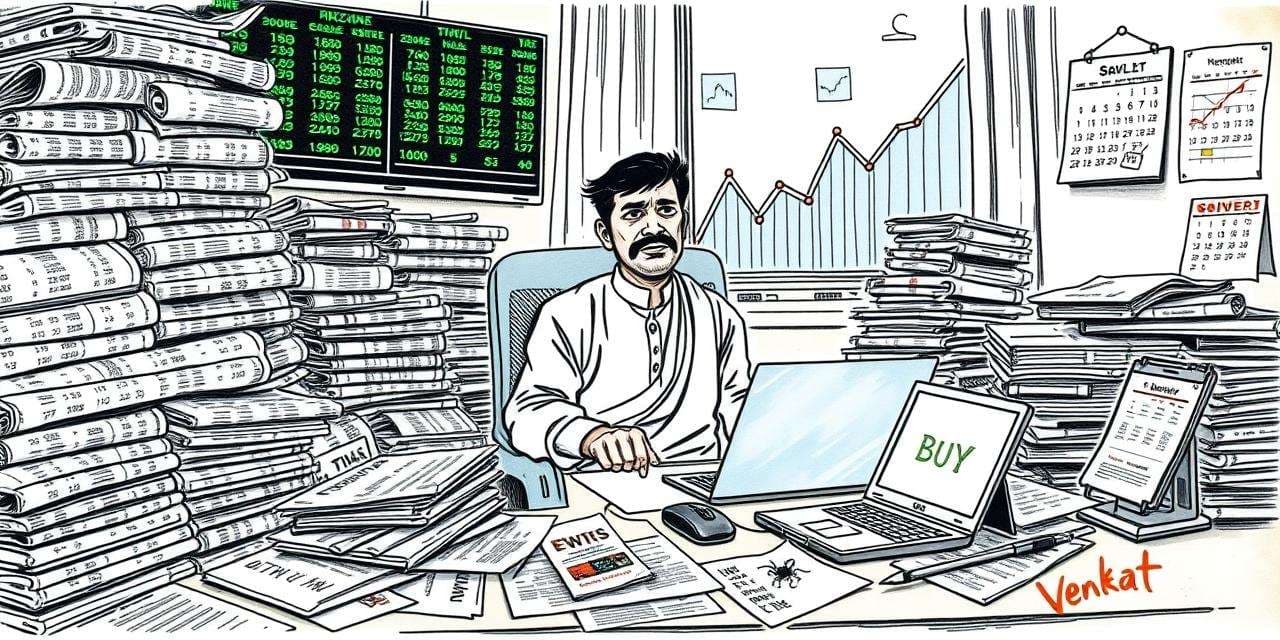

You have 23 tabs open right now. Four of them are Screener.in pages for stocks you will never buy. Two are Moneycontrol comparison pages for mutual funds you added to your watchlist in January. One is a Reddit thread titled "Which flexi-cap fund is best in 2026?" that has 94 comments and zero consensus.
You have been "researching" for three months. Your portfolio has not changed.
This is not due diligence. This is analysis paralysis. And it is costing you more than any bad stock pick ever could.
What does analysis paralysis actually look like in your trading data?
Most investors who suffer from analysis paralysis do not recognize it. They believe they are being thorough. The data tells a different story.
Here is what PortoAI's behavioral fingerprint detects in portfolios where analysis paralysis is the dominant pattern:
High watchlist activity, zero execution. The investor adds stocks to watchlists, sets price alerts, checks charts daily, reads quarterly results, and does not place a single buy order. Zerodha's watchlist has 40 stocks. The portfolio has 6, all bought over a year ago.
Mutual fund accumulation without strategy. Instead of choosing between Fund A and Fund B, the investor buys both. Then adds Fund C because a colleague recommended it. Then Fund D because Groww showed it as "trending." The portfolio now holds 14 mutual funds, most in overlapping categories. This is not diversification. It is indecision dressed as a strategy.
Frequent login, no trades. The investor opens Kite or Groww 4-5 times a day, checks prices, reads market updates, and logs out. PortoAI tracks this pattern: high engagement, zero action. Over three months, the investor spent roughly 90 hours monitoring a portfolio they did not change once.
Repeated research on the same stock. The investor has evaluated Tata Motors three separate times in four months. Each time, a new concern emerged: China slowdown, EV competition, JLR margins. Each concern triggered another round of research. Tata Motors moved from Rs 720 to Rs 880 during those four months. The investor watched the entire move.
The common thread: the research never ends because its purpose is not to reach a decision. Its purpose is to avoid making one.
Why does overthinking hurt more than a wrong decision?
Indian investors fear the wrong buy. They should fear the missed buy.
Consider two investors in January 2026. Both identified HDFC Bank at Rs 1,620 as attractively valued after the FPI-driven selloff. Investor A bought 50 shares. Investor B decided to wait for "one more quarter's results." By March, HDFC Bank was at Rs 1,780. Investor A made Rs 8,000. Investor B made Rs 0.
Now consider the worst case for Investor A. Say HDFC Bank dropped to Rs 1,500 instead. Investor A lost Rs 6,000 on paper. But that loss is recoverable. HDFC Bank is not going to zero. The Rs 8,000 that Investor B missed, by contrast, is gone permanently. There is no mechanism to recover an opportunity you did not take.
This asymmetry is what makes analysis paralysis more expensive than impulsive trading. The impulsive trader at least has positions. Some will work, some will not. The paralyzed investor has cash sitting in a savings account earning 3.5% while inflation runs at 5%.
A 2023 study published in the journal Risks (MDPI) found that negative emotions, particularly fear of regret, were the primary driver of decision-making paralysis among retail investors. The researchers noted that paralyzed investors did not lack information. They had too much of it. Every additional data point increased uncertainty instead of reducing it.
SEBI's own data paints the cost differently. The 2024 F&O study showed 93% of individual traders lost money. But the study only measured active traders. It did not measure the millions of demat account holders who opened accounts, funded them, researched extensively, and never traded at all. Those investors lost too: to inflation, to opportunity cost, to the slow erosion of purchasing power that comes from parking money in a savings account while "deciding."
How does information overload trigger the paralysis loop?
India's financial information ecosystem in 2026 is designed to produce paralysis, not decisions.
Count the inputs hitting a typical retail investor on any given morning: CNBC-TV18 running three tickers simultaneously, Moneycontrol push notifications about FII flows, Twitter threads from 15 different finfluencers with contradictory calls, Telegram tip channels sending "strong buy" alerts every 20 minutes, YouTube thumbnails screaming "THIS stock will 5X," and WhatsApp groups forwarding screenshots of someone else's profit.
Each piece of information is individually rational. Collectively, they create noise that makes any decision feel premature. "Wait for the FII data." "Wait for the RBI policy." "Wait for the US Fed." "Wait for Q4 results." There is always a reason to wait. There is always one more data point.
This is the paradox of choice applied to investing. Psychologist Barry Schwartz demonstrated that increasing the number of options beyond a threshold does not improve decision quality. It degrades it. With 5,000+ listed stocks on NSE and BSE and 2,000+ mutual fund schemes registered with AMFI, Indian investors face one of the largest choice sets of any retail investment market in the world.
The result is predictable. Rather than choosing, investors do one of three things:
-
Default to inaction. The portfolio stays unchanged. Cash accumulates. The investor tells themselves they are "waiting for a correction" even though they did not buy during the last three corrections either.
-
Outsource the decision. The investor follows a tip from a Telegram channel or a YouTube recommendation because making someone else's choice feels safer than making their own. This is how herd mentality replaces independent analysis.
-
Accumulate instead of choosing. Rather than picking one fund, buy all five. This produces the 14-fund portfolio with 70% overlap that PortoAI's SIP overlap analysis flags across Zerodha and Groww accounts.
None of these are decisions. They are ways to avoid making one.
What does the cost of waiting actually look like in rupees?
Numbers make this concrete.
SIP delay cost. An investor planning to start a Rs 15,000 monthly SIP in a Nifty 50 index fund spends 6 months "comparing" funds. Assuming 12% annualized returns (Nifty 50's 15-year CAGR is approximately 11.8% as of March 2026), that 6-month delay costs approximately Rs 2.7 lakh over 20 years in lost compounding. Not from a bad fund choice. From no fund choice.
Stock opportunity cost. An investor tracked Bajaj Finance from November 2025 at Rs 6,800. Spent December reading analyst reports. Spent January watching YouTube breakdowns. Spent February waiting for Q3 results. By March, the stock was at Rs 8,100. The investor's "research" cost Rs 1,300 per share in unrealized gains. At a modest 50-share position, that is Rs 65,000 gone.
The hidden cost of cash drag. If you have Rs 5 lakh sitting in a savings account earning 3.5% while you "decide" where to invest it, and equity markets return 12% that year, you lost Rs 42,500 in the difference. That is not theoretical. That is real money that your portfolio data shows as underperformance when you finally calculate your XIRR.
F&O indecision cost. Options traders face a unique version of this problem. An option's value decays every day (theta decay). The trader who spends two hours "analyzing" whether to enter a Bank Nifty trade at 2 PM has already lost money by 3:15 PM close, even if the trade idea was correct. PortoAI's overtrading detection catches the opposite problem, trading too much, but the paralyzed F&O trader bleeds money just as fast through inaction and missed setups that expire worthless.
How do you break the analysis paralysis loop?
The fix is not "stop researching." The fix is to give your research a deadline and a decision framework.
Set a research window, not a research depth. "I will spend 5 days evaluating this stock" is a better rule than "I will read every analyst report available." Deep research with no time boundary is procrastination with extra steps. After 5 days, you decide: buy, reject, or add to watchlist with a specific trigger price. No fourth option.
Use elimination, not comparison. With 2,000+ mutual funds available, comparing them all is impossible. Start with elimination criteria instead. Category? Large-cap index. Expense ratio under 0.5%? Three funds qualify. Track record above category average for 3 and 5 years? Two funds qualify. Now you are choosing between two, not two thousand.
Cap your fund count. If you hold more than 5 equity mutual funds, you almost certainly have overlap. PortoAI's SIP overlap analysis shows you exactly how much. Seeing that your "diversified" 8-fund portfolio is really a 3-stock-heavy concentration in HDFC Bank, Reliance, and Infosys is the fastest way to stop adding funds and start removing them.
Automate the first step. Start the SIP before you finish the research. A Rs 5,000 monthly SIP in an index fund while you spend the next three months choosing your ideal portfolio is infinitely better than Rs 0 invested while you chase perfection. You can always redirect the SIP later. You cannot get back three months of compounding.
Track your inaction. This is where behavioral AI changes the game. PortoAI's behavioral fingerprint does not just flag what you did. It flags what you did not do. If your login frequency is high but your trade frequency is zero for 90 days, that is a pattern. If your watchlist has 35 stocks and your portfolio has 5, that is a pattern. If you opened your broker app 120 times this quarter and placed 2 orders, that is a measurable gap between intention and action.
Accept "good enough." The best fund is not materially better than the second-best fund. Over 10 years, the difference between the top-performing large-cap index fund and the third-best is typically less than 0.5% annualized. The difference between any of them and your savings account is 8-9% annualized. Perfectionism in fund selection is optimizing for a 0.5% edge while paying a 9% penalty for delay.
Your data already shows whether you are paralyzed
Pull up your Zerodha or Groww account right now. Answer three questions:
- How many stocks are on your watchlist that you have been tracking for more than 60 days without buying?
- How many mutual fund schemes do you hold across all platforms?
- When was the last time you executed a new buy order (not a SIP auto-debit)?
If the answers are "more than 10," "more than 6," and "I don't remember," you are not being careful. You are stuck.
Connect your broker to PortoAI. The behavioral fingerprint will show you your pattern: how often you log in versus how often you act, how your watchlist compares to your portfolio, and whether your research is producing decisions or just producing anxiety. The data does not lie, and it does not wait for one more analyst report before telling you the truth.
The market moved while you were reading this article. It will move again tomorrow. The question is whether you will still be researching when it does.
Connect your Zerodha or Groww account. See if your data shows analysis paralysis.
Try PortoAI FreeFrequently Asked Questions
What is analysis paralysis in stock market investing?
Analysis paralysis is a behavioral pattern where an investor continuously researches, compares, and evaluates investment options but fails to execute any trade. It is driven by fear of making the wrong decision, not by caution or diligence. In India, this is common among retail investors overwhelmed by 5,000+ listed stocks, 2,000+ mutual fund schemes, and constant financial media noise from Twitter finfluencers, YouTube channels, and Telegram groups.
How does analysis paralysis cost money in the Indian stock market?
The cost is opportunity cost. An investor who delays starting a Rs 15,000 monthly SIP by 6 months while comparing funds loses approximately Rs 2.7 lakh over 20 years in compounding. An investor who tracked a stock for 4 months without buying while it rose 15% lost real returns. Cash sitting in a savings account at 3.5% while equity markets return 12% costs Rs 42,500 per Rs 5 lakh per year.
Is analysis paralysis the same as being a careful investor?
No. Careful investing involves defined research criteria, a time-bound evaluation, and a final yes-or-no decision. Analysis paralysis has no endpoint. The careful investor spends two weeks evaluating a stock and decides. The paralyzed investor spends two months reading every report and never acts. The difference is not the amount of research. It is whether the research leads to a decision or just to more research.
How many mutual funds should I hold in my portfolio?
Research consistently suggests 4-5 well-chosen funds is the practical maximum. Beyond that, overlap increases and marginal diversification drops. Most large-cap and flexi-cap funds in India hold the same top 20 stocks. A portfolio of 3-4 funds covering large-cap, mid-cap, and one thematic allocation achieves more genuine diversification than 12 overlapping funds.
Can AI tools help overcome analysis paralysis in investing?
AI tools like PortoAI help by revealing your behavioral patterns. If your trading history shows 30 stocks researched and none bought in three months, that is a measurable pattern. If your portfolio has 14 mutual funds with 70% overlap, the AI shows you that your indecision produced a concentrated portfolio disguised as diversification. The fix starts with seeing the pattern clearly.
What triggers analysis paralysis in Indian retail investors?
Three main triggers: information overload from finfluencers, news channels, and social media creating contradictory signals; fear of loss amplified by volatility and correction periods; and choice overload from India's massive investment universe. The paradox is that more information makes decisions harder, not easier, because every new data point introduces a new reason to wait.