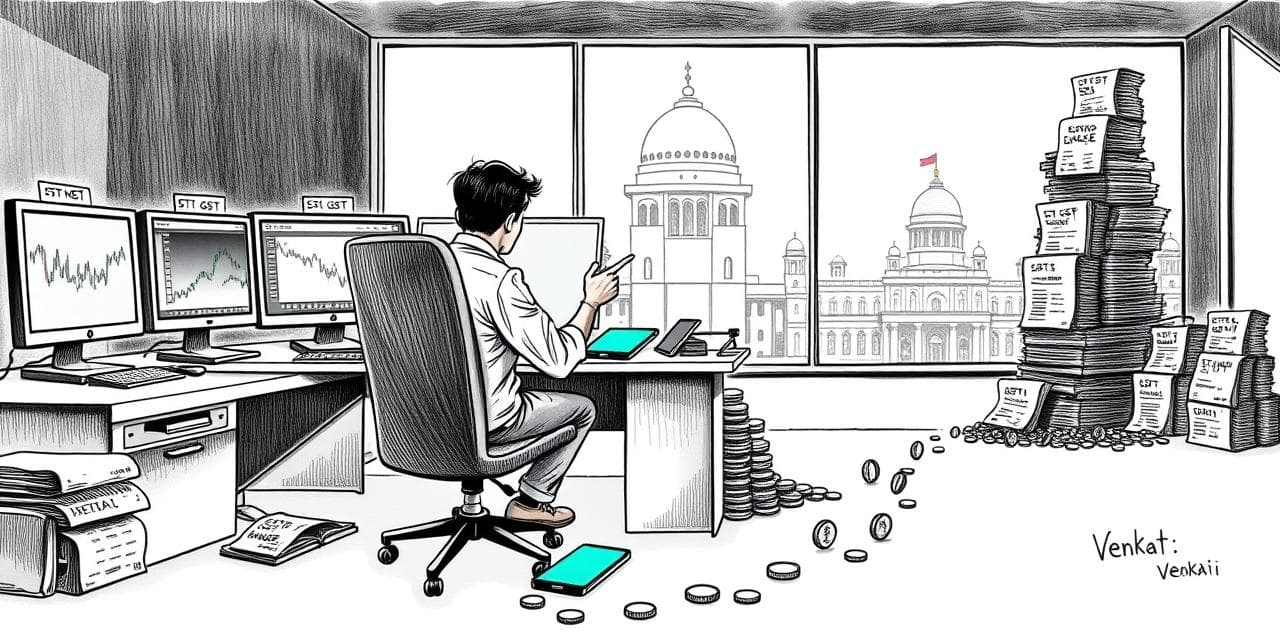

You know your P&L. You check it daily, maybe hourly. Red days sting. Green days feel earned.
But there is a number you have never calculated. A number your broker does not show you on the dashboard. A number that grows every single time you hit the buy or sell button, regardless of whether the trade makes money.
Your transaction costs for the year.
SEBI calculated it for you. In their September 2024 study, the average individual F&O trader spent ₹26,000 on transaction costs in FY24. Not losses. Not bad trades. Just the cost of pressing buttons.
For the 93% who lost money, transaction costs added another 28% on top of their trading losses. You lost ₹1 lakh on trades? You actually lost ₹1.28 lakh. The extra ₹28,000 went to the exchange, the government, and your broker.
What does one F&O trade actually cost you?
Let's break down a single Bank Nifty futures trade worth ₹10 lakh on Zerodha. Not the brokerage. Everything.
| Charge | Rate | Amount (₹) |
|---|---|---|
| Brokerage | ₹20 flat | 20 |
| STT (from April 2026) | 0.05% of contract value | 500 |
| Exchange transaction charges | 0.00173% | 17 |
| SEBI turnover fee | ₹10 per crore | 1 |
| Stamp duty (buy side) | 0.002% | 20 |
| GST (18% on brokerage + exchange + SEBI) | 18% | 7 |
| Total per leg | ~565 | |
| Round-trip (buy + sell) | ~1,050 |
One trade. ₹1,050 gone. You need the market to move more than ₹1,050 in your direction just to break even.
Now do the math for your month. If you trade futures 40 times (20 round-trips), that is ₹21,000 in charges. Per month. Before your first profitable trade.
For options, the per-trade cost is lower in absolute terms because STT is charged on premium, not contract value. But options traders typically make far more trades per day. Ten options trades a day, 22 trading days, that is 220 trades per month. Even at ₹40-50 per trade, you are looking at ₹8,800-11,000 monthly in charges.
Why "zero brokerage" is the most expensive phrase in Indian trading?
Zerodha charges ₹20 per F&O order. Groww, Angel One, and other discount brokers offer similar flat-fee structures. Some promote "zero brokerage" on equity delivery.
The phrase creates a specific illusion: trading is cheap.
It is not. Brokerage is one of eight charges on every trade, and on most F&O transactions, it is the smallest one. Look at that table again. On a ₹10 lakh futures trade, brokerage is ₹20. STT alone is ₹500. The government takes 25 times more than your broker does.
When Zerodha says "₹20 per trade," they are technically correct. When your brain registers "trading costs me ₹20," it is catastrophically wrong. The real cost is ₹565 per leg. Your broker showed you 3.5% of the actual number.
This is not deception. The Zerodha charges page lists every component. But the human brain anchors on the first number it sees, and the first number is always the brokerage. Every other charge, STT, stamp duty, exchange fees, GST, is a footnote. By the time you have read them, your mental model is already set: trading costs ₹20.
That ₹20 anchor is the reason you place 15 trades when 5 would have been sufficient. If the button said "this trade will cost you ₹565," you would think twice. Your broker knows this. The anchoring bias in your purchase decisions works against you in charges too.
What changes on April 1, 2026, and why should you care?
Budget 2026 hiked STT on futures from 0.02% to 0.05%, a 150% increase. On options, STT goes from 0.1% to 0.15% of premium. Both take effect April 1, 2026.
Let's put numbers on this.
Before April 2026: a ₹10 lakh futures trade paid ₹200 in STT.
After April 2026: the same trade pays ₹500 in STT.
That is ₹300 more per trade. Multiply by 20 round-trips per month, and your monthly STT bill jumps by ₹12,000. Over a year, that is ₹1,44,000 in additional STT alone, on top of the charges you were already paying.
According to Business Standard, Zerodha is also raising brokerage to ₹40 per order for traders who do not meet SEBI's 50% cash collateral rule. That doubles the brokerage component for many retail traders.
Here is what this means for a typical active futures trader doing 40 trades per month:
| Component | Before April 2026 (₹/month) | After April 2026 (₹/month) |
|---|---|---|
| Brokerage | 800 | 1,600 |
| STT | 8,000 | 20,000 |
| Exchange + SEBI | 720 | 720 |
| Stamp duty | 800 | 800 |
| GST | 270 | 420 |
| Total | ~10,590 | ~23,540 |
Your monthly cost of trading more than doubles. From ₹1.27 lakh per year to ₹2.82 lakh per year. That is ₹2.82 lakh you need to make in gross trading profits just to not lose money to the system.
93% of traders do not make that. They do not even come close.
How does overtrading multiply these invisible costs?
The charges table is a per-trade cost. The behavioral problem is how many trades you place.
SEBI's data is specific on this point: loss-making F&O traders spend 28% of their net trading losses on top as transaction costs. The more you lose, the more you trade. The more you trade, the more you pay in charges. The charges guarantee you lose more. It is a feedback loop with no exit except stopping.
PortoAI's overtrading detection exists for exactly this reason. When you connect your Zerodha or Groww account, the behavioral fingerprint analyses your trade frequency over time. It spots the patterns you cannot see in real time:
- Monday morning surge. Your trade count spikes on Mondays because you spent the weekend watching YouTube trading videos and arrive with "conviction" that is really just restlessness.
- Post-loss escalation. After a losing trade, your next trade comes within 8 minutes instead of your usual 45. The revenge trading pattern is visible in the timestamp data before you feel it emotionally.
- Expiry day overdrive. Weekly expiry Thursdays show 3x your normal trade count. The urgency of time decay tricks you into thinking speed equals profit. It does not. It equals charges.
Each of these patterns does not just cost you in bad trade outcomes. It costs you in raw charges that compound silently across months.
Consider this: reducing from 60 trades per month to 30 saves roughly ₹12,000-15,000 monthly in post-April 2026 charges on futures. That is ₹1.44-1.80 lakh per year. Not from better trades. Just from fewer trades.
What does your annual "trading tax" actually look like?
Most traders think of their P&L as: profit = winning trades minus losing trades.
The real equation is: profit = winning trades minus losing trades minus brokerage minus STT minus stamp duty minus exchange charges minus SEBI fees minus GST minus STCG tax on profits.
Let's run the full math for a moderately active futures trader after April 2026:
- 40 trades per month (20 round-trips)
- Average contract value: ₹10 lakh
- Gross trading P&L: breakeven (₹0, neither winning nor losing on trades)
| Annual cost | Amount (₹) |
|---|---|
| Brokerage (₹40 x 40 x 12) | 19,200 |
| STT (₹500 x 40 x 12) | 2,40,000 |
| Exchange charges | 8,640 |
| SEBI turnover fees | 480 |
| Stamp duty | 9,600 |
| GST | 5,040 |
| Total annual charges | ₹2,82,960 |
You broke even on trades and still lost ₹2.83 lakh. To the exchange. To the government. To your broker.
Now add STCG at 20% if you somehow make a profit after all this. The tax system takes 20% of whatever survives the charge gauntlet.
This is the number no one calculates. No broker dashboard shows it. No trading app pushes a notification saying "you spent ₹23,000 on charges this month." The cost is designed to be invisible. It gets deducted per-trade in amounts small enough to ignore (₹500 here, ₹40 there) but large enough to devastate at scale.
PortoAI calculates this for you. Connect your account, and the portfolio analysis shows your cumulative transaction costs alongside your P&L. For the first time, you see the real cost of every trade, not just the P&L.
How do you actually reduce these costs without stopping trading?
Stopping trading entirely is one option. But if you trade F&O and plan to continue, here are four concrete steps that reduce your charge burden by 40-60%.
1. Set a weekly trade count limit. PortoAI's behavioral alerts can flag when you exceed your normal trading frequency. If your average is 8 trades per week and you are at 14 by Wednesday, the alert fires before you place trade number 15. That fifteenth trade costs you ₹565 in charges. Ask yourself if it is really a high-conviction setup or just restlessness.
2. Eliminate revenge round-trips. The most expensive sequence in F&O trading: you lose on a trade, close it, and immediately re-enter the same direction with a larger position. That is two exits and two entries, four charge events, in the span of minutes. PortoAI's revenge trading detection flags this pattern by comparing your post-loss trade timing against your baseline.
3. Batch your trades. If you plan to enter three Nifty lots, enter all three in one order instead of three separate orders. One order at ₹565 beats three orders at ₹1,695. This sounds obvious. Check your order history. Most traders scale in across multiple orders out of "caution" that costs them triple in charges.
4. Track the cost before you click. Before every trade, run the mental math: "This trade costs me ~₹565 in charges. I need the market to move ₹X in my direction just to cover costs." If the expected move is smaller than your charge, the trade has negative expected value before it starts.
The 7% of F&O traders who make money in India, according to SEBI's study, do not have a secret strategy. They trade less frequently, with larger conviction per trade, and lower cumulative charges as a percentage of their capital.
Your broker makes money every time you trade. The exchange makes money every time you trade. The government makes money every time you trade. The only person who does not guaranteed-make-money every time you trade is you.
Connect your Zerodha or Groww account to PortoAI and see your actual transaction costs, trading frequency patterns, and behavioral fingerprint. Read-only. Takes 2 minutes.
Try PortoAI FreeFrequently Asked Questions
How much does each F&O trade actually cost in India?
A single Bank Nifty futures trade worth ₹10 lakh on Zerodha costs approximately ₹565 in total charges per leg after April 2026: ₹20-40 brokerage, ₹500 STT (0.05%), ₹20 stamp duty, ₹17 exchange transaction charges, ₹1 SEBI turnover fees, and ₹7 GST. A round-trip (buy + sell) costs roughly ₹1,050. For options, a ₹10,000 premium trade costs roughly ₹35-50 per leg. These are statutory charges that apply regardless of which broker you use.
What is the new STT rate on F&O from April 2026?
From April 1, 2026, STT on futures increases to 0.05% of contract value (up from 0.02%), a 150% increase. STT on options premium rises to 0.15% (up from 0.1%). On a ₹10 lakh futures contract, STT per trade jumps from ₹200 to ₹500. For an active trader doing 40 futures trades per month, annual STT alone rises from ₹96,000 to ₹2,40,000.
Why does zero brokerage not mean free trading?
Brokerage is one of eight charges on every F&O trade and typically the smallest. On a ₹10 lakh futures trade, brokerage is ₹20-40 while total charges exceed ₹565. STT, stamp duty, exchange transaction charges, SEBI turnover fees, and GST are government-mandated and apply identically across all brokers. Even with "zero brokerage," you pay ₹525+ per futures trade in non-negotiable statutory charges.
How much do Indian F&O traders lose to transaction costs per year?
SEBI's September 2024 study found that the average individual F&O trader spent ₹26,000 on transaction costs in FY24. Collectively, individual traders spent ₹50,000 crore on transaction costs over FY22-FY24. Loss-making traders spent an additional 28% of their net trading losses as transaction costs, reflecting the overtrading feedback loop where losses trigger more frequent trading which generates more charges.
Does PortoAI show transaction costs and overtrading patterns?
Yes. PortoAI connects to your Zerodha or Groww account through read-only API and analyses your complete trade history. It calculates cumulative transaction costs alongside P&L, flags overtrading patterns when trade frequency exceeds your personal baseline, detects revenge trading sequences where trades cluster immediately after losses, and tracks your trading frequency score as part of your behavioral fingerprint. You see the full cost picture that no broker dashboard shows.
How can I reduce F&O transaction costs without quitting trading?
Four steps. Set a weekly trade count limit and track it: cutting from 60 to 30 monthly trades saves ₹1.5-1.8 lakh per year in charges. Eliminate revenge round-trips, the most expensive behavioral pattern, by enforcing a cooling period after losses. Batch orders instead of scaling in across multiple separate trades. Before every trade, calculate the minimum market move needed to cover charges; if the expected move is smaller, skip the trade.
What percentage of F&O losses are from transaction costs versus bad trades?
SEBI data shows transaction costs account for 28% of net trading losses for the average loss-making F&O trader. For highly active traders executing 100+ trades per month, the ratio climbs to 35-40%. A trader who lost ₹1 lakh in trading P&L actually lost ₹1.28 lakh including charges. Even traders who break even on trade P&L lose money because transaction costs guarantee a negative expected value at high trade frequencies.