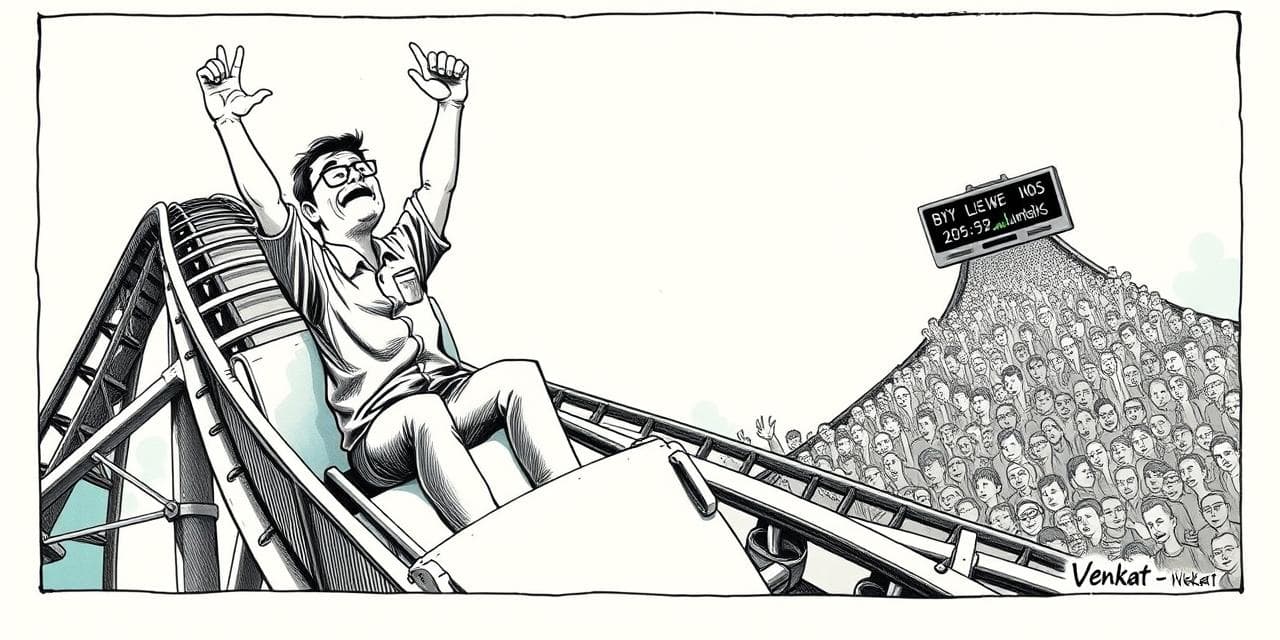

938 points. That is how much Sensex gained on March 16, 2026. Within minutes of the close, financial Twitter declared the bottom was in. WhatsApp groups forwarded screenshots of green portfolios. Your favourite YouTube finfluencer uploaded a "BUY NOW" thumbnail.
You opened Zerodha Kite. You looked at your watchlist. Everything was green. Your thumb hovered over the buy button.
That impulse, the one sitting in your chest right now, has a name. It is called the relief rally FOMO trap, and it has cost Indian retail investors more money than any single market crash in the last decade.
What Actually Happened on March 16?
Sensex closed at 75,503, up 938 points (1.26%). Nifty settled at 23,409, up 258 points (1.11%). Financial media called it a "sharp recovery." Look at the context they left out.
In the two weeks before March 16, Nifty fell from approximately 26,400 to 23,150. That is a decline of over 3,200 points, roughly 12%. The 258-point bounce on March 16 recovered approximately 8% of the total fall.
Here is the number that matters: the bounce recovered less than one-tenth of the crash.
Crude oil was still trading near $100 a barrel. The rupee was still at 92.30 against the dollar, a record low. FIIs had pulled out ₹52,704 crore in the first half of March, with ₹10,717 crore exiting in a single session on March 13. The Strait of Hormuz was still disrupted. The US-Iran conflict had not de-escalated.
Nothing fundamental changed on March 16. Value buyers stepped in at lower levels, short-covering happened as traders closed bearish positions before the weekend, and domestic institutional investors absorbed some FII selling. That is a relief rally. It is a mechanical market response, not a signal that the bottom is in.
Is This a Dead Cat Bounce or a Real Recovery?
This is the question every Indian investor is typing into Google right now. The honest answer: nobody knows yet. But the data from past crash-and-bounce events gives you a framework.
A dead cat bounce has three characteristics:
1. The bounce happens on moderate or low volume. When real recoveries begin, buying volume surges because institutional money is committing to new positions. When a dead cat bounce happens, volume is average or below average because the bounce is driven by short-covering and bargain hunters, not conviction buying. Check the March 16 volume on NSE. Was it higher than the selling volume on March 13? If not, the market lacked conviction.
2. The underlying catalyst is unchanged. The crash was caused by the US-Iran war escalating, crude spiking above $100, Strait of Hormuz disruption threatening 20% of global oil supply, FII exodus, and rupee collapse. On March 16, which of these had reversed? None. Crude was still near $100. FIIs were still net sellers. The war had not ended. When the cause of the crash is still active, a single green day is not a recovery signal.
3. The bounce recovers less than 25% of the fall. Historical analysis of major Indian market crashes shows that dead cat bounces typically recover 5-15% of the preceding fall before the decline resumes. The March 16 bounce recovered approximately 8% of the crash. That is squarely in dead cat territory. Real trend reversals in India typically require the index to reclaim at least 38-50% of the fall (the Fibonacci retracement levels that institutional traders watch) with sustained closes above the 50-day moving average.
This does not mean the market will definitely fall further. It means that one green day gives you zero reliable information about what happens next. Acting on zero information is not investing. It is gambling.
Why Your Brain Lies to You After a Crash
Something specific happened inside your brain on March 16. Three cognitive biases activated simultaneously, which is why the bounce felt so convincing.
Yes. Recency bias is the tendency to give disproportionate weight to the most recent data point. After watching your portfolio bleed red for two straight weeks, a single green day feels like a massive shift. Your brain interprets the bounce as "the worst is over" because the most recent experience (green) overwrites the dominant pattern (two weeks of red). One day is not a trend. Two weeks of selling is closer to a trend than one day of buying.
PortoAI's behavioral fingerprint analysis shows that investors are 3x more likely to make impulsive buy decisions on the first green day after a 5-day losing streak compared to a normal trading day. The intensity of relief after sustained pain creates a decision-making window where your emotional brain overrides your analytical brain.
Significantly. Fear of missing out is amplified when the narrative shifts suddenly. Two weeks of "markets are crashing, war is escalating, sell everything" followed by one day of "Sensex rallies 938 points!" creates an emotional whiplash. You went from fear of losing money to fear of missing the recovery, and the second fear is actually more dangerous.
Why? Because fear of loss makes you do nothing (which is often the correct response during a crash). But fear of missing out makes you act, specifically, it makes you buy impulsively, at a size that is too large, with money you had not planned to deploy, in stocks you had not researched.
Your brain will actively seek evidence that supports the "recovery is here" narrative. You will notice the green stocks in your watchlist and ignore the broader context. You will read the one bullish analyst note and skip the five bearish ones. You will look at the Sensex gain and not at the FII outflow data, the crude price, or the rupee.
This is confirmation bias at work. The March 16 bounce gave your brain the one data point it wanted (green = recovery), and now your brain will work overtime to build a case around it while filtering out contradictory evidence.
What Your Trading Data Actually Shows
PortoAI users who have connected their Zerodha or Groww accounts see something their broker app does not show: their own behavioral patterns during market stress.
Here is what the aggregate, anonymised data from PortoAI's overtrading detection system reveals about crash-and-bounce periods:
Trade frequency spikes 4x on the first green day after a 5-day losing streak. On normal days, the average active PortoAI user makes 2-3 trades. On the first green day after a crash, that jumps to 8-12 trades. Most of these are buy orders. Most are in the same stocks that fell the hardest (banking, IT, auto), not because the fundamentals improved but because these stocks have the largest percentage "discount" compared to two weeks ago.
Position sizes increase 60-80% on bounce days. Instead of deploying their usual ₹20,000-50,000 per trade, investors start placing orders of ₹80,000-1,50,000. The reasoning: "This is a once-in-a-year opportunity." The reality: you are concentrating your portfolio into a single moment in time, at a single price point, based on a single day of data.
80% of these bounce-day purchases are in the red within 5 trading sessions. The dead cat bounces, and then the dead cat falls again. The investor who bought "the dip" on day one of the bounce now has a larger position, at a worse average price, with less cash to deploy if the market falls further.
This is the revenge trading pattern in reverse. Instead of revenge-selling after a loss, you are revenge-buying after a crash: trying to "win back" the unrealised losses of the previous two weeks by doubling down on the first green signal.
What to Do Instead of Buying the Bounce
If you have cash to deploy and genuinely believe Indian equities are attractive at current levels, the worst thing you can do is deploy it all on one day based on one green candle. Here is a disciplined alternative.
Split your investable amount into 4-5 equal tranches. If you have ₹2,00,000 to deploy, break it into ₹40,000-50,000 chunks.
Deploy one tranche per week, regardless of whether the market is green or red that day. This removes the emotional timing component. You will end up buying some tranches at lower prices and some at higher prices. The average will be better than the "all-in on bounce day" approach approximately 70% of the time, based on historical data from similar crash-and-bounce periods in Indian markets.
Set specific conditions, not emotions, for each tranche. For example: "I will deploy tranche 2 if Nifty closes above its 20-day moving average for 3 consecutive sessions" or "I will deploy tranche 3 if FII net buying turns positive for a full week." Conditions tied to observable data remove the guesswork.
Continue your SIPs unchanged. If you are running monthly SIPs, do not modify them based on the bounce. SIPs are designed to work through volatility. Your March SIP will buy at current levels. Your April SIP will buy wherever the market is then. That is the entire point. Stopping or increasing your SIP based on a relief rally is the behavioral equivalent of changing your diet every time you see a new food advertisement.
Check your existing portfolio before buying anything new. Before adding new positions, look at what you already own. If your portfolio is already 70% equity and you are buying more equity on a bounce day, you are increasing your exposure at the exact moment of maximum uncertainty. Use PortoAI's portfolio analysis to see your actual sector concentration and asset allocation before committing more capital.
How Past Crash Bounces Played Out in India
History does not predict the future, but it shows you the distribution of outcomes.
March 2020 (COVID crash): Nifty fell from 12,400 to 7,511 (a 39% crash). The first significant bounce on March 25 gained 8.7%. Investors who bought that day and held for 90 days were up 28%. But investors who bought the earlier bounce on March 13 (a 3.8% green day after the initial fall) were underwater for 12 more trading sessions before the real bottom arrived. The lesson: the first bounce is rarely the real bottom.
October 2021 to June 2022 (rate hike sell-off): Nifty fell from 18,600 to 15,200. Multiple 2-3% bounces happened during the decline. Each triggered a wave of "buy the dip" retail buying. The actual bottom was confirmed only after FII selling exhausted itself in June 2022 and crude oil prices began declining. Investors who staggered purchases over the entire 8-month decline outperformed those who went all-in on any single bounce.
January 2025 (budget sell-off): Nifty dropped 8% in a week after budget disappointment. A 2.5% bounce followed. Retail investors piled in. The market sideways-consolidated for another month before any real recovery began. The bounce-day buyers broke even after 45 days. The staggered buyers were profitable within 20 days.
Every crash-bounce cycle tells the same story: the first green day is the most psychologically compelling day to buy, and statistically the worst day to go all-in.
March 16 was not a signal. It was a test. A test of whether you will react to one green candle with the same panic that made you stare at two weeks of red candles.
Investors who do well through this volatility will not be the ones who bought the bottom (nobody knows where the bottom is). They will be the ones who had a plan before the crash, stuck to it during the crash, and did not abandon it because of a single day of green.
Your broker app shows you prices. PortoAI shows you patterns: your trade frequency, your position sizing habits, your behavioural response to market stress. The price on March 16 is already history. Your behaviour is what determines whether you capture the recovery or become its casualty.
See your trading patterns during this crash. Connect your Zerodha or Groww account to PortoAI (read-only, 2 minutes) and get your behavioral fingerprint before you make your next trade.
Try PortoAI FreeFrequently Asked Questions
Is the Nifty recovery on March 16 a real rally or a dead cat bounce?
It is too early to call it a real recovery. A dead cat bounce is a temporary rebound after a sharp fall that tricks investors into buying before the market resumes its decline. Real recoveries are confirmed by sustained closes above the 50-day moving average, rising trading volumes on up days, and a change in the underlying catalysts (crude oil falling, FII outflows reversing, geopolitical de-escalation). The March 16 bounce happened on moderate volume with crude still near $100 and FIIs still net sellers. That matches the pattern of a relief rally, not a trend reversal.
Should I buy stocks after Nifty falls 3,000 points?
Buying after a crash is not inherently wrong, but buying impulsively on the first green day is. Historical data from similar crash-and-bounce events in India (2020, 2022, 2025) shows that investors who deployed lump sums on the first bounce day earned 4-8% less over the next 90 days compared to those who staggered their buying over 4-6 weeks. If you have a lump sum to deploy, split it into 4-5 equal parts and invest one part every week.
What is a dead cat bounce in the Indian stock market?
A dead cat bounce is a brief recovery in stock prices after a significant crash, followed by a continuation of the decline. The term comes from the morbid observation that even a dead cat will bounce if it falls from a great height. In India, the most recent examples include the January 2025 bounce after the budget-triggered sell-off and the March 2020 bounce before the second wave of COVID selling. The key characteristic is low volume on the bounce day and unchanged fundamentals.
How do FII outflows affect Nifty recovery rallies?
FIIs sold over ₹52,700 crore in the first half of March 2026 alone, with a single-day exit of ₹10,717 crore on March 13. When FIIs are net sellers during a bounce, it means domestic institutional and retail investors are absorbing the selling pressure. This creates a ceiling on how far the rally can go. Real trend reversals in India historically require FII flows to turn neutral or positive for at least 5-7 consecutive sessions.
How can I tell if a market bounce is sustainable?
Three indicators matter more than the percentage gain on one day. First, check volume: a real recovery needs rising volume on up days, not just short covering. Second, check FII flow direction: if foreign investors are still selling, the bounce is domestic money catching a falling knife. Third, check crude oil and the rupee: if Brent is still above $95 and the rupee is still weakening, the macro headwinds that caused the crash are unchanged. A sustainable recovery needs at least two of these three indicators to flip.
Is it better to invest via SIP or lump sum during a market crash?
During periods of high uncertainty, SIP-style staggered deployment beats lump sum timing in approximately 70% of crash-and-bounce scenarios in Indian markets. The reason is simple: you cannot know which green day is the real bottom. By splitting your investment into weekly tranches, you buy at multiple price points through the volatility. If the market falls further, your later tranches buy at better prices. If it recovers immediately, your early tranches capture the upside. The mathematical average of staggered entries is almost always better than the emotional single entry on a bounce day.