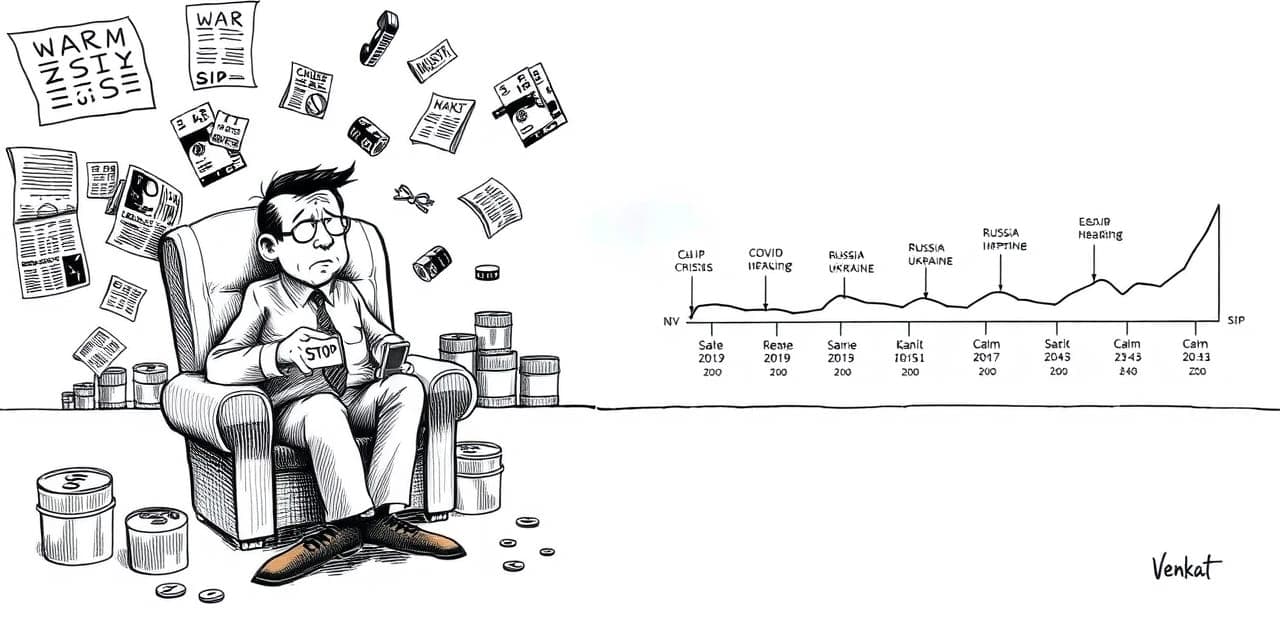

The Same Question, Every Time
Every geopolitical crisis since Indian equity markets existed has produced the same retail investor question. It arrived in March 2020 when COVID shut the world down and Nifty fell 38% in six weeks. It arrived in February 2022 when Russian tanks crossed into Ukraine and global markets shuddered. It arrived during Kargil in 1999, during the Gulf War in 1990, during every rupee crisis in between.
The question is always the same: should I stop my SIP?
The data has the same answer every time.
This is not a dismissal of the Iran war or what it means for crude oil at $92, for the rupee at ₹88.8, for an India that imports 85% of its oil. The macro disruption is real. The FPI selling (₹22,630 crore in a single week) is real. The Nifty falling 3% in a session is real. What is not real is the instinct that stopping your SIP now is a rational response to any of this.
What actually happens when you stop your SIP during a war?
The mechanics of a systematic investment plan are straightforward to the point of being boring. Every month, a fixed rupee amount buys units at whatever NAV is available. When the NAV is high, you buy fewer units. When the NAV is low, you buy more. The average cost of your units over time reflects every market level you purchased through.
When you stop a SIP during a crash, you break exactly the part of the mechanism that was working in your favour.
Consider what happened during COVID. Between January and March 2020, Nifty fell from 12,362 to 7,610. Investors who paused SIPs during that fall missed purchasing units at NAVs that, within 18 months, were trading at levels 70% higher. The SIP that continued through the crash accumulated units at an average cost that the investor who paused can never replicate. The units bought at 7,610 are now worth substantially more than the units bought at 12,362.
The same pattern repeated in 2022. Russia-Ukraine caused a 12% Nifty correction between January and June. Markets recovered entirely by November. The investors who stopped their SIPs in February and resumed in July bought back at higher levels than they sold out of.
"The market has never waited for the geopolitical situation to resolve before recovering. It typically recovers while the crisis is still ongoing, because institutional money moves on probability, not certainty."
The Crude Oil Problem Is Real. The SIP Logic Is Separate.
It is worth being precise about what the Iran war actually threatens for Indian investors.
India's dependence on oil imports makes every crude price spike a genuine economic concern. At $92 per barrel, the impact on India's current account deficit is significant. Rising crude feeds into retail inflation, which constrains the Reserve Bank's ability to cut rates, which affects rate-sensitive sectors like banking, NBFCs, and housing finance. This is a legitimate chain of consequences that any serious investor should understand.
But this chain of consequences applies to your asset allocation decisions, not to whether you run your SIP this month.
The question of whether you should have more or less equity exposure given a potential inflationary environment is a portfolio construction question. The question of whether you should interrupt a systematic investment plan because markets fell 3% this week is a behavioural question. They are not the same question, and conflating them is one of the most common and expensive mistakes retail investors make.
If crude stays elevated for an extended period, sectors with high oil sensitivity face margin pressure. Airlines, paints and chemicals manufacturers, logistics companies face direct cost headwinds. Upstream oil producers (ONGC, Oil India) benefit from higher realisation prices. Defence stocks often see renewed interest during geopolitical escalation.
None of this tells you to stop your SIP. It might, depending on your portfolio composition and risk tolerance, inform a conversation about whether your equity allocation is appropriate. That is a different exercise entirely.
Why does your brain want you to stop the SIP?
The psychological mechanism that makes investors want to stop SIPs during crises is well-documented. Humans are wired to treat loss as roughly twice as painful as equivalent gain is pleasurable. When markets fall, the pain of watching NAVs decline activates the same threat-response system that would have been useful when our ancestors needed to flee predators.
The problem is that markets are not predators. Stopping your SIP does not reduce the loss you have already experienced: those units at lower NAVs are already in your account. What stopping does is ensure you do not buy additional units at those lower prices. It converts a temporary paper loss into a permanent missed opportunity.
There is a particular irony in the SIP investor's version of this mistake. The entire premise of systematic investing is that you do not try to time the market. You accept that sometimes you will buy at highs and sometimes you will buy at lows, and that the average over time will be favourable. The investor who stops during a crash has decided to time the market at precisely the moment when timing is most difficult and the stakes are highest.
Does FPI selling mean you should stop investing?
One of the more common justifications for stopping SIPs during crises is: "if the big money is selling, shouldn't I follow?"
FPI selling during geopolitical events is a mechanical risk-off response. Foreign institutional investors manage global portfolios with specific mandate constraints. When global uncertainty rises, their models reduce exposure to emerging markets. This is not a fundamental judgement about whether Indian equities will be higher in three years. It is a portfolio management response to short-term volatility targets.
Domestic institutional investors (DIIs) have been absorbing this selling. They bought ₹12,000 crore on a single day in March while FPIs were selling. The DIIs managing pension funds and insurance portfolios have a longer time horizon than the FPIs executing risk-off trades. Their buying is also a signal. It happens to be a less dramatic one.
The retail investor who stops their SIP because FPIs are selling is following the shorter-term signal and ignoring the longer-term one.
The Only Legitimate Reason to Stop a SIP
There is one circumstance in which stopping a SIP is entirely rational: when you cannot afford to invest that money.
If the economic disruption from rising crude prices, a weaker rupee, or a broader market downturn has genuinely impaired your income or liquidity, stopping a SIP to protect your financial stability is not a behavioural mistake. It is prudent cash management. And when you do resume, checking whether your SIPs are actually diversified is worth doing before you restart on autopilot. Emergency funds exist precisely for this reason: to ensure that market volatility does not force investment decisions.
What this is not is a market view. Stopping because your finances require it is categorically different from stopping because the news is alarming. The first is financial planning. The second is emotional investing dressed up as analysis.
What History Registers
A brief record of what happened to investors who stopped SIPs during the worst of India's market crises:
Kargil War, 1999. Sensex fell approximately 18% during the conflict. Investors who stopped SIPs in May 1999 and resumed in August missed buying through the correction. By December 1999, Sensex was above its pre-war level.
Dotcom crash and 9/11, 2000-2001. A more prolonged correction over 18 months. SIP investors who continued through the entire period accumulated units at an average cost that provided significant returns in the 2003-2007 bull market.
COVID-19, March 2020. The sharpest single-month fall in Indian market history. Investors who stopped SIPs in March and April 2020 missed the single most productive buying opportunity of the decade. Nifty went from 7,610 to 18,000 in 18 months.
Russia-Ukraine, February 2022. A 12% correction that recovered within six months. SIP investors who continued through it accumulated units that recovered fully by the end of the year.
The pattern is not that crises do not cause damage. They do. The pattern is that stopping a systematic investment during that damage consistently produces worse outcomes than continuing.
The Question Worth Asking Instead
Rather than asking whether to stop your SIP, there is a more useful question: does your portfolio construction reflect your actual risk tolerance?
If a 3% Nifty correction in response to geopolitical news is causing you to question a systematic investment plan, the more honest interrogation is whether you are invested in a way that is sustainable for you. That question starts with understanding why your P&L is red and whether it's really the market. An investor who cannot hold through a correction will eventually stop at the wrong moment: not because they are irrational, but because their allocation was wrong for their temperament.
This is a harder question than whether to pause a SIP this month. It requires looking honestly at what percentage of your portfolio is in equities, whether that percentage is appropriate for your financial situation and time horizon, and whether your emergency fund is adequate to insulate your investment decisions from income shocks.
The SIP question is a symptom. The allocation question is the diagnosis.
Ask PortoAI how your portfolio is positioned for the current market environment. Connected to your actual Zerodha and Groww accounts.
Try PortoAI FreeFrequently Asked Questions
Should I stop my SIP because of the Iran war?
The historical data from every major geopolitical crisis affecting Indian markets (COVID, Russia-Ukraine, Kargil, the Gulf War) consistently shows that investors who stopped SIPs during the fall missed the bulk of the recovery. Markets do not wait for the all-clear signal before recovering. The investors who continued systematic investing through the correction accumulated units at lower average costs that produced better long-term returns.
What happens to Indian markets during a war?
In the short term, markets fall on uncertainty. Crude rises, the rupee weakens, FPIs sell. In every historical case involving India as an indirect participant in a foreign conflict, markets recovered within 3 to 18 months. The duration and depth of the initial fall varies considerably. The eventual recovery has been consistent across every instance in Indian market history since 1991.
Is it a good time to buy more when markets fall due to war?
Increasing SIP amounts during a correction is mathematically sound: the same rupee amount buys more units at lower NAVs, reducing your average cost further. Whether you should do this depends on your specific financial situation, your liquidity, and your risk capacity. It is not a recommendation that applies uniformly.
How does the Iran war affect my Indian mutual fund SIP?
Your SIP continues buying units regardless of market level. When NAV falls, the same monthly amount buys more units. If you stop during the fall and resume later, you miss precisely the purchases that lower your average cost the most. The units you would have bought at lower NAVs are the ones that produce the largest returns when markets recover.
Why are FPIs selling Indian stocks during the Iran war?
FPIs manage global portfolios with specific mandate constraints. When geopolitical uncertainty rises, their risk models reduce emerging market exposure mechanically. This is not a fundamental judgement on India's long-term prospects. It is a short-term portfolio management response. Domestic institutional investors have been absorbing this selling, which suggests the longer-term view from Indian capital remains constructive.