
The Equity Instinct That Breaks in the Commodity Market
You have spent years trading Nifty stocks. You understand how to read a quarterly result, how to size a position around a breakout, how to think about sector rotation. Then you open an MCX account and apply the same mental model to crude oil.
It does not work. And it costs money before most traders figure out why.
Equities have company fundamentals: earnings, debt, management, competitive moat. When HDFC Bank reports strong numbers, the thesis is clear. Commodities have no fundamentals in that sense. Crude oil does not care about its own earnings. It cares about US inventory levels, OPEC quota compliance, dollar strength, and whether a pipeline in the Gulf of Mexico is functioning. Gold cares about real interest rates, the Federal Reserve's forward guidance, and how much physical demand is coming from China and India. Silver straddles industrial demand and safe-haven flows.
The analytical toolkit is different. Applying equity instincts to MCX is one of the most expensive mistakes Indian retail commodity traders make, and it is also one of the most invisible, because the traders doing it rarely stop to check whether their approach matches what actually moves the market they are trading.
What Commodity Trading Mistakes Actually Look Like in Your Trade History
The following five patterns show up consistently when you analyze MCX trade logs from Indian retail accounts. They are not rare edge cases. They are the norm.
Most Indian retail traders underestimate how large a single commodity contract is relative to their capital.
A standard Gold contract on MCX is 1 kg. At current gold prices of approximately ₹7,500 per gram, that is a contract value of ₹7.5 lakh. The margin requirement is roughly 4-6%, so ₹30,000-45,000 gets you into the trade. But your exposure is ₹7.5 lakh. A 1% move in gold prices, which happens routinely, is a ₹7,500 move on your position.
Most traders look at the margin and calculate position size based on that. They should be looking at the notional contract value and calculating size based on that.
This is the same logic behind F&O position sizing mistakes, where the leverage embedded in options and futures catches traders who are used to thinking in cash equity terms. Commodities have the same trap: the entry cost is small, the exposure is large.
The data signature in your trade history: take any significant loss from a commodity position and calculate what percentage of your total capital it represented. If it is more than 2-3% on a single trade, your position sizing is not accounting for the full contract value.
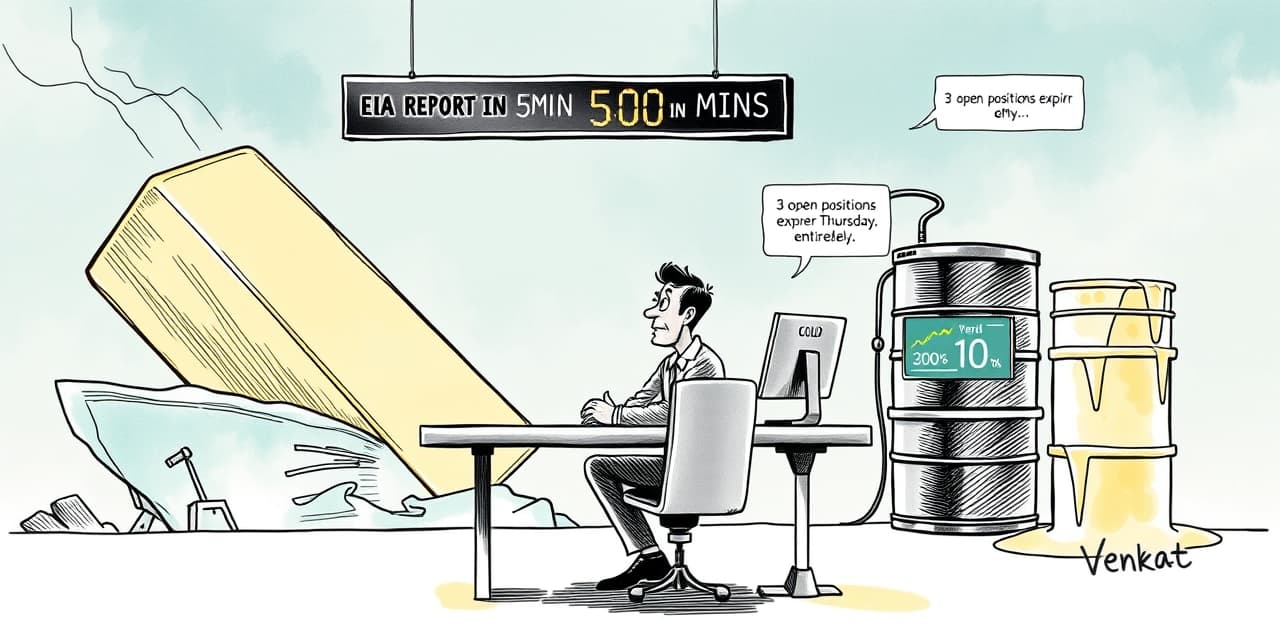
Crude oil traders who do not know when the EIA weekly inventory report drops are flying blind.
The US Energy Information Administration releases its weekly petroleum status report every Wednesday at approximately 8 PM IST. It shows whether US crude inventories increased or decreased compared to the prior week. A larger-than-expected build (more supply) pushes crude prices down. A larger-than-expected draw (supply tightening) pushes prices up. The move can be 1-2% in under a minute.
If you hold a crude position into that window without a plan for how you will respond to each scenario, you are not trading. You are guessing.
The same applies across commodities:
- Gold and silver: Federal Reserve meetings, US inflation data (CPI), non-farm payrolls. These move gold because they drive dollar strength and real interest rate expectations.
- Natural gas: EIA natural gas storage report (Thursday, approximately 7:30 PM IST). Weather forecasts for extreme cold or heat in the US.
- Electricity futures: Seasonal demand cycles, monsoon impact on hydro generation capacity, grid load data from POSOCO.
Trading any of these without marking the relevant data releases on your calendar is a structural mistake, not a one-off error. The pattern in your trade history: losses that cluster around specific days of the week or month are usually data-release losses. Most traders attribute these to "bad luck" or "volatility." The data calendar tells a different story.
Stocks do not expire. A Tata Motors position you bought two years ago is still sitting in your demat account, compounding or decaying based on the underlying business.
Commodity futures expire. Every MCX contract has a specific expiry date, after which physical delivery kicks in (for most retail traders, something they absolutely do not want). To stay in a commodity trade past expiry, you have to roll the position to the next contract month, which involves closing your current position and opening a new one in the far-month contract.
This rollover has a cost. The price difference between the near-month and far-month contract is called the roll spread, and in markets with contango (where far-month prices are higher than near-month, common in crude oil during supply gluts), rolling repeatedly bleeds capital.
The mistake: treating a commodity futures position as a long-term investment. Holding crude because "it will eventually recover" is not how commodity futures work. You are holding a contract that expires in weeks, and every roll costs money.
The equity mental model of "buy and hold through the cycle" does not translate. Commodity trading requires a time-bounded thesis: why will this move before expiry?
MCX trading hours extend until 11:30 PM IST on weekdays, covering the US market session. Gold and crude oil particularly see their largest moves during the US afternoon, which corresponds to Indian evening hours. This creates a specific trap: retail traders in India who have finished their day jobs enter commodity positions in the evening, exactly when volatility is highest and their decision-making quality is lowest.
Overtrading is a measurable pattern in equity trading. In commodity trading, the same behavioral driver operates differently: it is not just about trade frequency, it is about when within the session the trades cluster. Trades placed in the last 90 minutes of the MCX session, when US markets are most active and price swings are largest, have systematically worse outcomes for retail traders who are not set up to react to fast-moving global news.
The data signature: pull your commodity trade log and filter by time of day. If your losses are concentrated between 9:30 PM and 11:30 PM IST, you are trading the highest-volatility window without the infrastructure to manage it.
Gold, crude oil, natural gas, and silver are all "commodities" in the same way that a mid-cap IT stock and a PSU bank are both "equities." The surface-level category conceals completely different underlying dynamics.
Gold is a monetary metal. It moves on fear, real yields, and dollar strength. Its primary driver is sentiment around the global financial system, not physical supply and demand on any given day.
Crude oil is an industrial commodity. It moves on supply logistics, OPEC politics, refinery demand, and economic growth expectations. It is also dollar-denominated, which means a strengthening rupee against the dollar reduces the rupee price of crude even if the dollar price holds flat.
Natural gas has high seasonal volatility, particularly in US winters. Electricity futures respond to domestic Indian grid dynamics, which are entirely different from global commodity markets.
Trading all four with the same analytical framework, the same position sizing rules, and the same holding period targets is a category error. Your win rate and average return will differ significantly across commodities in your trade history, and if you have never segmented your performance by instrument, you are managing the portfolio blind.
What AI Finds When It Analyses Your MCX Trade History
The five patterns above are not theoretical. They are observable in trade log data, and identifying them in your own history is what changes behavior.
AI analysis of your commodity trades specifically looks for:
- Session timing clustering: whether your profitable trades and losing trades cluster at different times of day, suggesting you trade well in the morning session (lower volatility, more predictable) and poorly in the evening session
- Pre-release holding patterns: whether you consistently hold positions into major data release windows, and whether those specific trades have worse outcomes than your average
- Position size consistency: whether your sizing in different commodities is calibrated to the contract value or to the margin requirement
- Rollover behavior: whether you are rolling positions mechanically without assessing whether the thesis still holds, accumulating roll costs on positions that have already stopped working
- Instrument-level performance: whether your gold trades and your crude trades have fundamentally different outcomes, suggesting you have a better edge in one market than the other
This is the same behavioral analysis that PortoAI applies to equity and F&O accounts, extended to your commodity trading data through the Kite API. The output is not generic advice. It is a read of your specific trade history against your own patterns.
The investors who improve their commodity trading outcomes are not the ones who read more research reports. They are the ones who reviewed their own trade history and found the recurring mistake they had been invisible to.
Connect your trading account to PortoAI and see what your commodity trade history actually shows. Pattern analysis across gold, crude, silver, and nat gas positions.
Try PortoAI FreeFrequently Asked Questions
Frequently Asked Questions
What are the most common commodity trading mistakes in India?
The five patterns that appear most consistently in Indian retail MCX trade histories are: applying equity analytical instincts to commodity markets that move on entirely different drivers, miscalculating position size relative to contract notional value, holding positions through scheduled data releases without a response plan, treating commodity futures as long-term holdings and accumulating rollover costs, and trading the high-volatility late-evening MCX session without the infrastructure to react to US market news. None of these require advanced knowledge to fix. They require reviewing your own trade data to see the pattern.
How is commodity trading different from stock trading in India?
Equities are driven by company fundamentals: earnings, management quality, sector growth. Commodity prices are driven by global supply and demand, geopolitical events, currency movements, and scheduled data releases from bodies like the EIA and the US Federal Reserve. A crude oil position requires tracking OPEC quotas and US inventory data, not quarterly results. Gold requires tracking real interest rates and dollar strength. The instruments also expire on a fixed schedule, requiring rollover decisions that equities never demand. The analysis, the timing, and the risk management framework are all different.
What lot sizes should Indian retail traders use for commodity trading?
Beginners should start with the mini or micro contracts: Gold Mini (100g, approximately ₹75,000 contract value), Silver Mini (5 kg), Crude Oil Mini (10 barrels). Standard contracts (Gold at 1 kg, Crude at 100 barrels) have contract values of ₹7-8 lakh and ₹6-7 lakh respectively, which is too large for most retail capital bases to size appropriately. The margin requirement gives a false sense of affordability. Position size should always be calculated on the full contract value, not the margin.
When should I avoid holding commodity positions overnight in India?
The highest-risk overnight windows for Indian commodity traders are Tuesday nights (before Wednesday EIA crude inventory report), Wednesday nights before US inflation data releases when scheduled, and US Federal Reserve meeting nights for gold and silver positions. Holding into these windows without a pre-defined response plan (what will you do if the move goes against you by 1.5%?) is the structural version of the mistake. Setting a rule to either close or significantly reduce positions before these releases removes the decision from emotional trading conditions.
How do I analyse my own commodity trading performance?
Export your MCX trade history from your broker. Segment it by instrument (gold vs crude vs silver vs nat gas), by time of day (morning session 9 AM to 5 PM vs evening session 5 PM to 11:30 PM), and by proximity to major data releases. Calculate your win rate and average return for each segment separately. Most traders find significant differences across these segments that are invisible in the aggregate P&L number. AI tools that connect directly to your broker account and perform this analysis automatically can surface these patterns without requiring you to build the spreadsheet manually.