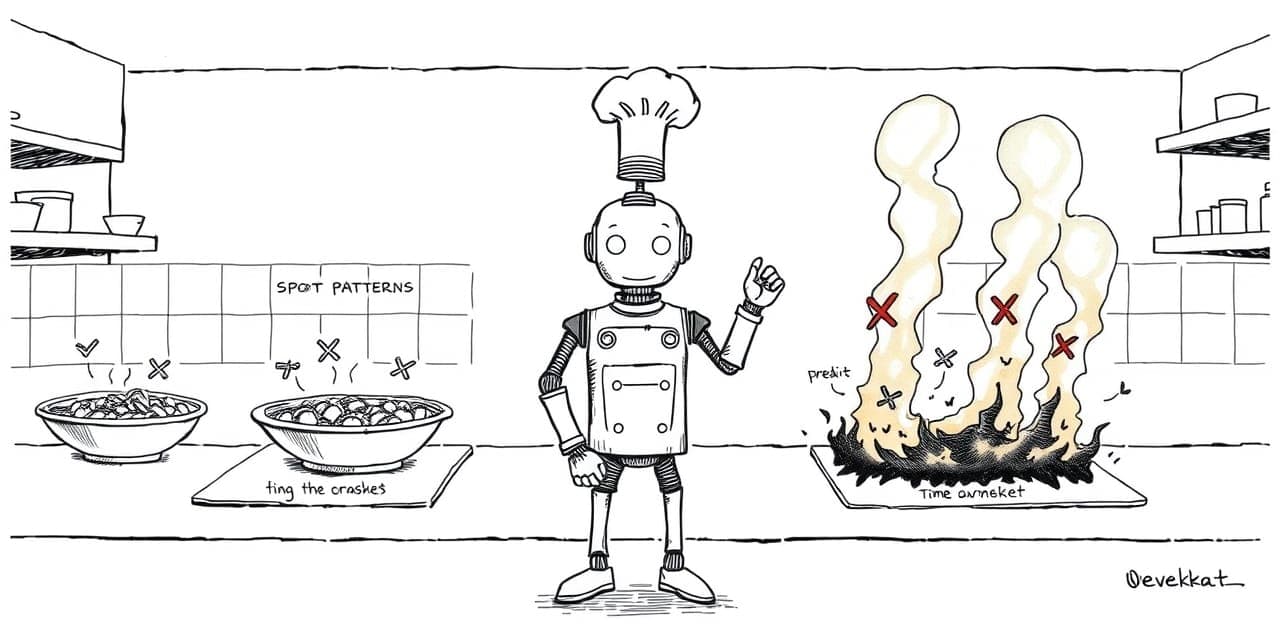

You've seen the ads. "AI-powered investing." "Let our algorithm do the work." "Predict the next big move with AI."
Every fintech in India right now is slapping an "AI" badge on their product and hoping you don't ask too many questions.
So let's ask the questions. What can AI actually do for your investments? What's genuinely useful, what's smoke and mirrors, and, critically, what's legally questionable in the Indian context?
This isn't a hit piece on technology. AI tools are genuinely useful for investors. But the useful stuff isn't what most companies are selling you.
The AI Hype in Indian Investing
The Indian retail investing boom is real. Post-2020, millions of new investors opened Zerodha and Groww accounts. F&O volumes went through the roof. And with that boom came an avalanche of products promising to help you "invest smarter with AI."
The problem? Most of it is repackaged nonsense.
When people ask "can AI predict stock market movements?" they're usually asking because someone sold them that idea. A Telegram channel with a "proprietary AI algorithm." A screener that claims to identify "AI-selected multibaggers." An app that promises to tell you when to buy Bank Nifty options.
Here's the honest answer: no AI can reliably predict stock prices. Not because the technology isn't good enough, but because markets are fundamentally unpredictable. They reflect the collective decisions of millions of humans, each responding to new information in real time. Any AI that could predict that would immediately cause the market to change, making the prediction wrong.
That's not a limitation of current AI. That's a property of how markets work.
That is not where AI's value actually lies for individual investors. The real value is somewhere far less glamorous and far more useful.
What AI Can Do (And Does Well)
Let's be specific about what AI genuinely does well in an investing context.
A human analyst can read one earnings call transcript in a sitting. AI can process hundreds of them, flag language patterns that historically precede guidance cuts, compare tone across quarters, and surface signals that would take a team weeks to find. This is table stakes for institutional desks now.
For retail investors, this translates to: better-informed research, faster context, and not having to spend three hours digging through a company's annual report to answer a basic question.
This is the one most people overlook, and it is where AI actually earns its place in your investing process.
Your Zerodha or Groww account holds years of data about your actual behavior: when you panic-sell, when you overtrade, which sectors you keep returning to even when they burn you, how your position sizing changes when you're on a losing streak. That's a rich behavioral dataset. AI can analyze it in seconds and give you something no stock tip ever could: a mirror.
If you have holdings across Zerodha, Groww, and maybe a legacy HDFC Securities account, you probably don't have a clean picture of your total portfolio. AI tools that connect to multiple brokers can aggregate everything, calculate your real exposure, flag concentration risks, and give you a unified P&L view. That's genuinely hard to do manually.
SEBI's own research shows that the majority of retail F&O traders lose money, and a significant chunk of those losses come not from picking wrong stocks, but from behavioral mistakes. Overtrading. Averaging down on losers. Revenge trading after a bad session. Holding winners too short and losers too long.
AI is actually quite good at identifying these patterns. It doesn't get emotional. It doesn't make excuses. It just shows you what you're doing.
Being able to ask "how has the IT sector performed during Fed rate hike cycles?" and get a coherent, sourced answer in seconds is genuinely useful. It's not magic. It's just a much faster research process.
See also: the best AI tools for stock market investing in India for a breakdown of what's actually worth using.
What AI Cannot Do (Despite Claims)
This is where you need to be skeptical of anyone selling you AI investing tools.
If any tool, AI or otherwise, could consistently predict whether Nifty 50 closes up or down tomorrow, every hedge fund in the world would have bought it and traded it into oblivion. Markets are efficient enough that sustained, reliable prediction is essentially impossible. Anyone claiming otherwise is either lying or confused.
This one is obvious, but it still needs saying because people keep falling for it. No investment product, AI-powered or otherwise, can guarantee returns. Any tool that suggests it can is making a claim that's both factually wrong and almost certainly illegal under SEBI guidelines.
AI can tell you that a company's revenue has grown 20% YoY. It cannot tell you whether the new CEO is going to execute well. It can flag that promoter pledging has increased. It cannot tell you whether that's a red flag or a temporary situation with a clear resolution. Qualitative judgment, especially about management quality, sector dynamics, and macro timing, still requires a human.
You've seen the ads: "AI tells you exactly when to buy and sell." This is fantasy. Even the most sophisticated quantitative funds with billions in resources and decades of data cannot time markets consistently. An app is not going to do what Renaissance Technologies can't do reliably.
AI knows what you tell it, or what it can access. It doesn't know your job stability, your upcoming expenses, your actual risk tolerance (as opposed to what you said on an onboarding questionnaire), or your family situation. These things matter enormously for investment decisions. No AI tool has that context unless you explicitly provide it.
COVID in March 2020. The Adani-Hindenburg selloff in January 2023. Russia-Ukraine in February 2022. None of these were in any training dataset. AI models trained on historical Indian market data have no mechanism to anticipate unprecedented events, and unprecedented events are precisely what cause the largest portfolio drawdowns. Any system claiming to "protect you from crashes" is overfitting to past crashes that looked nothing like the next one will.
The SEBI Perspective: What's Legal and What's Not
This matters a lot in India, and most people don't think about it.
SEBI has clear regulations around investment advice. If anyone, human or AI, is giving you specific buy/sell recommendations for securities, that entity needs to be a SEBI-registered Investment Adviser (IA) or Research Analyst (RA). Full stop.
A Telegram bot telling you to "buy TCS at ₹3,800, target ₹4,200, stop loss ₹3,650"? If it's not from a SEBI-registered entity, that's illegal. An app using AI to recommend specific stocks without registration? Also illegal.
This is worth keeping in mind when evaluating any AI investing tool. Ask: is this company SEBI-registered? Are they giving me specific recommendations or helping me analyze and decide for myself? The distinction matters legally.
The gray area is research and analysis: providing data, historical context, behavioral insights, and educational content. Tools that help you understand your portfolio and think through decisions are very different from tools that tell you what to trade.
If you're using AI tools for your investing, understand where that line is. And if a tool is making specific recommendations without SEBI registration, that should be a red flag, not a feature.
For a broader look at what AI tools actually do, see can AI help with stock market investing in India?, where we go into the nuances there.
Where Does AI Actually Create Value for Individual Investors?
The real value is not in market data analysis, which every institution already has. It is in analyzing your own trading behavior. Your order history, your patterns of panic-selling and overtrading, the specific mistakes you repeat: that data is uniquely yours. Almost no AI tool helps you analyze it, and that is the gap that actually matters.
Here's the turn that most AI investing products miss entirely.
This is where PortoAI is focused. Not on predicting markets (impossible) or giving you stock tips (requires SEBI registration), but on connecting to your actual broker accounts (Zerodha, Groww, or others) and analyzing what you've actually been doing.
When you connect PortoAI to your Zerodha account securely without sharing your password, it can look at your real trade history and start answering questions like:
- What percentage of your trades happen in the first 30 minutes of market open, and how do those compare to your afternoon trades in terms of P&L?
- How does your average position size change after a losing week versus a winning week?
- Are you actually diversified, or are you concentrated in two or three correlated sectors?
- Have you been averaging down on a particular stock for six months while it bleeds?
These aren't hypothetical insights. They're derived from your actual data. And they're the kind of insights that can actually change how you invest, because they're about the part you can control.
You cannot control whether the RBI holds rates or cuts them. You cannot control whether Infosys misses its quarterly guidance. You cannot control whether FIIs decide to pull money out of Indian equities for three months.
But you can control whether you panic-sell when they do. You can control whether you revenge trade after a bad week. You can control whether you concentrate 40% of your portfolio in one sector because you "have conviction."
That's where AI earns its keep.
How to Evaluate Any AI Investing Tool
Before you pay for any AI tool or hand it access to your portfolio, run it through this checklist:
Generic AI tools that don't have access to your real data can only give you generic insights. If it can't see what you've actually done, its analysis is theoretical. An AI that can't see your ₹2.3 lakh position in Bank Nifty futures can't tell you that you're overexposed to volatility right before an RBI policy announcement.
Market data analysis is available everywhere. What you need is analysis of your specific behavior and your specific portfolio, the stuff nobody else can give you. "IT sector is under pressure" is something you can read on Moneycontrol. "You've put 38% of your portfolio in IT in the last two months, which is a 2x increase from your historical average, and IT has underperformed in your last three concentrated positions." That's personalized and that's useful.
Generic tips are what every Telegram channel gives you for free (and illegally). What you're paying for, or should be, is analysis of your situation, not the market at large.
Vague claims like "AI-powered investing" mean nothing. Ask specifically: what data does it use? What outputs does it produce? What decisions does it help you make? If the answer is "our proprietary algorithm identifies winning stocks," walk away.
If it's making specific stock recommendations, is it SEBI-registered? If not, that's a problem, both legally and as a signal about how seriously the team takes compliance.
Any honest AI tool should be clear about its limitations. If a tool claims it can predict markets or guarantee better returns, that's not a feature. It's a lie. The tools worth trusting are the ones that lead with what they can't do.
The AI investing tools worth using are the honest ones. The ones that say: "We can't tell you what the market will do. But we can show you what YOU'VE been doing, and that's worth a lot."
Frequently Asked Questions
Can AI guarantee stock market returns?
No. Any tool or advisor promising guaranteed returns is either lying or violating SEBI regulations. AI is a tool for analysis, not a crystal ball.
What is the most useful AI feature for investors?
Behavioral analysis: detecting your own patterns like overtrading, revenge trading, and concentration risk. SEBI data shows most retail losses come from behavioral mistakes, not bad stock picks.
Should I trust AI stock recommendations?
Only from SEBI-registered advisors. Unregistered AI tools giving specific buy/sell recommendations are illegal in India. Use AI for analysis and pattern detection, not stock tips.