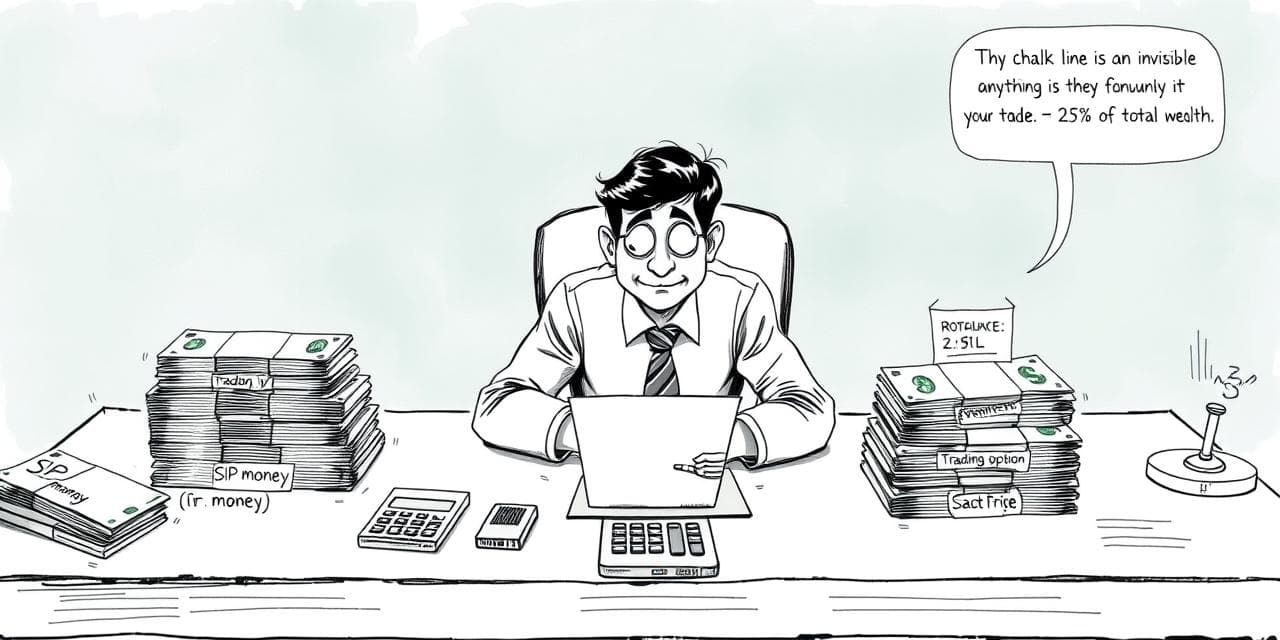

You made Rs 80,000 on three good trades last month. Now you are seriously considering putting Rs 40,000 of that into a weekly Bank Nifty call option this Thursday.
Ask yourself one question: would you place that same trade with Rs 40,000 from your SIP portfolio?
You would not. The trade is identical. The money is identical. One feels like a gamble with real money you earned over years. The other feels like playing with profits you found. This is not a personality trait. It is a cognitive error with a name: mental accounting bias.
Does Your Brain Know That All Rupees Are Equal?
Technically, every rupee is identical to every other rupee. Rs 1,000 from your salary, Rs 1,000 from a Bank Nifty trade, and Rs 1,000 from your Diwali bonus will all buy exactly the same groceries.
Your brain does not operate this way.
The Nobel Prize-winning economist Richard Thaler identified mental accounting in the 1980s: people mentally categorise money into separate accounts based on its source and intended purpose, then apply different spending and risk rules to each category. The physical money is the same. The psychological restrictions and permissions are entirely different.
In Indian investing, this plays out across every platform combination. Your Zerodha trading account becomes the risk pool. Groww or Coin mutual funds become the serious portfolio. Savings accounts become the safety buffer. Diwali bonuses and IPO listing gains get filed under money that arrived unexpectedly, therefore available to spend or speculate freely.
Each account has its own internal rules. None of those rules are based on math.
A 2024 study published in the SAGE journals examining Indian retail investors found that this mental separation is widespread and that it directly predicts impulsive trading behaviour, with men showing a pronounced tendency to treat capital gains as free money available for higher-risk bets than they would place with their initial capital. (Source: Investor Impulsivity and Mental Accounting, SAGE 2024)
What Are the Three Pots Most Indian Investors Keep in Their Heads?
There is a consistent pattern in how Indian retail investors mentally structure their money. It usually breaks into three categories, each with its own risk tolerance and psychological rules.
This is your SIP portfolio. It represents discipline and future security. You do not touch it during market falls. You did not start these SIPs to trade them. The emotional weight attached to this money is high. You evaluate this money conservatively.
A typical investor with Rs 8 lakh in SIP investments would not consider deploying even Rs 50,000 from this pool into any high-risk trade, no matter how confident they felt.
This is your Zerodha or Angel One account. You funded it with Rs 2 lakh a year ago to "try" trading. It has grown to Rs 3.5 lakh through a combination of stock picks and some F&O trades. Rs 1.5 lakh in profit sits on top. That profit feels different from the original Rs 2 lakh. Original capital carries emotional weight. Profit is free chips.
Most investors will take risks with their trading account profits that they would never take with the original capital. That Rs 2 lakh was funded from savings, with friction and intention. Rs 1.5 lakh arrived through the market without that emotional journey. It does not feel fully real.
IPO listing gains, a Diwali bonus, a relative's gift, a freelance payment. This money arrived without the regular routine of earning it through work. Studies show it gets spent or risked at a significantly higher rate than regular income.
If you got Rs 25,000 from a lucky IPO allotment and listing gain last year, the probability that you deployed it into a speculative idea rather than your systematic portfolio is high. It did not feel like your SIP money. It felt like a gift from the market.
Why Do F&O Traders Pay the Highest Price for This Bias?
F&O is where this bias does its most concentrated damage, and Indian retail investors are deeply concentrated in that segment.
What enables this is called the house money effect. After a winning trade, gains feel like the market's money. Losing that money in the next trade hurts less than losing your salary would. Lower emotional pain means a lower threshold to place the next trade.
This is why overtrading patterns concentrate in the days immediately after a good session. It is not a coincidence. Traders who had a profitable Thursday expiry spend more on options premium the following week. The winning trade created house money, and house money feels available to bet.
SEBI's September 2024 study confirmed that 93% of individual F&O traders lost money over the FY22-FY24 period, with aggregate losses exceeding Rs 1.8 lakh crore across three years. (Source: SEBI Study, September 2024) The house money effect plays a direct role in that number. A trader who made Rs 30,000 on one expiry and subsequently lost Rs 50,000 on the next three did not lose Rs 50,000. They lost Rs 50,000 because the Rs 30,000 win removed the psychological guardrails that would have kept their next trade smaller.
Net loss: Rs 20,000. Felt experience: ahead by Rs 30,000 in one account, behind by Rs 50,000 in another. Math does not work that way. Emotion does.
Does Keeping Separate Accounts Make This Worse?
Separating trading capital from long-term investments is standard advice. Discipline through separation, the reasoning goes. Not wrong. But for many Indian investors, physical account separation deepens the mental accounting distortion rather than eliminating it.
When your long-term portfolio lives on Groww and your trading account lives on Zerodha, you look at two separate screens showing two separate numbers. Each platform shows you only its own slice of your financial picture. Your Groww app does not know about your Zerodha profits. Your Zerodha app does not know about your SIP corpus. You never see a single unified number.
That invisibility is where mental accounting festers.
If you saw a single screen showing: SIP portfolio Rs 8 lakh + trading account Rs 3.5 lakh + savings Rs 4 lakh = total investable net worth Rs 15.5 lakh, your mental framing would shift. The Rs 40,000 Bank Nifty trade becomes not "40% of my trading pot" but "0.25% of my total wealth." Both statements are mathematically true. The second one is the one that should drive the decision.
This is why the inability to see across platforms is a structural problem for multi-broker investors, not just a convenience issue. The platform separation is quietly doing psychological damage to how you evaluate risk.
What Would Your Numbers Actually Show If You Combined Everything?
Here is the practical question: what does your real portfolio look like when all accounts are counted together?
Most investors cannot answer this without pulling out their phone, opening multiple apps, and doing arithmetic in their head. That arithmetic almost never happens in the moment a trading decision needs to be made. In that moment, only one number is visible: the trading account balance. Only one context is active: recent trading history. SIP corpus and savings balance are invisible.
Behavioral pattern analysis across trading histories shows a consistent signature for mental accounting: investors keep systematic discipline in one account (small, regular SIP top-ups, infrequent rebalancing) while operating with no systematic discipline in the adjacent account (reactive trades, large position sizing relative to the trading account balance, frequent small losses from option premium decay).
PortoAI's behavioral fingerprint analysis works across both the Zerodha and Groww data connected to your account. When you see your trading pattern history mapped against your SIP behaviour, the mental separation collapses. You can see the months where your trading account bled small amounts weekly while your SIP compounded quietly. You can see whether your trading activity added to or subtracted from your total portfolio value, not just the trading account value.
If your trading account returned 8% last year while your SIP returned 14%, the trading account is destroying value on a risk-adjusted basis. You cannot see this without the combined picture. With the combined picture, the trading account stops feeling like a separate game with separate stakes.
The cognitive trick that makes this work: when you are about to place a trade, consciously add your SIP corpus and savings to the mental calculation. "I am about to risk Rs 40,000 of my Rs 15 lakh total net worth on this trade." That sentence is more accurate than "I am about to trade Rs 40,000 from my Rs 3.5 lakh trading account." The second sentence invites recklessness. The first invites the seriousness the decision deserves.
Your XIRR tells you whether your trading activity has added or subtracted from your compounding. It is the only number that forces all accounts to speak the same language.
Most F&O traders overestimate their trading P&L because they remember the wins and underestimate the frequency of small option premium losses. Include brokerage, STT on option exercise, SEBI turnover fees, and the opportunity cost of capital sitting idle in your trading account. On this fully loaded basis, the majority of traders who believe they are modestly profitable are, in fact, flat or slightly negative. PortoAI's portfolio analysis accounts for costs automatically when you connect your broker data.
Mental accounting affects SIP investors in a different form: the tendency to pause or stop SIPs during market downturns while keeping money sitting in a savings account at 3.5%. The SIP is mentally categorised as the risky allocation. The savings account is the safe pot. But for a long-term investor, keeping capital idle in a savings account during a market correction is not safety, it is opportunity cost. The behavioral cost of stopping SIPs at the wrong moment follows the same mental accounting logic as the trading account problem.
Connect your Zerodha and Groww accounts to PortoAI. See your complete behavioral fingerprint across both platforms: where your trading history is adding to or subtracting from your total portfolio.
Try PortoAI FreeFrequently Asked Questions
What is mental accounting bias in investing?
Mental accounting is the tendency to treat money differently based on where it came from or where it is kept, even though one rupee is always worth one rupee regardless of its source. Investors with this bias will take large risks with trading profits that they would never take with their salary savings, because the trading profits feel like bonus money rather than real money.
How does mental accounting affect Indian stock market investors?
Indian investors commonly maintain separate mental buckets: SIP money treated as sacred long-term capital, trading account money treated as a risk pool, and windfall money like IPO gains or bonuses treated as free to spend or speculate. This separation leads to different risk thresholds for the same rupee depending on which account it sits in, resulting in excessive risk-taking with trading gains and over-caution with other savings.
Why do F&O traders fall into the mental accounting trap?
F&O traders experience the house money effect: after a winning trade, subsequent losses feel like they came from the market's money rather than their own capital. This lowers the emotional pain of losing, which lowers the threshold to place the next risky trade. Trading histories show that position sizes and option premium spend increase in the sessions immediately following a profitable day, a direct consequence of the house money effect.
Does having separate Zerodha and Groww accounts make mental accounting worse?
Yes. Platform separation physically reinforces the mental separation. You see one number on Groww and a different number on Zerodha, and your brain categorises them as different pots with different purposes. Without a unified view of your total net investable wealth, you cannot make rational allocation decisions. The platforms show you only their own slice, so the distortion deepens over time.
How can I overcome mental accounting bias in my portfolio?
The most effective counter is to express every proposed trade as a percentage of your total net investable wealth, not as a percentage of your trading account balance. Before placing any trade, add up your SIP corpus, trading account, and savings. Then evaluate the trade against that total number. This framing forces the correct reference point and removes the illusion that trading account money has lower stakes.
What is the house money effect in trading?
The house money effect is a specific form of mental accounting where investors take larger risks after a winning trade because the gains feel like the market's money rather than their own. In stock markets, this translates to F&O traders increasing their position size after a profitable expiry, then giving back the gains and more on the following trades. The overall account value moves in a two-steps-forward-three-steps-back pattern that is invisible unless you track it systematically.